
What Does Liquidation Mean and How to Avoid Liquidation 2026? Best Strategies for Beginners


You open a trade. Leverage set to 10x. Price moves against you by 10%. Your position is gone.
That's liquidation. It happens fast. It happens to beginners and experienced traders alike. And if you don't understand how it works, it will happen to you too.
Let's break down what does liquidate mean in crypto, why liquidations happen, and how to avoid getting caught.
What Is Liquidation in Crypto?
Liquidation in crypto happens when you trade with leverage and the market moves against you. The exchange closes your position automatically because you no longer have enough funds to keep it open.
You lose your collateral. The trade ends. No second chances.
When someone asks what does it mean to get liquidated in crypto, the answer is simple: the exchange decides your position is too risky and closes it for you. You don't get a vote.
How Crypto Liquidations Happen
Let's walk through the process step by step.
- Step 1: You open a leveraged trade. You put up collateral called "initial margin."
- Step 2: The market moves against you. Your remaining margin shrinks.
- Step 3: You hit the "maintenance margin" level — the minimum amount the exchange requires to keep your trade open.
- Step 4: The exchange issues a margin call. This is a warning. They ask you to add more funds.
- Step 5: If you don't add funds and price keeps moving against you, the exchange automatically closes your position.
- Step 6: The exchange charges a liquidation fee for closing your trade. That fee encourages traders to close their own positions before the system does it for them.
The whole process can take seconds. Most traders never see the margin call coming.
What Is the Liquidation Price?
The liquidation price is the exact price at which your position gets automatically closed.
It's not a fixed number. It depends on several factors:
- How much leverage you used
- The current price of the asset
- Your remaining account balance
- The exchange's maintenance margin rate
You can calculate your liquidation price before opening a trade. Most exchanges show it to you. If you ignore it, that's on you.
Types of Liquidation: Partial vs Total
Not all liquidations are the same.
Partial liquidation means only part of your position gets closed. The exchange reduces your exposure but leaves some of your trade open. This is usually voluntary — the trader chooses to close a portion to protect the rest.
Total liquidation means your entire position is gone. Everything. The exchange closes your whole balance to cover losses. This is almost always forced liquidation. You didn't act. The exchange acted for you.
Here's what new traders don't know: after total liquidation, the exchange also charges a fee. So you lose your margin plus you pay for the privilege of being liquidated.
What Happens If Liquidation Exceeds Your Margin?
Bad situation. It's called bankruptcy.
If price moves so fast that your liquidation price blows past your initial margin, you could end up with a negative balance. You owe the exchange money.
Most major exchanges have insurance funds to cover this. The insurance fund absorbs the loss so you don't go negative. But not every exchange has one, and not every trade is covered.
Check before you trade. Don't assume you're protected.
How to Avoid Liquidation
Three methods. All of them work. None of them are complicated.
Control your risk percentage per trade
Decide how much of your account you're willing to lose on a single trade. The standard rule? 1% to 3% of your total account.
If you risk 1% per trade, you'd need to lose 100 trades in a row to go broke. That's nearly impossible even in crypto.
This is the single most important rule in trading. Most people ignore it. Most people get liquidated.
Always use a stop-loss
A stop-loss automatically closes your trade at a preset price.
Example: You enter at 10,000.Yousetastop−lossat10,000.Yousetastop−lossat9,800. If price drops to $9,800, you're out. You lost 2% instead of 100%.
Without a stop-loss, a sudden crash liquidates your entire position. With one, you live to trade another day.
Be smart with leverage
Higher leverage = higher risk. That's not a theory. That's math.
- 2x leverage: price moves 50% against you to get liquidated
- 5x leverage: price moves 20% against you
- 10x leverage: price moves 10% against you
- 20x leverage: price moves 5% against you
- 50x leverage: price moves 2% against you
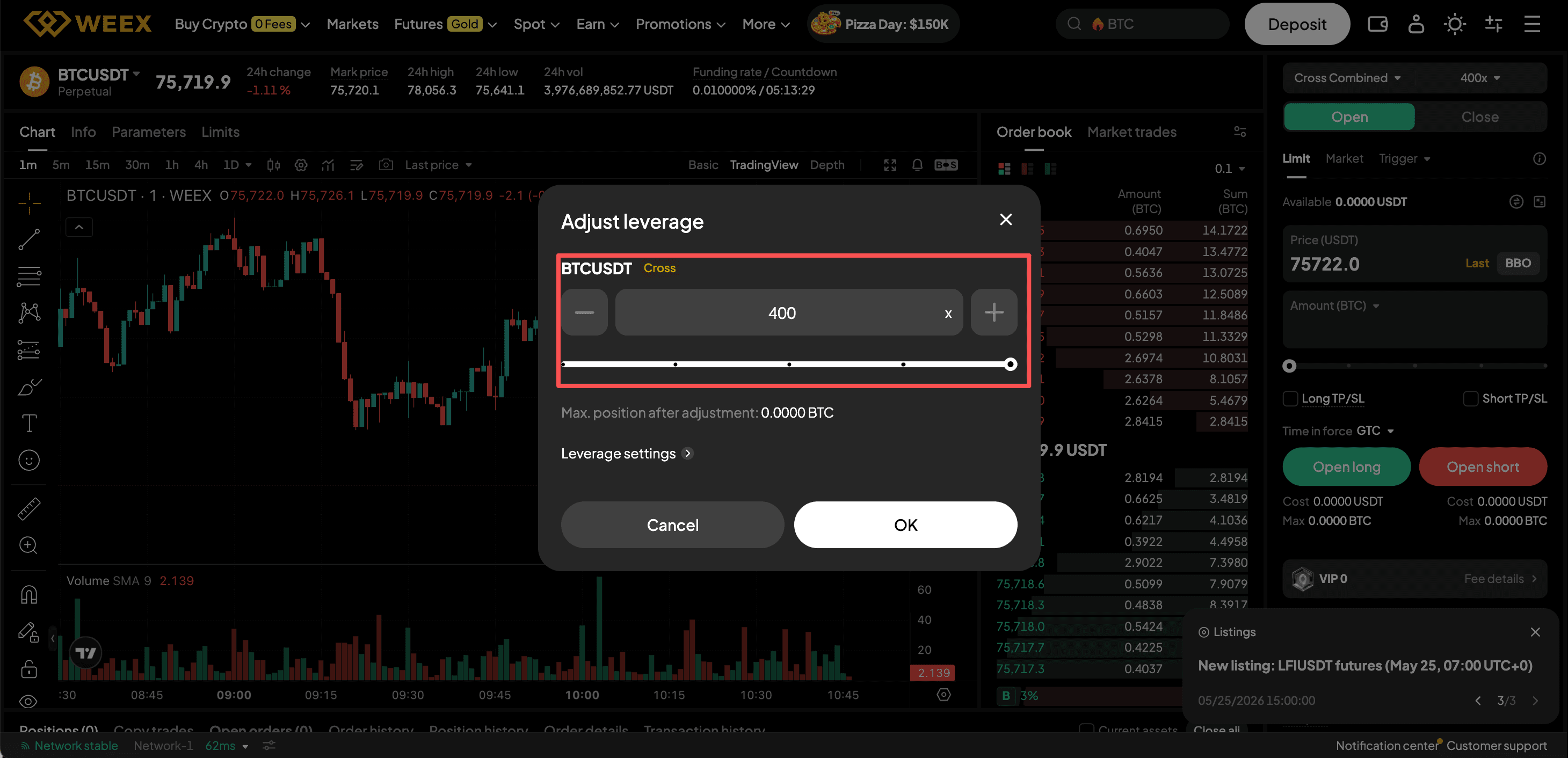
Most beginners use too much leverage. Then they wonder why they got liquidated.
Match your leverage to your risk tolerance and market conditions. High volatility + high leverage = guaranteed liquidation.
Final Thoughts
Crypto liquidation explained in one sentence: you borrow money to trade, price moves the wrong way, the exchange takes your money and closes the trade.
Understanding what does liquidate mean in crypto is the difference between surviving and blowing up your account.
The tools to avoid liquidation are simple. Risk 1-3% per trade. Use stop-losses. Don't over-leverage.
But simple doesn't mean easy. It takes discipline. Most traders don't have it. That's why most traders lose money.
Ready to start futures trading? Sign up on WEEX Now and Start Trading!
FAQ
Q: What is liquidation in crypto?
Liquidation in crypto happens when a leveraged trade moves against you and the exchange closes your position automatically because you no longer have enough margin to keep it open.
Q: What does liquidate mean in crypto?
To liquidate means the exchange forces you to close a leveraged position at a loss. You lose your collateral (initial margin) and the trade ends.
Q: What does it mean to get liquidated in crypto?
Getting liquidated means you failed to meet the margin requirements for your leveraged trade. The exchange closes your position, and you lose the funds you put up as collateral.
Q: How do crypto liquidations happen?
Liquidations happen when the market moves against your leveraged position, your margin drops below the maintenance requirement, and the exchange issues a margin call. If you don't add funds, the exchange automatically closes your position.
You may also like

MicroStrategy's STRC Unpegged: Buy the Dip or Brace for Impact?
How to Buy Cryptocurrency on WEEX Exchange 2026: Full Guide
Prediction Market Apps 2026: How Prediction Markets Work? Are They Safe and Legal?
Is Polymarket Legal in India in 2026? Key Legal Updates on Prediction Markets
14 Best Prediction Market Apps in 2026: The Ultimate Guide to Crypto-Native and Regulated Platforms
Can Politicians Rig Election Prediction Markets? The Dark Side of Election Prediction Markets
2026 US Election Odds: Who Leads Right Now on Polymarket and Kalshi?
What Is a Crypto Prediction Market? Key Opportunities in the Prediction Market Sector
Plot twist in the AI race—the next big flex is actually physical infra?
How to Profit on Prediction Market: A Beginner's Guide to Prediction Market
Decentralized Prediction Market: A Beginner's Guide for WEEX Users
Kalshi Prediction Market Explained: How It Works and Who Can Use It
What Is WXT Used For? A Beginner's Guide to WEEX Token Utility
Top Prediction Market Websites in 2026: Which Platform Is Best for You?
How to Start Spot Trading on WEEX: No Leverage, No Liquidation Risk
What Is a Prediction Market Platform? How It Works and Key Risks
Can You Make Money on Prediction Markets? Risks and Strategies
Is a Prediction Market Just Gambling? How It Works and Key Risks
MicroStrategy's STRC Unpegged: Buy the Dip or Brace for Impact?
How to Buy Cryptocurrency on WEEX Exchange 2026: Full Guide
Prediction Market Apps 2026: How Prediction Markets Work? Are They Safe and Legal?
Is Polymarket Legal in India in 2026? Key Legal Updates on Prediction Markets
14 Best Prediction Market Apps in 2026: The Ultimate Guide to Crypto-Native and Regulated Platforms
Can Politicians Rig Election Prediction Markets? The Dark Side of Election Prediction Markets
Contents
Popular coins


