
How to Trade FUTU Futures in 2026: Why WEEX TradFi is the Best Choice for Beginners


You’re not here for dividends. You’re here because Futu Holdings (FUTU) powers China’s online brokerage boom—and you want to know: too late, or just getting started?
By 2026, Futu’s twin apps (Futubull and Moomoo) made it a $21.7 billion force. But active traders know: while others wait for the NASDAQ bell, the smart crowd trades FUTU futures 24/7 on crypto exchanges.
This guide covers: what FUTU futures are, how TradFi perpetual contracts work, and how to trade them without a traditional broker account.

What Is Futu Holdings
Futu Holdings is the parent company behind Futubull and Moomoo — two digital brokerage platforms dominating Hong Kong, Singapore, and increasingly the US market .
The company makes money three ways:
- Brokerage commissions from every trade users place
- Margin financing interest when traders borrow to leverage up
- Wealth management fees from fund products
As of May 2026, FUTU trades around 124–124–155 per share, with a 52-week range between 96.27 and 202.53 . The stock is volatile — exactly what futures traders want.
FUTU Recent earnings snapshot (Q4 2025):
- EPS: 3.07(beatestimatesby3.07(beatestimatesby0.01)
- Revenue: 827.15million(above827.15million(above788.73M expected)
- Next earnings (Q1 2026): estimated June 4, 2026
What Are FUTU Futures
Traditional futures are contracts to buy or sell an asset at a predetermined price on a specific future date. They expire. You have to roll them over. It’s a headache.
FUTU futures on WEEX Exchange work differently.
What you’re trading is a perpetual contract — no expiration date, no rollover, no physical delivery. You hold the position as long as you want and close it when you’re ready.
Here’s the key: you’re not buying Futu stock. You’re trading the price movement of FUTU using USDT as your margin. Go long if you think earnings will crush estimates. Go short if you think the Hong Kong market cools off.
What Is TradFi Perpetual Contracts
TradFi stands for Traditional Finance — stocks, commodities, forex, gold. TradFi perpetual contracts apply crypto’s most successful derivative structure (the perp) to these traditional assets .
How they work:
You deposit USDT. You choose an asset — FUTU stock, gold, crude oil, NASDAQ indices. You open a position with leverage. No broker account. No USD bank transfer. No tax forms. Just a crypto wallet and a few clicks .
Key differences from traditional futures:
| Feature | Traditional Futures | TradFi Perpetuals (on WEEX) |
| Expiration date | Yes — must roll over | No — hold indefinitely |
| Settlement currency | USD, HKD, etc. | USDT |
| Trading hours | Market-specific sessions | 7月24日 |
| Physical delivery | Possible for commodities | Never — cash settled |
| Account needed | Brokerage account | Crypto wallet + exchange account |
The funding rate mechanism keeps the perpetual price anchored to the real FUTU stock price. Every few hours, longs pay shorts or shorts pay longs depending on which side is more crowded .
This structure has exploded in 2026. Binance’s TradFi perp volume grew from 0.2% to 4.9% of major futures markets in just 90 days — with silver perps hitting 20.8% of COMEX volume at peak .
Why FUTU Futures in 2026
- Earnings volatility
Futu reports Q1 2026 earnings around June 4 . The stock moved 15-20% around past reports. With 10x leverage, that’s a 150-200% move — in either direction.
- Hong Kong-China retail boom
Chinese retail investors are hungry for US stocks. Futu’s platforms are their primary gateway. As long as that demand holds, FUTU stays relevant.
- 24/7 access to NASDAQ names
Futu trades on NASDAQ. NASDAQ closes at 4 PM ET. If news drops at 9 PM, traditional traders wait until morning. FUTU futures traders act immediately .
- No PDT rule
The Pattern Day Trader rule (25k minimum for frequent trading) doesn’t apply to crypto-based futures. Trade as much as you want with whatever capital you have.
FUTU Stock vs. FUTU Futures: What’s the Difference?
| Aspect | FUTU Stock | FUTU Futures (Perpetual) |
| What you own | Equity share | A contract tracking price |
| Trading hours | NASDAQ hours (9:30 AM – 4 PM ET) + limited after-hours (4-8 PM ET) | 7月24日 |
| Leverage | 2x max from most brokers | Up to 100x |
| Settlement currency | USD | USDT |
| Dividends | You receive them | Priced in (no separate payment) |
| Voting rights | Yes | No |
Note: Stock is for investors. Futures are for traders.
How to Trade FUTU Futures on WEEX TradFi: Step-by-Step
Step 1: Deposit funds
You need to deposit USDT (Tether) on WEEX. Buy USDT with fiat or transfer from your crypto wallet.
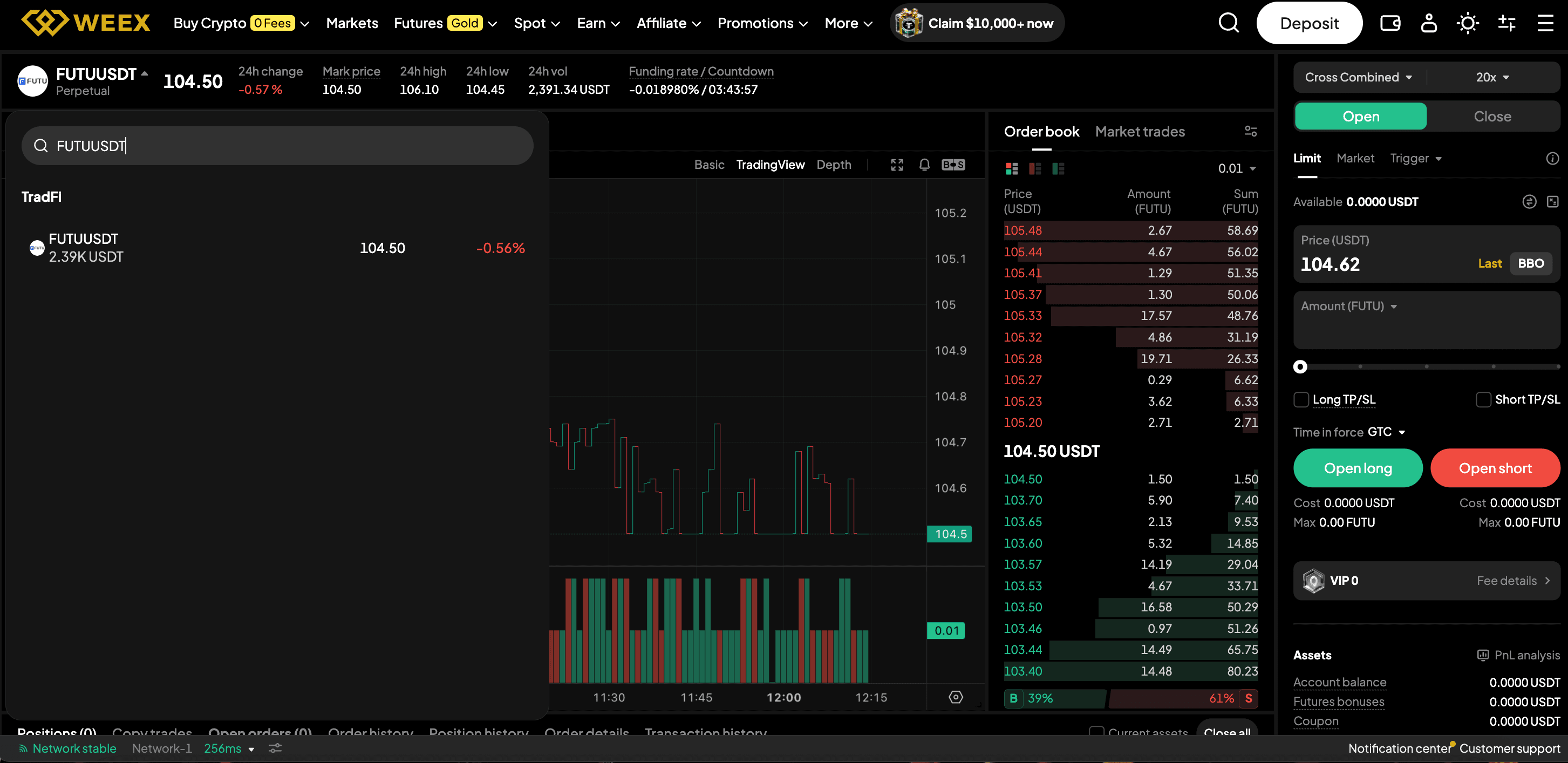
Step 2: Find the FUTU perpetual contract
Go to the WEEX Futures page and search for FUTUUSDT.
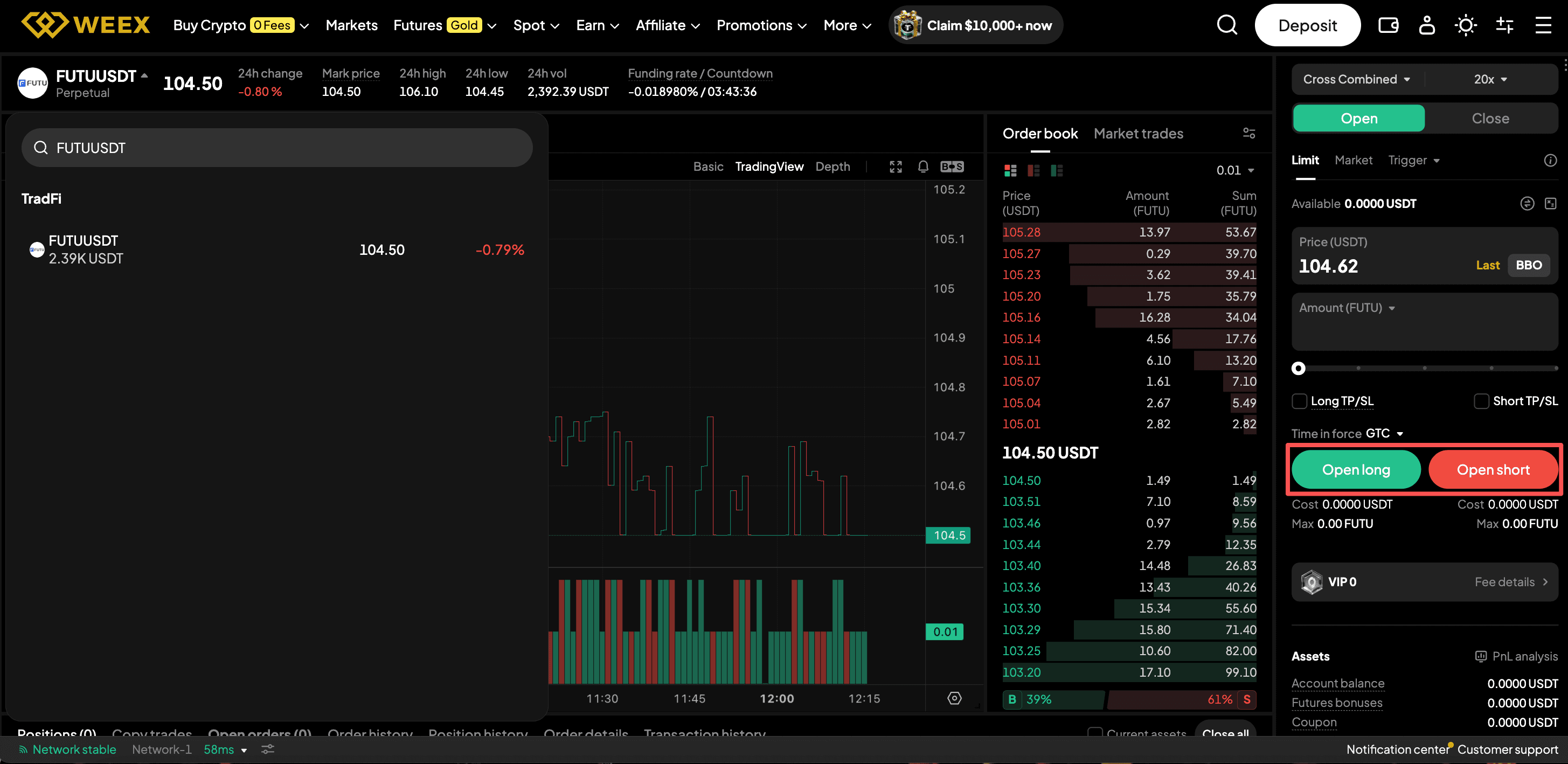
Step 3: Decide to go long or short
- Go long: You expect Futu’s next earnings to beat estimates or Hong Kong retail activity to surge
- Go short: You think valuation is stretched or competition (like Tiger Brokers) is eating market share
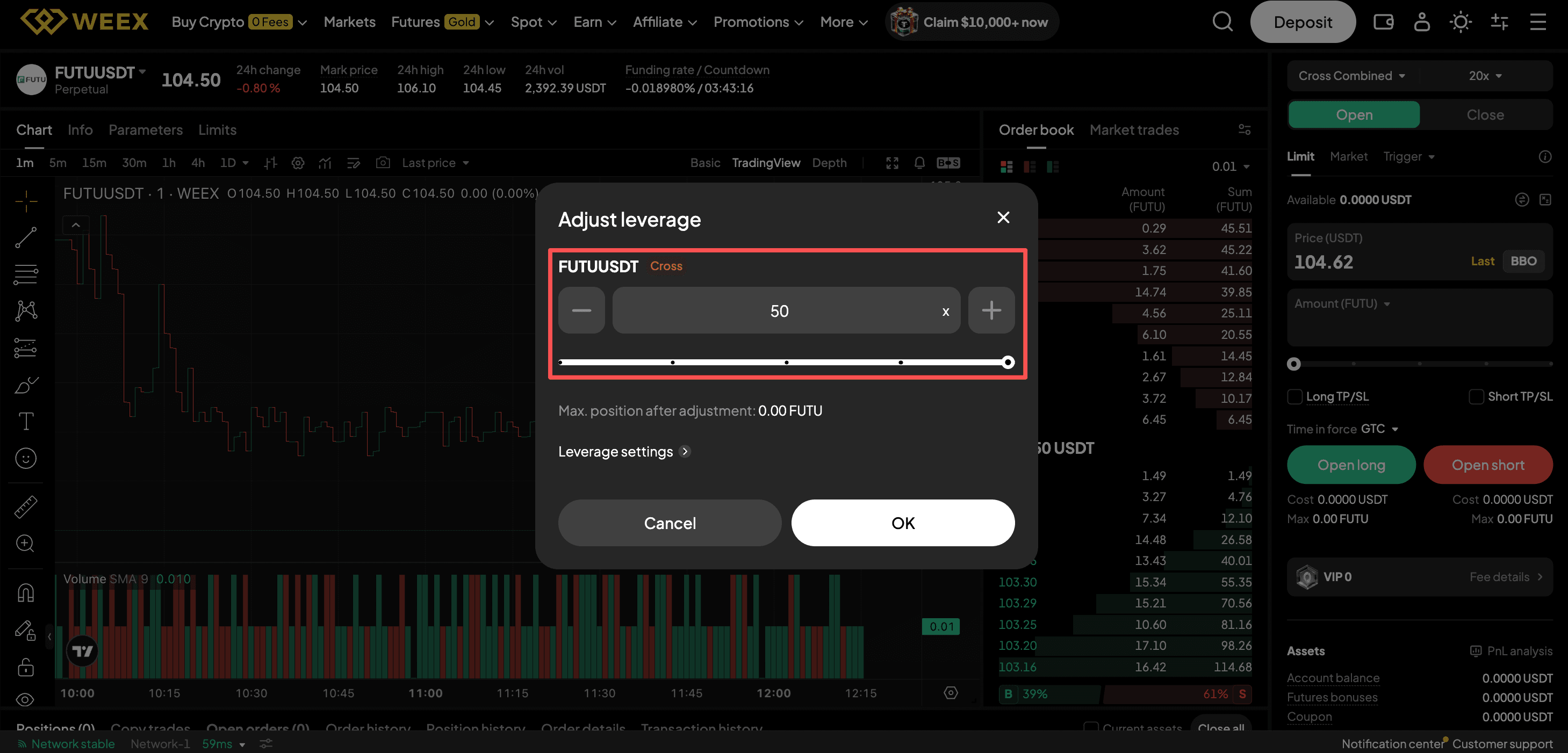
Step 4: Set leverage
Start small. 5x or 10x is plenty for beginners. 100x leverage means a 1% move against you liquidates your position. You can access up to 50x leverage on FUTU .
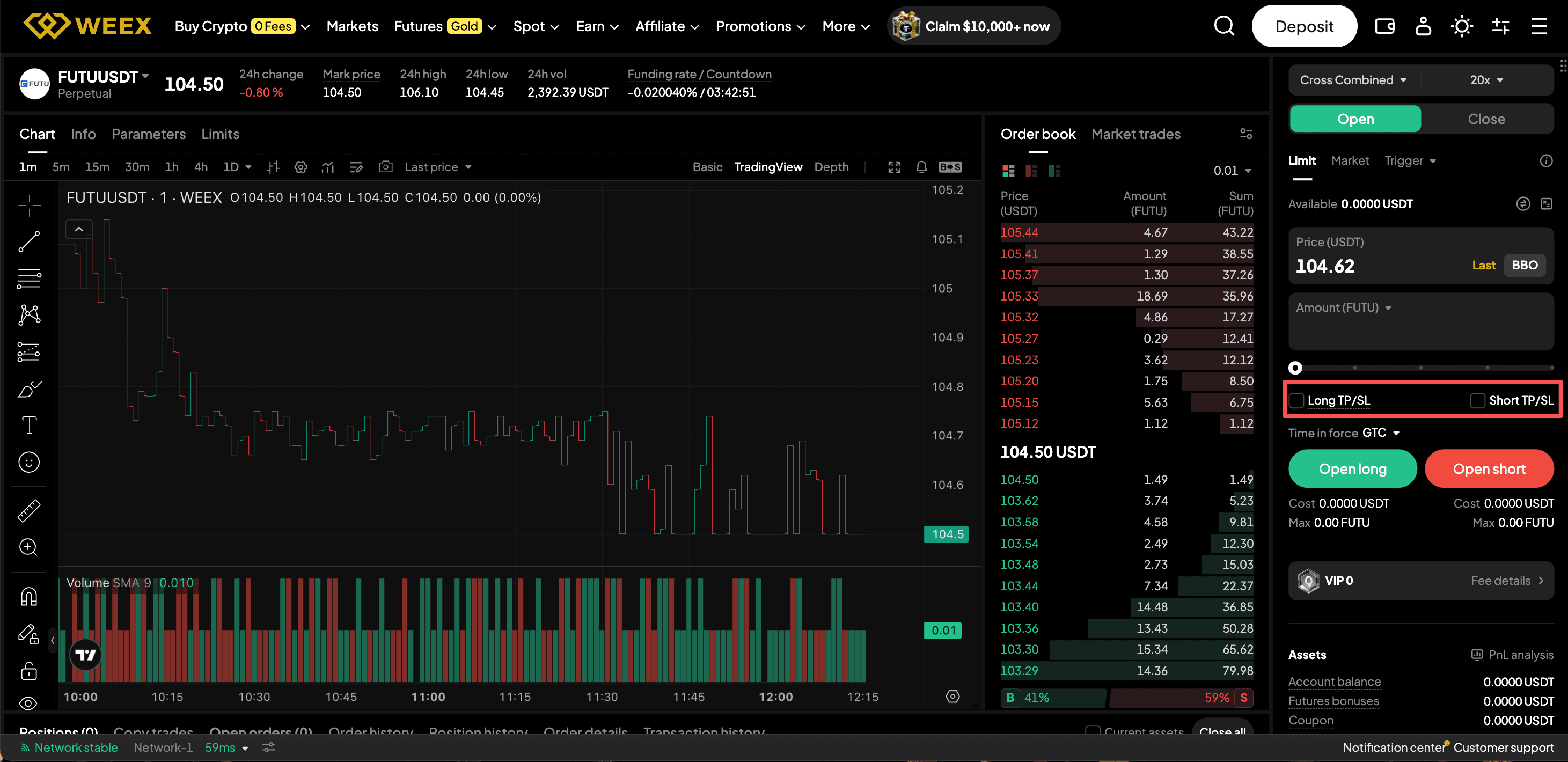
Step 5: Place stop-loss and take-profit
Always set stop-loss and take-profit before clicking buy. The market can gap overnight. Stop-losses save accounts.
Step 6: Monitor funding rates
Check the funding rate before holding overnight. If it’s high, you’re paying to keep the position open.
Key Risks to Know Before Trading FUTU Futures
- Liquidation risk: Leverage magnifies losses. A 10% drop with 10x leverage = 100% loss. Your position closes automatically when margin runs out.
- Funding rate cost: If everyone is bullish on FUTU, longs pay shorts. Holding through high funding rates eats profits.
- Basis risk: The perpetual price tracks the real FUTU price via an index. In extreme volatility, the basis can widen before correcting.
- After-hours spreads: When NASDAQ is closed, FUTU futures still trade. Liquidity can thin out, widening spreads .
Conclusion
The debate is whether Chinese retail demand for US stocks will cool off. The data says no. Hong Kong and Singapore trading volumes remain strong, and Futu's platforms keep adding users.
Even if competitors catch up, Futu holds the edge. Its app experience and liquidity keep traders locked in. For active traders: earnings volatility + 24/7 markets + leverage = opportunity.
Ready to trade FUTU futures? Sign up on WEEX Now and Start Trading!
FAQ
Q: What is FUTU futures?
FUTU futures are perpetual contracts tracking the price of Futu Holdings stock (NASDAQ: FUTU). They have no expiration date and settle in USDT, allowing 24/7 trading.
Q: How is FUTU futures different from buying FUTU stock?
Futures give you leverage, 24/7 access, and USDT settlement. Stock gives you ownership, dividends, and voting rights. Futures are for short-term trading; stock is for investing.
Q: What are TradFi perpetual contracts?
TradFi perpetuals apply crypto’s perpetual swap structure to traditional assets like stocks, gold, and oil. You trade price movement with USDT margin, no broker account required .
Q: Where can I trade FUTU futures?
You can trade FUTU futures on WEEX TradFi. Look for FUTUUSDT pairs on the futures trading page.
You may also like

How to Buy Cryptocurrency on WEEX Exchange 2026: Full Guide
Prediction Market Apps 2026: How Prediction Markets Work? Are They Safe and Legal?
Is Polymarket Legal in India in 2026? Key Legal Updates on Prediction Markets
14 Best Prediction Market Apps in 2026: The Ultimate Guide to Crypto-Native and Regulated Platforms
Can Politicians Rig Election Prediction Markets? The Dark Side of Election Prediction Markets
2026 US Election Odds: Who Leads Right Now on Polymarket and Kalshi?
What Is a Crypto Prediction Market? Key Opportunities in the Prediction Market Sector
Plot twist in the AI race—the next big flex is actually physical infra?
How to Profit on Prediction Market: A Beginner's Guide to Prediction Market
Decentralized Prediction Market: A Beginner's Guide for WEEX Users
Kalshi Prediction Market Explained: How It Works and Who Can Use It
What Is WXT Used For? A Beginner's Guide to WEEX Token Utility
Top Prediction Market Websites in 2026: Which Platform Is Best for You?
How to Start Spot Trading on WEEX: No Leverage, No Liquidation Risk
What Is a Prediction Market Platform? How It Works and Key Risks
Can You Make Money on Prediction Markets? Risks and Strategies
Is a Prediction Market Just Gambling? How It Works and Key Risks
What Are the Most Popular Prediction Market Platforms in 2026?
How to Buy Cryptocurrency on WEEX Exchange 2026: Full Guide
Prediction Market Apps 2026: How Prediction Markets Work? Are They Safe and Legal?
Is Polymarket Legal in India in 2026? Key Legal Updates on Prediction Markets
14 Best Prediction Market Apps in 2026: The Ultimate Guide to Crypto-Native and Regulated Platforms
Can Politicians Rig Election Prediction Markets? The Dark Side of Election Prediction Markets
2026 US Election Odds: Who Leads Right Now on Polymarket and Kalshi?
Contents
Popular coins


