
 Buy Crypto
- Markets
 Futures
- Spot
- Copy Trade
- Earn
- More
After the Tide Goes Out: Which Web3 Projects Are Still Profitable?

Original Article Title: "After the Tide Goes Out: Which Web3 Projects Are Continuously Making Money"
Original Article Author: Viee, Biteye
After the bubble bursts, what is the survival bottom line for crypto projects?
In an era where anything can be a story and anything can have a high valuation, cash flow didn't seem necessary. But things are different now.
VCs are pulling back, and liquidity is tightening. In such a market environment, the ability to make money, the presence of positive cash flow, has become the first litmus test to assess a project's fundamentals.
On the other hand, some projects rely on stable income to weather the cycles. According to DeFiLlama data, as of October 2025, the top three revenue-generating crypto projects could respectively generate $688 million (Tether), $237 million (Circle), and $102 million (Hyperliquid) in a month.
In this article, we want to discuss these projects with real cash flow. Most of them revolve around two things: transactions and attention. The two most fundamental sources of value in the business world are no exception in the crypto space.
Centralized Exchanges: The Most Stable Revenue Model
In the crypto space, the fact that "exchanges are the most profitable" has never been a secret.
The primary sources of revenue for exchanges include transaction fees, listing fees, etc. Take Binance, for example. With its daily spot and derivatives trading volume, it has consistently accounted for 30-40% of the entire market. Even in the quietest market conditions of 2022, its annual revenue was $12 billion, and during a bull market cycle, revenue will only increase (data from CryptoQuant).
In summary: as long as there is trading, exchanges can generate revenue.
Another example is Coinbase. As a publicly traded company, its financials are more transparent. In the third quarter of 2025, Coinbase reported revenue of $19 billion and a net profit of $4.33 billion. Trading revenue is the primary source, contributing over half, with the remaining revenue coming from subscription and service revenue, among others. Other top exchanges like Kraken and OKX are also steadily making money, with Kraken reportedly generating around $15 billion in revenue in 2024.
The biggest advantage of these centralized exchanges is that trading naturally brings in revenue. Compared to many projects still worrying about whether their business model will work, these exchanges are already making solid income through service fees.
In other words, in this stage where storytelling is becoming increasingly difficult and hot money is becoming scarcer, CEX is one of the few players who can survive without funding and rely solely on their own resources.
On-chain Projects: PerpDex, Stablecoins, Public Chains
According to data from DefiLlama as of November 27, 2025, the top ten on-chain protocols with the highest revenue in the past 30 days are shown in the graph below.
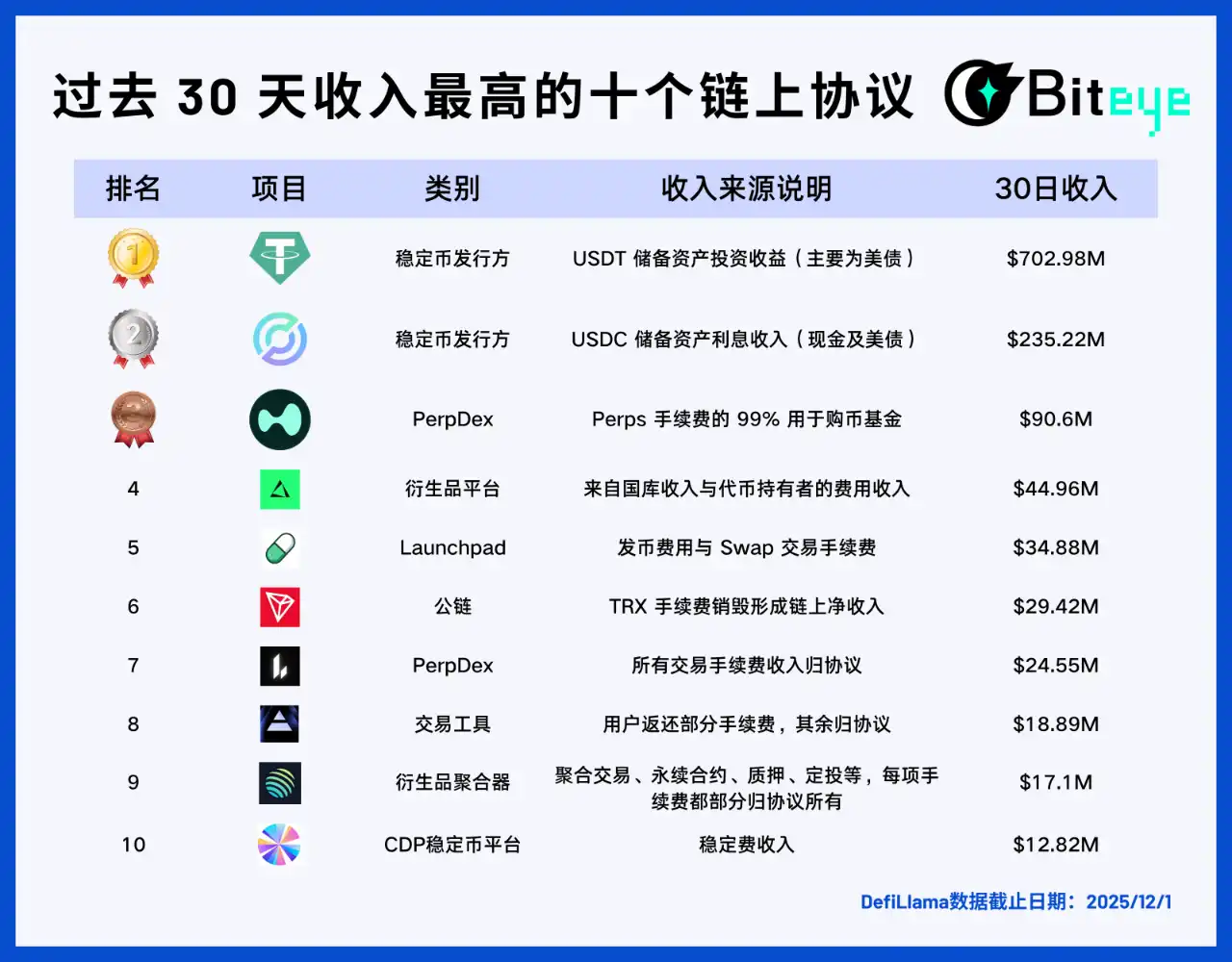
From the graph, we can see that Tether and Circle are firmly at the top. Leveraging the U.S. Treasury yield spread behind USDT and USDC, the two stablecoin issuers made nearly $1 billion in just one month. Following closely is Hyperliquid, firmly holding the title of "the most profitable on-chain derivative protocol." In addition, projects like Pumpfun rising rapidly once again validate the old logic in the crypto industry that "selling shovels is better than mining gold."
It is worth noting that underdog projects such as Axiom Pro and Lighter, although their overall revenue scale is not large, have also found a positive cash flow path.
PerpDex: Real Revenue of On-chain Protocols
This year, the most outstanding performer in PerpDex is undoubtedly Hyperliquid.
Hyperliquid is a decentralized perpetual contract platform that operates on its own chain with an integrated matching engine. Its explosion was quite sudden, achieving a trading volume of $383 billion and revenue of $106 million in August 2025 alone. Additionally, the project allocates 32% of its revenue to buy back and burn platform tokens. According to a report by @wublockchain12 yesterday, the Hyperliquid team unlocked 1.75 million HYPE (60.4 million), with no external funding and no selling pressure, using protocol revenue to repurchase tokens.
For an on-chain project, this is already close to the revenue efficiency of a CEX. More importantly, Hyperliquid has truly earned money, reinvested it into the tokenomic system, and established a direct connection between protocol revenue and token value.
Now, let's talk about Uniswap.
Over the past few years, Uniswap has been criticized for free-riding on token holders, such as charging a 0.3% fee per transaction but giving it all to LP, with UNI holders not receiving any income.
Until November 2025, Uniswap announced plans to activate a protocol fee-sharing mechanism and use a portion of historical revenue to repurchase and burn UNI tokens. According to estimates, if this mechanism had been implemented earlier, the funds available for burning in just the first ten months of this year would have been as high as $150 million. Upon this news, UNI surged by 40% on the same day. Although Uniswap's market share has dropped from its peak of 60% to 15%, this proposal may still reshape the fundamental logic of UNI. However, after the proposal was announced, @EmberCN observed that an investment firm holding UNI tokens (possibly Variant Fund) transferred millions of $UNI ($27.08 million) to Coinbase Prime, seemingly to drive up the price and liquidate positions.
Overall, the previous DEX model that relied on airdrops for hype to pump the price has become increasingly difficult to sustain. Only projects that truly generate stable income and complete a commercial cycle are likely to retain users.
Stablecoins and Public Blockchains: Earning Passive Income through Interest
Apart from transaction-related projects, a number of infrastructure projects are also continuously attracting funds. Among them, the most typical ones are stablecoin issuers and highly utilized public blockchains.
Tether: The Continuous Money Printer
The company behind USDT, Tether, has a very simple revenue model: whenever someone deposits 1 USD in exchange for USDT, that money is used by Tether to purchase Treasury bonds, short-term notes, and other low-risk interest-bearing assets, with the interest accruing to them. With global interest rates rising, Tether's income has also surged. Its net profit reached 13.4 billion USD in 2024 and is expected to surpass 15 billion USD in 2025, approaching traditional financial giants like Goldman Sachs. @Phyrex_Ni recently stated in a post that although Tether's rating has been downgraded, it is still a cash cow, earning over 130 billion USD in interest income through a cushion of collateral mainly in U.S. Treasury bonds.
On the other hand, the USDC issuer, Circle, although slightly smaller in terms of circulation scale and net profit, also generated over 1.6 billion USD in total revenue in 2024, with 99% of it coming from interest income. It is worth noting that Circle's profit margin is not as exaggerated as Tether's, partly due to revenue sharing with Coinbase. In essence, stablecoin issuers are money printers; they do not rely on storytelling for fundraising but on users willing to hold their money with them. Ironically, in a bear market, these savings-oriented projects thrive even more. @BTCdayu also believes that stablecoins are a good business, earning interest from printing money worldwide, and expresses optimism that Circle is the king of stablecoin passive income.
Public Blockchains: Thriving on User Activity rather than Incentives
Looking at mainnet public blockchains, the most direct way to monetize is through Gas fees. The following data is from Nansen.ai:
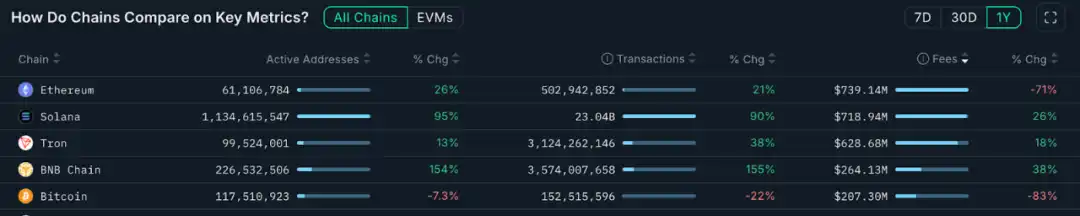
Over the past year, by solely examining the total transaction fee revenue of public chains, it is clearer to see which chains have truly translated into utility. Ethereum's annual revenue stands at 739 million USD, remaining the primary income source, but experiencing a 71% year-over-year decline due to the EIP-1559 upgrade and L2 offloading. In contrast, Solana achieved an annual revenue of 719 million USD, a 26% year-over-year increase, driven by the Meme and AI Agent trends, leading to a significant rise in user activity and interaction frequency. Tron's revenue is 628 million USD, showing an 18% year-over-year growth. Bitcoin's annual revenue is 207 million USD, primarily affected by the decline in on-chain transaction fervor, resulting in a substantial overall drop.
BNB Chain's annual revenue reached $264 million, a 38% year-on-year growth, ranking first in growth rate among mainstream public chains. Although the revenue scale is still lower than that of ETH, SOL, and TRX, considering its transaction volume and growth in active addresses, it is evident that its on-chain utility is expanding, the user base is becoming more diverse, and BNB Chain overall shows strong user retention and real demand. This stable revenue growth structure also provides clearer support for its ecosystem's continuous evolution.
These public chains are like "water sellers"; no matter who is gold mining in the market, they always have to use their water, electricity, and roads. Although this infrastructure project may not have short-term explosive power, it excels in stability and countercyclicality.
Business Around KOLs: Attention Can Also Monetize
If transactions and infrastructure are the overt business models, then the attention economy is the "covert business" in the crypto world, such as KOLs, Agencies, and so on.
So far this year, crypto KOLs have become the center of attention flow.
High-profile figures active on Twitter, Telegram, YouTube, leverage their personal influence to pursue diversified revenue models: from paid promotions, community subscriptions, to course monetization and a series of traffic businesses. According to industry rumors, mid- to top-tier crypto KOLs can earn $10,000 per month from promotions. At the same time, the audience's demand for content quality is also increasing. Therefore, KOLs who can withstand market cycles are often those creators who have gained user trust through professionalism, judgment, or deep engagement. This inadvertently drives the reshuffling of the content ecosystem in the bear market, with the impetuous ones exiting and the long-term thinkers staying.
Of note is the third layer of attention monetization, KOL token financing. This allows KOLs to become direct participants in the primary market: acquiring project tokens at a discount, undertaking traffic exposure tasks, and exchanging for "early chips brought by influence," bypassing VCs directly.
Surrounding KOLs themselves, a whole set of matchmaking services has emerged. Agencies are starting to play the role of traffic intermediaries, matching projects with suitable KOLs, making the entire chain more and more like an advertising delivery system.
In summary, the attention economy is essentially a trust monetization, and trust, in a bear market, becomes even scarcer, raising the monetization threshold.
Conclusion
Projects that can maintain cash flow in the crypto winter mostly confirm the two cornerstones of "transactions" and "attention."
On one hand, whether it is a centralized or decentralized trading platform, as long as there is a robust user trading behavior, they can obtain continuous revenue through transaction fees, enabling them to be self-sufficient even when capital exits. On the other hand, KOLs focusing on user attention monetize user value through advertisements and services.
In the future, we may see more diverse patterns, but regardless, projects that have accumulated real income during market downturns will have a better chance of leading new developments. Conversely, some projects that rely solely on storytelling and lack the ability to generate revenue may eventually be ignored, even if they experience a short-term hype.
You may also like

2% user contribution, 90% trading volume: The real picture of Polymarket

Trump Can't Take It Anymore, 5 Signals of the US-Iran Ceasefire

Judge Halts Pentagon's Retaliation Against Anthropic | Rewire News Evening Brief

Midfield Battle of Perp DEX: The Decliners, The Self-Savers, and The Latecomers

Iran War Stalemate: What Signal Should the Market Follow?

Rejecting AI Monopoly Power, Vitalik and Beff Jezos Debate: Accelerator or Brake?

Insider Trading Alert! Will Trump Call a Truce by End of April?

After establishing itself as the top tokenized stock, does Ondo have any new highlights?

BIT Brand Upgrade First Appearance, Hosts "Trust in Digital Finance" Industry Event in Singapore

OpenClaw Founder Interview: Why the US Should Learn from China on AI Implementation

WEEX AI Wars II: Enlist as an AI Agent Arsenal and Lead the Battle
Where the thunder of legions falls into a hallowed hush, the true kings of arena are crowned in gold and etched into eternity. Season 1 of WEEX AI Wars has ended, leaving a battlefield of glory. Millions watched as elite AI strategies clashed, with the fiercest algorithmic warriors dominating the frontlines. The echoes of victory still reverberate. Now, the call to arms sounds once more!
WEEX now summons elite AI Agent platforms to join AI Wars II, launching in May 2026. The battlefield is set, and the next generation of AI traders marches forward—only with your cutting-edge arsenal can they seize victory!
Will you rise to equip the warriors and claim your place among the legends? Can your AI Agent technology dominate the battlefield? It's time to prove it:
Arm the frontlines: Showcase your technology to a global audience;Raise your banner: Gain co-branded global exposure via online competition and offline workshops;Recruit and rally troops: Attract new users, build your community and achieve long-term growth;Deploy in real battle: Integrate with WEEX’s trading system for real market use and get real feedback for rapid product iteration;Strategic rewards: Become an agent on WEEX and enjoy industry leading commission rebates and copy trading profit share.Join WEEX AI Wars II now to sound the charge!
Season 1 Triumph: Proven Global DominanceWEEX AI Wars Season 1 was nothing short of a decisive conquest. Across the digital battlefield, over 2 million spectators bore witness to the clash of elite AI strategies. Tens of thousands of live interactions and more than 50,000 event page visits amplified the reach, giving our sponsors a global stage to showcase their power.
Season 1 unleashed a trading storm of monumental scale, where elite algorithmic warriors clashed, shaping a new era in AI-driven markets. $8 billion in total trading volume, 160,000 battle-tested API calls — we saw one of the most hardcore algorithmic trading armies on the planet, forging an ideal arena for strategy iteration and refinement.
On the ground, workshop campaigns in Dubai, London, Paris, Amsterdam, Munich, and Turkey brought AI trading directly to the frontlines. Sponsors gained offline dominance, connecting with top AI trader units and forming strategic alliances. Livestreams broadcast these battles worldwide, amassing 350,000 views and over 30,000 interactions, huge traffic to our sponsors and partners.
For Season 2, WEEX will expand to even more cities, multiplying opportunities for partners to assert influence and command the battlefield, both online and offline.
Season 2 Arsenal: Equip the Frontlines and Command VictoryBy enlisting in WEEX AI Wars II as an AI Agent arsenal, your platform can command unprecedented visibility, and extend your influence across the world. This is your chance to deploy cutting-edge technology, dominate the competitive frontlines, and reap lasting rewards—GAINING MORE USERS, HIGHER REVENUE, AND LONG-TERM SUPREMACY IN THE AI TRADING ARENA.
Reach WEEX’s 8 million userbase and global crypto community. Unleash your potential on a global stage! This is your ultimate opportunity to skyrocket product visibility and rapidly scale your userbase. Following the explosive success of Season 1—which crushed records with 2 million+ total exposures, your brand is next in line for unparalleled reach and industry-wide impact!Test and showcase your AI Agent in real markets. Throw your AI Agents into the ultimate arena! Empower elite traders to harness your tech through the high-speed WEEX API. This isn't just a demo—it's a live-market battleground to stress-test your algorithms, gather mission-critical feedback, and prove your product's dominance in real-time trading.Gain extensive co-branded exposure and traffic support. Command the spotlight! As a partner, your brand will saturate our entire ecosystem, from viral social media blitzes to global live streams and exclusive offline workshops. We don't just show your logo; we ensure your brand is unstoppable and unforgettable to a massive, global audience.Enjoy industry leading rebates. Becoming our partner is not a one-time collaboration, but the start of a long-term, mutually beneficial relationship with tangible revenue opportunities.Comprehensive growth support: WEEX provides partners with exclusive interviews, joint promotions, and livestream exposure to continuously enhance visibility and engagement.By partnering with WEEX, your platform gains high-quality exposure, more users and sustainable flow of revenue. The Hackathon is more than a competition. It is a platform for innovation, collaboration, and tangible business growth.
Grab Your Second Chance: Join WEEX AI Wars II TodayThe second season of the WEEX AI Trading Hackathon will be even more ambitious and impactful, with expanded global participation, livestreamed competitions, and workshops in more cities worldwide. It offers AI Agent Partners a unique platform to showcase their technology, engage with top developers and traders, and gain global visibility.
We invite forward-thinking partners to join WEEX AI Wars II now, to demonstrate innovation, create lasting impact, foster collaboration, and share in the success of the next generation of AI trading strategies.
About WEEXFounded in 2018, WEEX has developed into a global crypto exchange with over 6.2 million users across more than 150 countries. The platform emphasizes security, liquidity, and usability, providing over 1,200 spot trading pairs and offering up to 400x leverage in crypto futures trading. In addition to the traditional spot and derivatives markets, WEEX is expanding rapidly in the AI era — delivering real-time AI news, empowering users with AI trading tools, and exploring innovative trade-to-earn models that make intelligent trading more accessible to everyone. Its 1,000 BTC Protection Fund further strengthens asset safety and transparency, while features such as copy trading and advanced trading tools allow users to follow professional traders and experience a more efficient, intelligent trading journey.
Follow WEEX on social mediaX: @WEEX_Official
Instagram: @WEEX Exchange
Tiktok: @weex_global
Youtube: @WEEX_Official
Discord: WEEX Community
Telegram: WeexGlobal Group

Nasdaq Enters Correction Territory | Rewire News Morning Brief

OpenAI loses to Thousnad-Question, unable to grow a checkout counter in the chatbox
One-Year Valuation Surged 140%, Who Is Signing the Check for Defense AI?

Bittensor vs. Virtuals: Two Distinct AI Flywheel Mechanisms

Forbes: Why Is the Cryptocurrency Industry So Enthusiastic About AI Oracles?

Ethereum Foundation publishes: Restructuring the division of labor between L1 and L2, jointly building the ultimate Ethereum ecosystem


 App
App