
Bitcoin's ecosystem has been steadily growing. How do experienced players view the ecosystem's future development?


In a little over a month, the Ordinals protocol will celebrate its 2-year anniversary on the Bitcoin mainnet. In 2023, the Bitcoin ecosystem went from being ignored to an inscription craze. This year, following the historic Bitcoin halving for the 4th time, the Bitcoin ecosystem has seen many changes, such as Runes, the development of a new meme community, discussions on OP_CAT, and more.
In May of this year, Bitcoin Asia, Ordinals Asia, and various Bitcoin-related side events were held in Hong Kong. At that time, everyone was full of expectations for the second half of the year in the Bitcoin ecosystem, especially for Bitcoin Layer2 and Runes. Fast forward to the end of 2024, with Trump's election, Bitcoin surged all the way, and we finally saw Bitcoin reaching a six-digit dollar price.
However, compared to Bitcoin's fierce price surge, the performance of the Bitcoin ecosystem seems lackluster.
Runes, the most influential token protocol in the Bitcoin ecosystem, still has a total market capitalization of less than $20 billion. Since Trump's election, the total market capitalization of Runes briefly exceeded the $20 billion mark. However, even with just breaking through the $20 billion mark and approximately doubling its total market value, the Rune ecosystem couldn't hold its ground. Currently, Rune is facing its second challenge to reach the $20 billion mark, with a total market capitalization of approximately $19.2 billion.
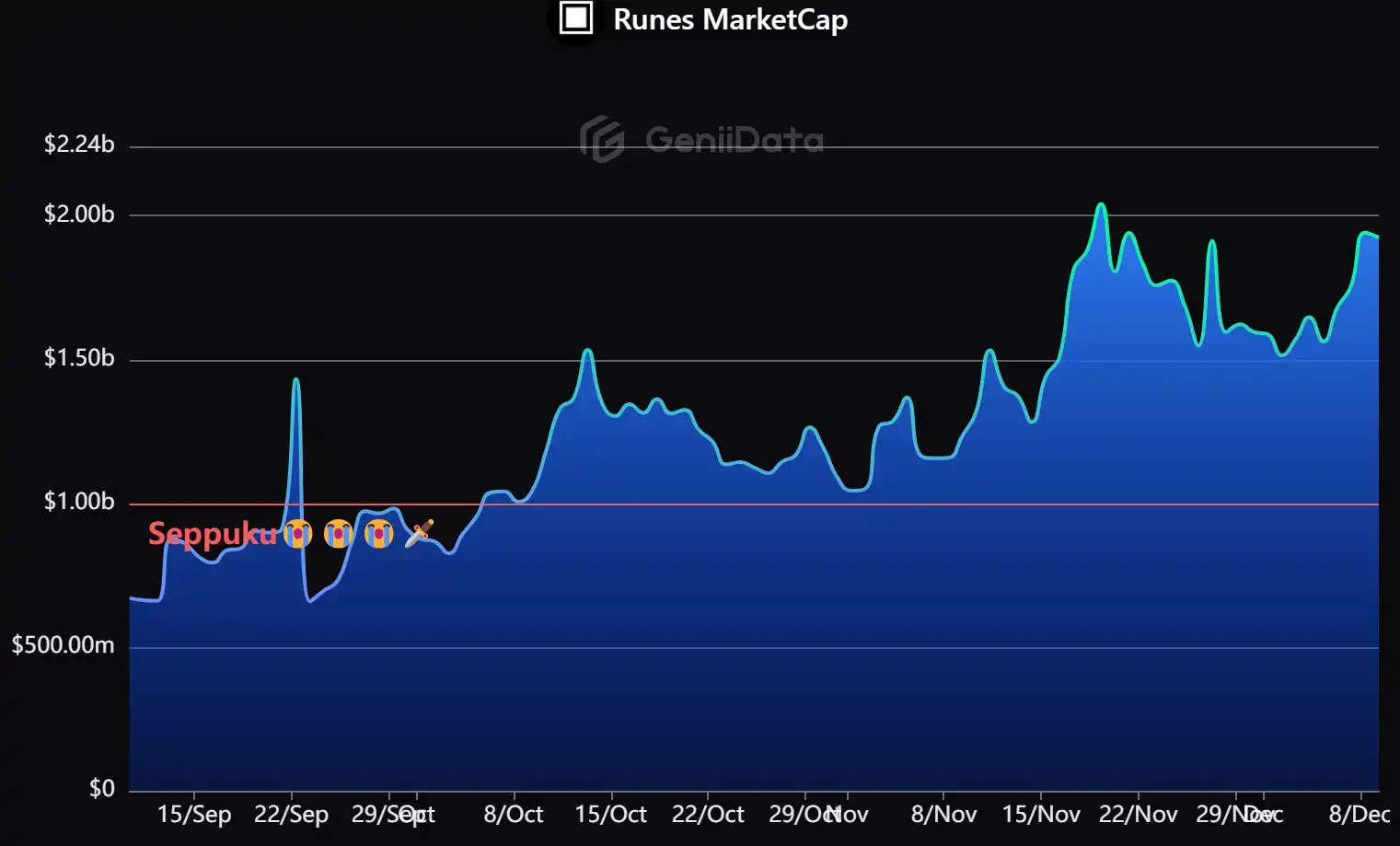
Indeed, solely looking at the data, pulling a top-level meme coin from Solana could surpass Runes in market cap...
And another familiar old friend, BRC-20, still surpasses Runes in total market cap, with almost $36 billion. Although it maintains the lead in data, BRC-20 also faces some issues, such as in the composition of its market value, where the spot trading of $ORDI and $SATS listed on Binance already accounts for nearly half, leaving many other low-value assets. Some active Western communities, mainly with $PUPS and $WZRD, have already or are about to shift towards the Rune ecosystem.

BlockBeats invited three deeply involved Bitcoin ecosystem players to look back on the past year's performance of the Bitcoin ecosystem. Are they more optimistic or pessimistic about the future? Have they seen a subtle change in the development logic of the Bitcoin ecosystem? How do they interpret some unique phenomena within the Bitcoin ecosystem?
Guests:
Dr. Gold Dog (@ordjingle): Ordinals Protocol Contributor
Ivan (@ivantkf): Former Magic Eden Bitcoin Eco Asia Pacific Community Lead, BRC-1155 Protocol Author
An anonymous senior dev, a significant contributor to the BRC-20 protocol
Bitcoin has broken the $100,000 barrier, why is the Bitcoin ecosystem still lukewarm?
Looking back at this past year, Bitcoin has undoubtedly been the star of the Crypto market, and with Trump's election, it has surged ahead, breaking the $100,000 barrier once again, creating cryptocurrency history.
However, Bitcoin's continuous rise seems not to have provided much of a boost to the Bitcoin ecosystem. CEXs are unenthusiastic about listing Rune tokens, especially Binance, which has yet to list any Rune token contracts or spot listings. The Bitcoin Layer2 projects that received attention earlier this year, apart from Fractal and Merlin, seem not to have left a profound impression on people.
Currently, the total market cap of Rune is not even as high as a top-tier Solana meme coin. In the NFT sector, the top 10 market cap Bitcoin NFT projects only include Bitcoin Puppets in 10th place, with Node Monkes in 11th place. ETH NFTs still hold a higher position and influence in the NFT market.
Why hasn't the Bitcoin ecosystem surged along with the rise in Bitcoin?
Dr. Gold Dog: In fact, the narrative of the Bitcoin ecosystem is still valid, such as Bitcoin itself as a store of value, the significance of on-chain data, and so on. However, the narrative of just issuing coins on Bitcoin may have already consumed much of its novelty, whether it's Rune or BRC-20, they have entered a community development stage that requires relatively long-term accumulation.
From the perspective of VC investments, top Crypto VCs have not completely abstained from investing in the Bitcoin ecosystem, but their involvement has not been particularly deep. It is more like "alternative" investments. If they have not shown a strong interest in taking a "bet" on the Bitcoin ecosystem, then the short-term opportunities in the Bitcoin ecosystem may still be relatively limited.
For Tier 1 CEXs, the possible reason for not listing native tokens is quite simple: native token trading is not yet widespread and active enough to meet the listing standards of CEXs. If listing native tokens does not bring in traffic growth or significant fee revenue, CEXs lack the motivation to list native tokens.
However, the Bitcoin ecosystem has not been completely untouched by Bitcoin's price surge. Whether it's native tokens, BRC-20 tokens, or Bitcoin NFTs, they have all experienced a noticeable price increase along with Bitcoin's surge. This increase, although not substantial, indicates that the Bitcoin ecosystem is still recognized by the market, but it remains a niche track and has not yet attracted widespread or sizable funding.
Ivan: For assets that are not listed and need to be purchased on-chain using Bitcoin, in this market environment where Bitcoin's price has surged significantly, if Bitcoin is exchanged for native tokens or other Bitcoin ecosystem assets, it may not outperform Bitcoin's price surge. Moreover, if Bitcoin drops, it will also face a double loss.
If a story like last year's BRC-20, which drove the entire market crazy, emerged, these concerns would not exist, as Bitcoin's price was still low. But now, this kind of story is unfolding on Solana rather than on Bitcoin, with Bitcoin reaching a price of $100,000 per coin. People are willing to use their precious Bitcoin to buy any "sh*tcoin" based on the expectation of better returns than Bitcoin. However, currently, using Bitcoin on the Bitcoin mainnet to exchange for other assets is not cost-effective.
This bull market is mainly driven by ETFs, allowing traditional institutional funds to find a stable channel to connect with Bitcoin. Everyone knows that a lot of money is in Bitcoin, and through fund overflow, market funds can be diversified to drive the development of Bitcoin's on-chain ecosystem. In contrast, Solana's meme ecosystem is thriving on-chain, generating multiple stories of sudden wealth to attract both new and old retail investors to switch funds to purchase SOL, driving the price rise and continuous on-chain development. Therefore, for the Bitcoin ecosystem to take off, there still needs to be a narrative that can truly land and create the next $ORDI wealth myth, in order to re-attract capital from other chains back to the Bitcoin ecosystem.
dev: Solana is now very hot, not just for Bitcoin ecosystem players. Apart from those making money on Solana, players in any other ecosystem will feel a gap in their hearts.
However, during last year's bear market, the Bitcoin ecosystem already had a thorough outbreak. After such a big outbreak, it takes time to adjust and settle down, waiting for new events to attract more incremental players.
But such an event has not yet arrived. Although there was Serum this year, basically it is still the same group of Ordinals that has already covered the audience, with no additional points to attract players from other ecosystems. Without a breakthrough in the narrative, the immaturity of ecosystem infrastructure further restricts liquidity entry. Whether it's BRC-20 or Serum, the trading experience without being listed is not much different from NFTs, which will make institutional investors who want to enter worry about potential exit issues.
Against the backdrop of the United States embracing Bitcoin, has the fundamental landscape of the Bitcoin ecosystem changed?
This year, as Bitcoin repeatedly hit new highs and with the expectation that the United States will fully embrace Bitcoin following Trump's election, the "Miner Revenue Thesis" has always been one of the optimistic views on the long-term development of the Bitcoin ecosystem. However, today, the boost that the "US Embrace" narrative has given to the entire crypto market seems to have dealt a blow to the "in-circle narrative innovation," with voices that used to obsess over useless innovations in the crypto world almost disappearing during the enthusiastic surge.
For the Bitcoin ecosystem, which has many values built on the five words "Bitcoin mainnet" of the "strong narrative track," the quiet transformation of the market's largest narrative, has it also had a certain impact?
Dr. JinDog: If Bitcoin truly becomes a strategic reserve asset for the United States, and even all countries start to reserve assets strategically, then I would probably tend to think that doing nothing is the best option, as the security of Bitcoin must absolutely come first. From this possibility, any potential impact on the security of Bitcoin is a hidden danger to Bitcoin's greatest interest. Sovereign nations being able to see Bitcoin as a strategic reserve is the biggest driver for Bitcoin.
Previous views, such as increasing miners' income, in the current context of being "officially embraced," naturally the priority will once again be placed behind network security. If Bitcoin can be given a higher legal status by more sovereign states, nothing can be more out of the ordinary than this.
If we were to say from this perspective, the resurrection of OP_CAT on the mainnet, such as the probability of it happening in this bull market cycle might be very low. When the Bitcoin price was not rising before, everyone might have felt an urgency to innovate to make the network active, but now that things are good again, the necessity to take risks of potential trial and error to open up this uncertainty has greatly diminished in the short term. However, attempts such as OP_CAT on Fractal, like CAT20, are very good and meaningful.
Ivan: For miners, the surge in Bitcoin's price due to the U.S. embracing crypto has definitely made the fees paid to the Bitcoin ecosystem look less generous by comparison. While some might argue it's still good, even if it weren't, Bitcoin's price has already risen over 5x from its low.
Additionally, the portion of ETF funds hasn't flowed into the Bitcoin ecosystem either. When combined, it makes the current Bitcoin ecosystem not much different from other chains, where experienced insiders are PvPing. This is why everyone is very eager for Binance to list Rune, believing that if this were to happen, it would be like a spark igniting the whole ecosystem.
dev: I've always felt that miners don't really care about Ordinals or the Bitcoin ecosystem. Most miners I've interacted with are quite pragmatic; they just calculate the mining profitability, consider the various costs involved, at what price Bitcoin needs to be sold to break even with mining, etc.
They also don't contemplate basic questions like whether Bitcoin should prioritize security over innovation. They simply mine faithfully, which is a very normal thing to do. Just as Web2 miners of gold, silver, copper, and iron mines don't think about the sustainable development of the mining area, it's just real life.
Bitcoin Core and ecosystem developers, as well as players, are more interested in this issue compared to miners.
If we step out of the Bitcoin ecosystem and look at the entire market, it is currently in a bull market. Sooner or later, the Bitcoin ecosystem will rise with the bull market tide, and liquidity will inevitably overflow into this track because no high-relief and reliably narrated track from past bull markets will be overlooked by subsequent speculators. So from my perspective, the fundamentals of the Bitcoin ecosystem haven't changed much. There will be opportunities; it's just uncertain at which stage of the bull market these opportunities will arise.
Has BRC-20 Fallen?
Although BRC-20's total market value is still more than double that of Rune's, deep participants in the Bitcoin ecosystem can directly feel that BRC-20's ecosystem activity is gradually distancing itself from Rune's ecosystem. Some active Western communities, primarily with $PUPS and $WZRD, have already or are about to transition to the Rune ecosystem.
Nevertheless, BRC-20 remains the only Bitcoin asset protocol with two Binance spot listings. In comparison, Rune still has none, which is still a significant advantage of BRC-20 over Rune in the current stage.
Over the past half month, the concept of "grassroots promotion" led by "" on the BRC-20 has brought some renewed attention to the BRC-20. Is this a good thing or a bad thing? Has the BRC-20 declined?
Dr. Gold Dog: The BRC-20 indeed did not have the same level of excitement as last year, but I do not believe it has "declined." After all, the BRC-20 was the first Bitcoin FT protocol born after the Ordinals protocol came out, and its historical status remains.
As a Bitcoin FT protocol, the BRC-20 protocol itself has been continuously updated and its related infrastructure has been advancing. However, compared to the initial hype surrounding the emergence of the BRC-20 and the issuance of assets on Bitcoin, these actions appear to be relatively minor innovations.
The concept of "grassroots promotion" is actually quite interesting. If we do not immediately label coins like "" and "fifa" as having a "grassroots promotion" tag, and instead look at it from the perspective of asset issuance and development, it may just be a meme aimed at an audience unfamiliar to us.
For example, we have often joked before that the Rune and BRC-20 are "mutually exclusive between China and the West." If we look at the meme community popular in Rune, such as $PUPS and $BDC, to some extent, it can also be seen as a grassroots promotion by a self-organized group of young Westerners. For each coin, how to get more and more people to accept this coin is a challenge. If there can be a breakthrough in this aspect, then the so-called "grassroots promotion" is not as bad from the perspective of the crypto market.
Ivan: Although the BRC-20 is not very popular at the moment, it cannot be said to have "declined." The overall market value and trading volume of the BRC-20 ecosystem are actually quite strong, and Chinese funds are also quite familiar with BRC-20 targets like $ORDI, $SATS, and $PIZZA. It's just that the current market spotlight is on Solana, and funds always tend to concentrate where the action is happening. Therefore, both the BRC-20 and Rune may be waiting for the next breakthrough.
Assets like $PUPS and $WZRD migrating to Rune could be mainly because their audience is primarily Western, so migrating to the Rune ecosystem, which has more influence in the West, might better help expand the community around the coin itself. Additionally, another reason could be that Binance has not yet listed any Rune tokens, so if, as a Rune token, they strive to get listed in the future, the breakthrough they may achieve could be even greater.
Dev: Now, "Ordinals are dead" is basically a meme, but last year it still had a bit of self-deprecation and lack of confidence. Back then, it was even more pessimistic, with jokes going as far as suggesting "death." The current situation of BRC-20 is far from as bad as it was back then, and I don't think BRC-20 is heading towards "decline."
Actually, I see Runes and BRC-20 as a single entity. If liquidity spills over into the Bitcoin ecosystem, it will be like a rising tide lifting all boats, similar to the Rune bull run last year. Everything labeled BRC-XXX will skyrocket, and people won't even worry about whether something new is a true or false innovation. The concern will shift to hopping on the bandwagon, finding something cheap with potential for a pump, or getting into a new project for free tokens or airdrops.
From a user's perspective, BRC-20's ecosystem infrastructure has been continuously evolving. The timing and catalyst for the next BRC-20 surge cannot be predicted. What's more important is that when the wind blows, the ecosystem infrastructure at that time can handle a greater influx of liquidity.
Why is the phenomenon of "Chinese and foreigners not trading with each other" so apparent in the Bitcoin ecosystem, while it is not seen on Solana or other chains?
On Solana, although there are many meme coins that the Chinese community may not immediately understand, they are usually quickly covered by relevant "educational information," and there is no clear distinction of only Chinese or only English-speaking target audiences. However, in the Bitcoin ecosystem, it is very noticeable that Chinese players generally show less interest in Runes, while English-speaking players were rarely involved during the BRC-20 craze last year.
Why does this phenomenon occur?
Dr. Jinguo: Firstly, there is indeed a cultural understanding gap. This interesting phenomenon reminds me of an interview between Jack Ma and Elon Musk. Jack Ma's English is already quite good, and in one interview, he had a phrase that roughly meant "99.9% of tools are not smarter than humans," which was an exaggerated and somewhat humorous statement. However, Musk took this as a statement of fact by Jack Ma and made a joke based on that data, but Jack Ma missed Musk's point.
In the Bitcoin ecosystem, Casey often creates English compound words, and they think it's a fun activity, but we who didn't grow up in an English-speaking environment don't see where the humor lies. This is also very common in various Rune memes.
From a technical perspective, Rune does have innovations compared to BRC-20, which some foreigners actually appreciate. However, a token protocol is still heavily related to profit-making. Foreigners did indeed miss the BRC-20 wave, and coincidentally Rune also resonates more with their culture. This phenomenon is the result of various factors.
Ivan: Early on, foreigners did participate in Ordinals, but they were more involved in OTC trading of small images on Discord, while we were doing BRC-20 OTC on WeChat. From the beginning, there were differences in the directions or emphases of participation between Chinese and foreign participants.
Last year, when OKX had already achieved a very smooth BRC-20 trading experience on mobile, many foreigners were still unaware. The Chinese-speaking community, as a direct driving force of the BRC-20 ecosystem, not only had enthusiastic player engagement but also handled a considerable amount of infrastructure. Naturally, everyone would think, we have everything set up, the stability has been tested, and there have been no major security issues like double-spending, so it's safe to play with this.
dev: The die-hard foreign players in the Ordinals community were mainly focused on playing NFTs at that time. When BRC-20 was newly introduced, they didn't think highly of it, considering it as simply writing a JSON text to an inscription, having to carve another inscription for a transfer, which was seen as a lot of hassle.
These individuals were already supporters of Casey. Initially, Casey also didn't like this idea, believing that Ordinals should be used for artwork. Unexpectedly, the Chinese-speaking community, with its immense influence, directly ignited BRC-20. I once had direct communication with domo, and he mentioned that most of the builders who proactively approached him were from the Chinese-speaking community.
The explosive popularity of BRC-20 definitely shook foreigners, so after the launch of Rune, the Western community also actively participated. They wouldn't have any bias against issuing coins on Bitcoin, but they certainly weren't interested in taking over old assets. The distinction between not supporting old and new projects transcends borders.
Chinese people are a cornerstone of the BRC-20 ecosystem, and $ORDI is what we have been preaching. Builders of the BRC-20 ecosystem like UniSat, OKX, etc., all have Chinese backgrounds. For Chinese people, after the launch of Rune, many of us who originally held positions in BRC-20 might feel that Rune is coming to divert attention—considering we built so much on BRC-20, the entire protocol has been running quite smoothly, so how come foreigners say it's not working?
What Score Would You Give to Bitcoin's Ecosystem Development This Year?
In 2023 and 2024, Bitcoin events in Hong Kong transitioned from small-scale spontaneous gatherings to a week-long "Bitcoin Week," significantly increasing the number of people who understand and are optimistic about the Bitcoin ecosystem. However, the envisioned Bitcoin ecosystem that can compete with Solana and Ethereum is not yet visible in the near term. As 2024 draws to a close, what score would you give to the development of the Bitcoin ecosystem?
Dr. Jin Dog: 70 points. There were no significant deviations from expectations, either positively or negatively. The fundamental value propositions that make people optimistic about the Bitcoin ecosystem remain unchanged, and the number of people knowledgeable about the Bitcoin ecosystem continues to grow. Although 2024 did not see a wealth myth as sensational as last year's $ORDI, the foundation of this ecosystem is now stable and showing signs of growth.
I think this is quite good. Rapid development could also lead to rapid demise. As the Bitcoin ecosystem is a newly emerging narrative in this cycle, it still has a long way to go and should steadily move forward.
Ivan: 60 points. This score is primarily due to the high expectations from the previous year, such as the well-known dream pie chart comparing BRC-20 and ERC-20 from last year.
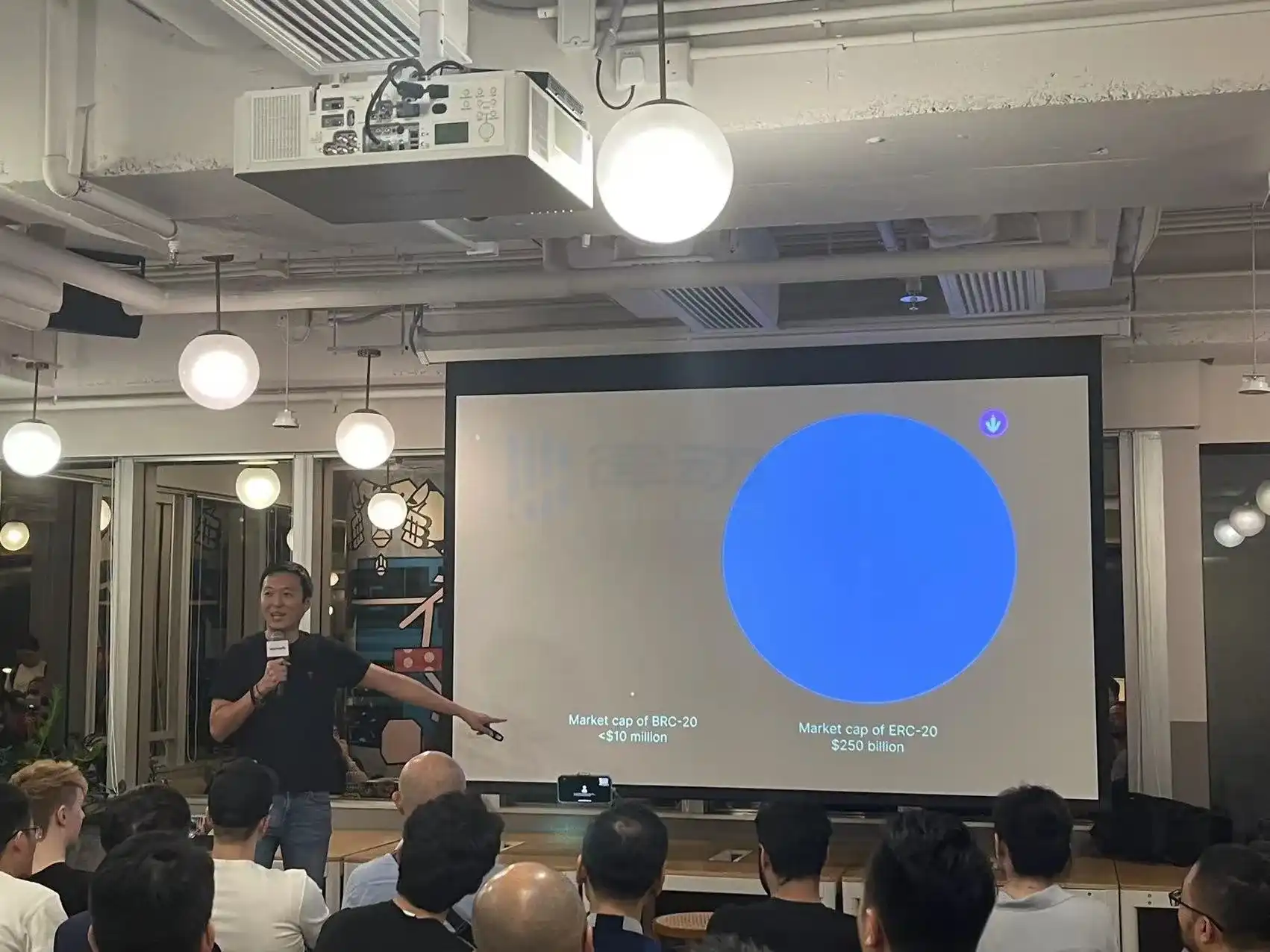
Initially, there was an expectation that the Bitcoin ecosystem would rapidly follow the path Ethereum ecosystem took, with breakthroughs in projects such as stablecoins, Layer 2 solutions, and various other project types. However, the current development outcomes have not met expectations.
But this year is only the second year for the Bitcoin ecosystem. Perhaps next year, the scale of events in Hong Kong and around the world will be even larger. The Bitcoin ecosystem will continue to evolve with more people joining in. It is still too early to make a final judgment. NFTs are a great example. They emerged in 2017, but it was not until 2021 that they surged in popularity; the Bitcoin ecosystem is still in its early stages.
dev: I won't give a score as I tend to be more pessimistic.
I hope to see something like the resurgence of OP_CAT, truly enabling Bitcoin to execute Turing-complete smart contracts, which would then facilitate a significant amount of development on top of it. This is ultimately a matter of consensus. Without a complete consensus, the concept of the Bitcoin ecosystem may be pseudo-demand, and everyone can only use "unconventional methods" to work on Bitcoin.
Nevertheless, I believe that in this bull run, liquidity will definitely overflow into the Bitcoin ecosystem, and we will have fun in this bull run. However, in the long term, I am not optimistic that the Bitcoin mainnet, without changes, will be able to truly develop the Bitcoin ecosystem.
You may also like

Claude enforces "facial recognition for household registration," starting in July, no ID card means no access?

After 18 years, blockchain has finally started to head towards the main channel

SpaceX IPO, Nvidia, and Bitcoin: Why Traders Are Watching More Than Just Crypto in 2026

Paul Graham: How to Make a Billion Dollars

If the AI bubble has already burst, who will truly remain?

Morning Report | Prediction market platforms like Kalshi and Polymarket jointly sue Kentucky over 14.25% trading tax; Bridgewater founder discusses decision-making in the AI era: principled thinking should run parallel to AI, human insight remains irre...

What is the connection between Huang Zheng of Pinduoduo and blockchain?

The other side of Musk's trillion-dollar fortune: 85% cannot be sold
The U.S. government prohibits foreigners from using Fable 5, Anthropic issues a rebuttal

Citibank releases "2030 Asset Tokenization Market Outlook": 6 major trends may create a $8.2 trillion market
The trillion-dollar valuation test: Are the three major super IPOs a celebration for tech stocks or a nightmare for the crypto market?
Morning Report | Digital Asset completes $355 million financing led by a16z Crypto; Meta completes operational separation from Manus

a16z Crypto Partner: Cash flow is the moat

Cryptocurrency market makers collectively seek change as it becomes increasingly difficult to make money

How TradeXYZ, xStocks, and Alpaca break down the SpaceX IPO into three different strategies
$75 billion in risk asset redistribution: How will SpaceX's IPO affect U.S. stocks and Bitcoin?
Why Is BlackRock Investing $5 Billion in the SpaceX IPO?
Morning News | CME Group launches Nasdaq Cryptocurrency Index futures; Asset management giant Janus Henderson strategically invests in Ethena
Claude enforces "facial recognition for household registration," starting in July, no ID card means no access?
After 18 years, blockchain has finally started to head towards the main channel
SpaceX IPO, Nvidia, and Bitcoin: Why Traders Are Watching More Than Just Crypto in 2026
Paul Graham: How to Make a Billion Dollars
If the AI bubble has already burst, who will truly remain?
Morning Report | Prediction market platforms like Kalshi and Polymarket jointly sue Kentucky over 14.25% trading tax; Bridgewater founder discusses decision-making in the AI era: principled thinking should run parallel to AI, human insight remains irre...


