
Bull and Bear Journey: GMT Trichronicle and Path to Nirvana



Original Author: 0x Jane, Crypto Researcher
Introduction
One day in the crypto world equals three years in real life.
During these three years, the entire market went from a bull market in the first half of 2021 to the depths of a bear market, and then turned bullish by the end of 2024. Bitcoin broke through the $100,000 mark, during which countless projects did not survive the bear market, falling, silent, or going to zero in the crypto winter.
Three years is indeed a long time for a crypto project. Only a few projects have been able to survive and create new value and achievements. Can an old tree blossom anew? Can an old coin have a fresh start?
Yes, a present example is SOL (Solana's ecosystem token).
And I believe, the next example might be GMT (FSL's ecosystem token)—from the initial STEPN application, through the blooming of a diverse product line, to the beginning of the governance era; this path is not smooth, but because of past adversity and achievements, it shines even brighter.
This retrospective will delve into GMT's past three years from various dimensions such as historical evolution, user data, airdrop benefits, and collaboration cases, traversing the resilient footsteps of the past three years, helping everyone to objectively understand the GMT project (reaffirming faith).
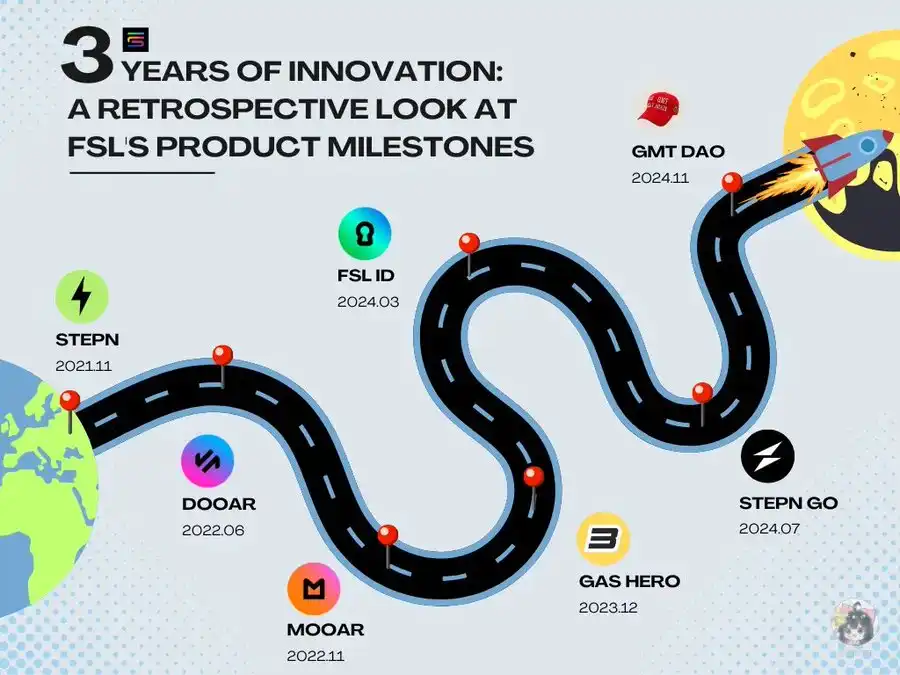
GMT/FSL Product 3-Year Milestone Overview
1. Starting Point and Horizon
Born at the tail end of the bull market: The Rise of STEPN
Starting from the launch of STEPN at the end of 2021, GMT was born as the governance token in a two-token system. After listing on Binance in March 2022, the coin's price skyrocketed, quickly breaking out of its range, becoming a phenomenal crypto project of that year. Later, as the bear market arrived, the project also went into a slump, but a genuine and strong player community endowed the ecosystem with robust resilience, allowing the product to survive.
One often hears people ask: Is STEPN still alive?
Yes, for those who remain committed to the STEPN community, STEPN is no longer just about making money; it's a habit, a pursuit of a healthy lifestyle through exercise.
STEPN has become a benchmark in the Web3 movement.
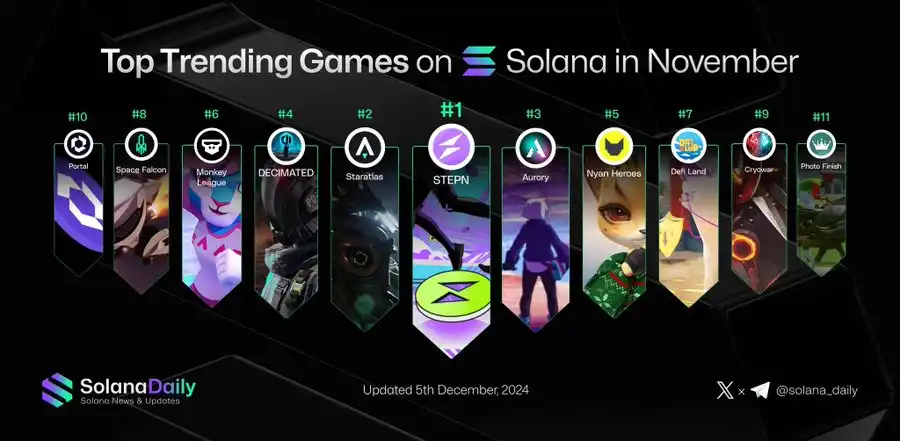
Solana's newly released November trend game project
According to official figures, the total registered users of STEPN OG exceed 5.7 million, with a total distance of over 340 million kilometers.
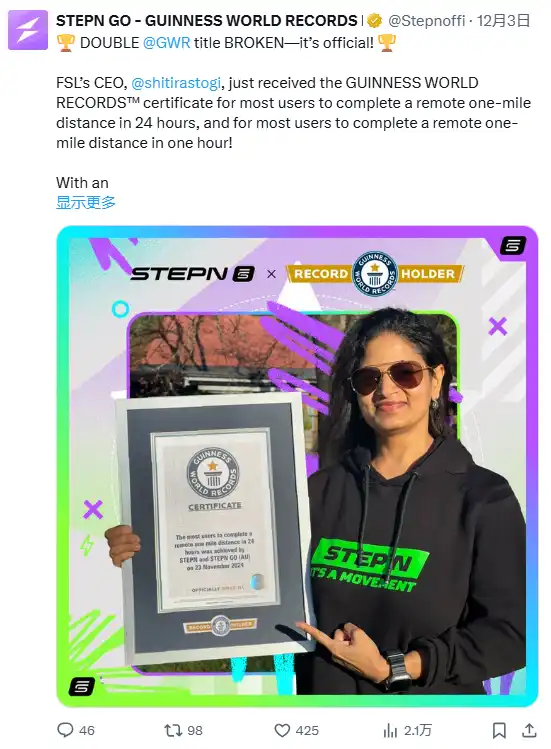
In a recently completed Guinness World Record event, 42,656 participants completed a one-mile run in the real world, setting two world records together!
Product Matrix Expansion: FSL Ecosystem Map Taking Shape
The success of the first-generation running shoes has provided ammunition for its parent company FSL to weather the bear market.
However, during the entire bear market, FSL's two founders did not rest on their laurels but remained active in the community, earnestly creating and refining new products.
There is now a phenomenon-level application for healthy living narratives, STEPN, and the second-generation STEPN GO, currently in beta testing (using a brand-new economic model), Gas Hero (exploring full on-chain asset and community co-creation UGC), CEX product DOOAR, NFT trading/creation/distribution tool MOOAR based on on-chain assets and a lottery tool, a custom interactive NFT game project MORCHI and its MEME token SUT, further connecting these products through FSL ID, and upcoming FSL Game Hub, FSL Pay, and VR metaverse social project MOONBASE, FSL is gradually constructing a complete Web3 ecosystem, with the GMT public chain emerging.

At this point, some people may want to come out and criticize Gas Hero, as the current state of the game has come down to just Gas.
However, but wait! Wasn't Gas Hero once glorious? Whether it's the groundbreaking "surrender and lose half" loss compensation plan, or @Mable_Jiang Baby Mable's unwavering commitment to operations, along with the rebuilding and redevelopment of the new GH 2184 after learning from past GH experiences, it clearly demonstrates the project team's persistence and sincerity.
The road of innovative exploration is full of thorns, where success is merely accidental, and failure is the standard outcome of most experiments. The valuable experiences gained from these experiments, which cost hundreds of millions of real money, will all serve as a foundation. With the improvement of the entire ecosystem and the start of the bull market in crypto, there will be opportunities to nurture new major results after a solid buildup.
Those newborn branches are slowly reaching out to the endless future.
Governance and Transformation: Buyback, Burn, and GMT DAO
In November 2024, the project team repurchased up to 6 billion of all unreleased investor tokens.
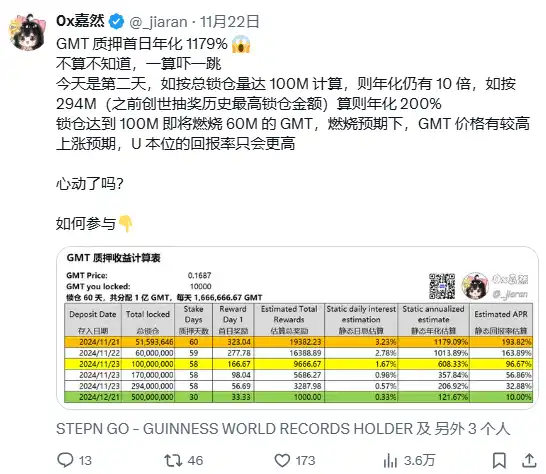
Following this, the GMT DAO was officially established, and the burngmt website was launched. Players can stake their GMT on the website for up to 60 days and share from a pool of up to 1 billion GMT airdrop rewards.
We know that in today's market, people's faces turn pale when discussing VC coins. There are hardly any retail investors willing to touch VC coins because: what was once a peak now faces continuous monthly unlocks leading to constant selling pressure, a continuous decline in token price, and severe lack of confidence among holders and traders.
And the current staking voting opportunity is: if the community locks in 9 billion GMT by January 20, 2025, then all 6 billion GMT repurchased will be permanently burned. Once completed, it will permanently reduce the maximum token supply by 10% and eliminate the largest single source of selling pressure.

This is not just a milestone for the GMT project, but also a transformation.
— From a VC coin with a large amount of supply being dumped to a fully circulating MEME coin, and from an "X to earn" chain game coin to a platform coin with a strong community base and the ability to sustain itself, there is immense room for imagination.
※ For information on how to participate in GMT staking and governance voting, you can refer to my previous article.
II. Measuring Trust in Footsteps: Offline Events and Real Communities
The success of every crypto project cannot be achieved without a strong and vibrant community.
I have read many articles analyzing how Solana has rebuilt and risen from the ashes. Lily Liu, Chair of the Solana Foundation, and many KOLs generally believe that, in addition to technical innovation, Solana's full recovery should be attributed to the strong community vitality. The Solana Breakpoint held in Singapore this year received high praise, with widespread acclaim on social media.
One of the reasons why I maintain additional confidence and expectations for GMT is also due to this factor: FSL also has an incredibly strong and vibrant community foundation. Perhaps many people have not truly realized this yet.
Sponsoring Meaningful Community Initiatives
From supporting a half-year journey of two mixed-race brothers running the Great Wall of China, to backing a charity challenge for U.S. veteran Nels Matson to cross America, and sponsoring marathons in Taipei and Japan, FSL's actions have always conveyed a belief in the most sincere way: wherever you are in the world, as long as you choose to express your love for health and life through footsteps and sweat, they are there cheering you on from behind.
In December 2022, the BBC's coverage made the story of the Great Wall runners known worldwide.
In November 2024, Nels Matson's feat of running across the United States in 3,550 miles in just 72 days also received support from FSL. These were not mere cases of brand endorsement, but rather turning each real-life run into a warm force, inspiring more people to take the first step.
Real-World Resonance: Offline Events
Some may wonder: Does STEPN still have real-world players? Data can provide evidence, but nothing is more convincing than offline gatherings.
Each year, there are numerous spontaneous offline player events within the FSL ecosystem, with an incomplete count showing events held in 2024:
August Tokyo offline event, 100+ attendees
August two Taipei offline events, averaging 100 attendees per event
September Singapore offline event, 70+ attendees
November Malaysia offline event, 40+ attendees
November Vietnam offline event, 100+ attendees
November Japan offline event, 100+ attendees
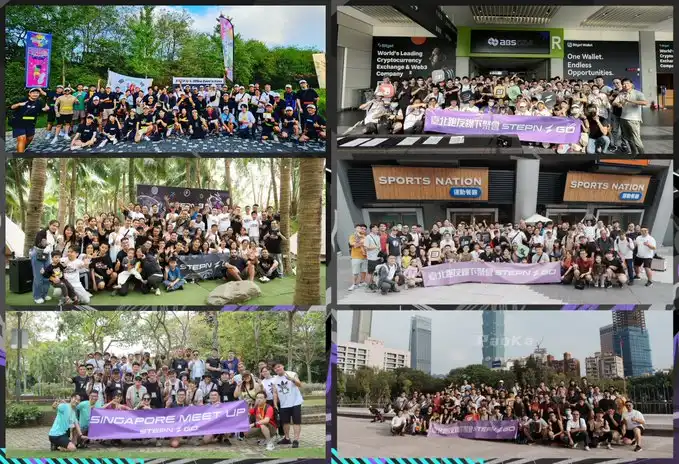
Snapshot of some offline events
In September, a special offline event took place in South Korea—two young individuals who had bonded during past meetups celebrated their wedding, with co-founder Yawn recording a VCR to send blessings to the newlyweds.
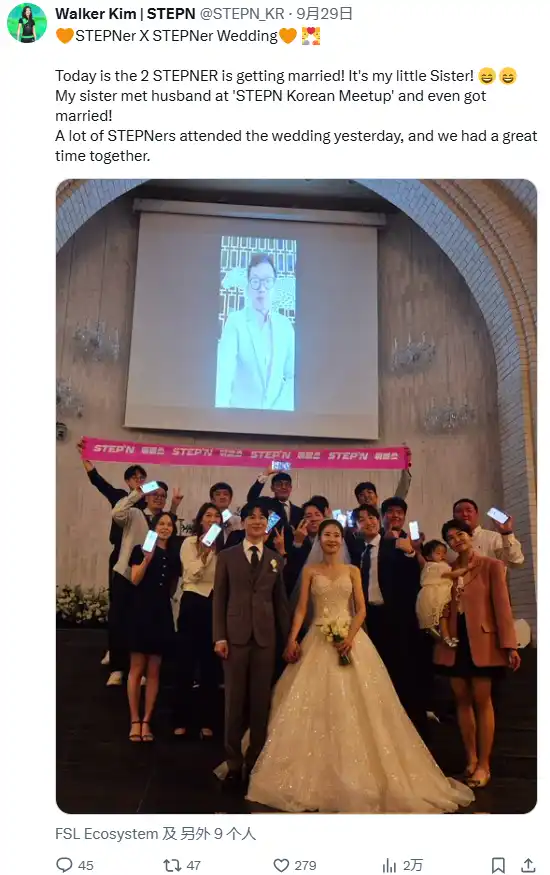
※ Official offline events page
These stories are like stars in the night sky, telling us that beyond the screens, beyond the data, there are many real people in this community running, laughing, meeting, and embracing each other.
Those moments of offline encounters are like clusters of bonfires lit in the harsh winter, allowing people to warm each other even in the long night.
Listening and Responding: Enacting "User Co-Creation" through Action
Some projects only claim to "listen to the community's voice," but you seldom see them taking actual action, while some teams truly treat user feedback as a guiding light.
In the world of crypto, it is not common to see founders who have made enough money stepping up to the forefront of the community. However, the FSL team — including co-founders @yawn_rong, @Jerry10240, and CMO @Mable_Jiang — are consistently on the front lines, listening to user feedback and answering questions in WeChat groups and Discord. Their interaction with users is not just a formality; it genuinely helps solve problems, iterate on products, and translate user needs into forward progress.
In this regard, they coincidentally align with industry leaders like Vitalik (Ethereum founder), CZ (Binance founder CZ), and He Yi. The rapid rise of Bitget is also inseparable from the efforts of Xie Jiayin, the top-notch customer service representative. Teams that can truly persevere in bear markets and steadily advance in bull markets all understand the art of dialogue and listening. They let users know that in this still partially untamed Web3 territory, their voices are not echoes in an empty valley but the foundation of the future.
These genuine and meaningful sponsorships, offline events, continuous listening, and prompt responses not only humanize the digital world but also instill confidence in GMT's future. What I see here is not only products and tokens but also a group of flesh-and-blood, passionate individuals, and a community that stands steadfast together in the storms. Perhaps this is the most valuable asset in the Web3 world — a community power that is enduring, sincere, and reliable.
III. Airdrops and Incentives: The Colder the Winter, the More Blooms the Spring
During the long crypto winter, some projects only keep repeating "trust us" without taking tangible actions, while others reward their early believers with real value, providing warmth to the "faithful" who stood by them from the start. FSL belongs to the latter.
Rewarding Loyal Followers: Fulfilling Promises from Start to Finish
Over the past three years, for users holding the Genesis Sneaker and loyal long-term players who have been consistently active, FSL has always generously airdropped rewards, serving as a lifeline that traverses the bear market. Airdrops are indeed a powerful way to recharge faith (second only to pumping), with early Genesis holders accumulating returns that are at least 20 times their initial investment.
During April's airdrop event this year, FSL made an official announcement of a long-term commitment: the Trailblazer Reward Program will become regular and ongoing.
As shown in my previous tweet, as well as in the historical airdrop chart compiled by Crystal Sister @Crystal_Yingw, it intuitively illustrates FSL's generous trajectory over time. Behind each airdrop is a reward for trust and a renewed commitment to the future.
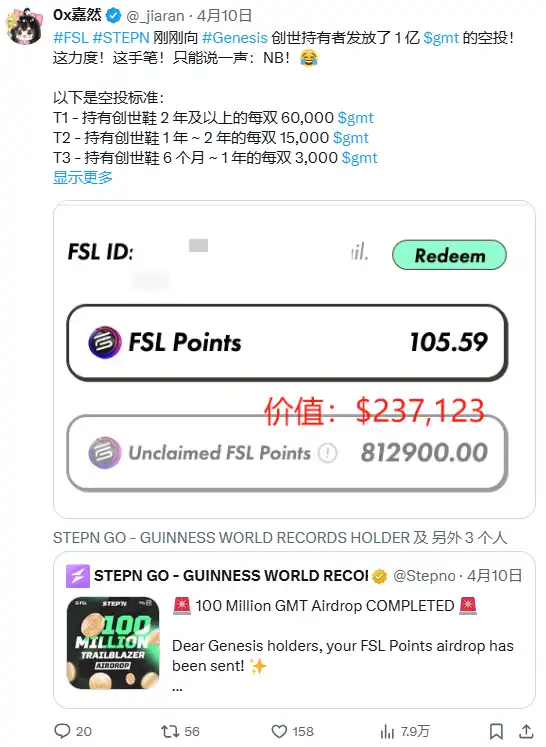
Here, I will take the liberty to quote Crystal Sister's @Crystal_Yingw compiled historical airdrop chart.

FSL Points Consumption Rebate: Visible Ecosystem Feedback
After the launch of FSL ID, FSL further institutionalized the concept of "consumption brings rewards." Users can earn FSL Points at a corresponding rate for any consumption within the FSL ecosystem and can exchange them for GMT at a 1:1 ratio anytime.
Governance Token Linked to Incentives
With the establishment of the GMT DAO, users are no longer just bystanders but also decision-makers driving the ecosystem forward. Governance voting has set up a 100 million GMT incentive pool, creating a clever link—engage in decision-making, voice your opinions in governance, and you will receive additional rewards. In this bottom-up co-creation process, the significance of airdrops and incentives has already transcended mere material rewards, becoming a value resonance between users and the project. It is for this reason that every user participating in voting and contributing ideas is 'betting' on their own future while also shaping the long-term value of GMT.
Just this week, FSL also launched its first brand collaboration with Adidas, offering 1200 pairs of limited edition physical shoes for free shipping to the community.

The tangible community feedback and persistence have led me to believe that on this destined and unknown path, FSL is far from just a verbal commitment companion, but is willing to accompany everyone with real resources and motivation.
Four, Cross-Border Collaboration and International Influence
In the Web3 industry, simple technology is not enough to drive a long journey. Those who truly have the opportunity to break through the circle not only need a solid underlying logic but also need cross-industry resonance that penetrates industry barriers. And FSL clearly understands this.
When you click on FSL's Partnerships page, the first thing that catches your eye is a series of well-known international brands and heavyweight IPs: from Asics to Line, from the classic sci-fi masterpiece "Ghost in the Shell" to Apple Pay, and from Casio, Adidas, Snoop Dogg, Docomo... This dazzling list of partners is not only a trust pass certificate to the market but also the best proof of FSL's deep penetration into diverse cultures, industries, and scenarios.

Especially in the deep collaboration with the global top sports brand Adidas, multiple cross-border interactions have made FSL's mark no longer limited to a particular vertical field but integrated into a broader sports, fashion, and lifestyle landscape. This strong alliance has not only won FSL a more prominent reputation on the international stage but also laid a solid foundation for GMT's long-term value.
In this network intertwined with resources and capital, GMT not only represents a governance token but also symbolizes a super ecosystem that can interact and create together with major forces in various industries worldwide. Looking to the future, we have reason to believe that a solid cross-border foundation and a global brand aura will continue to provide a steady stream of wind power for GMT's long journey.
Five, Looking Back and Looking Ahead: Resolutely Moving Forward in Tempering
Drawing Confidence from Historical Achievements
Looking back over the past three years, GMT has been able to stand tall in the long bear market. Technological innovation, user operations, ecosystem expansion, and partnership upgrades have made the project foundation even more solid. The resilience nurtured in the cold wind is the very foundation of today's confidence.
Many people have asked me, "Why have you been able to persist in the running shoe industry for so long?" — Because of belief, because of all the people who have weathered the storms with me.
Looking Forward: Governance and Infinite Possibilities
The establishment of the GMT DAO marks a new beginning.
With scarcer tokens, a broader ecosystem, and deeper community involvement, GMT may lead towards a broader horizon. I believe that in such a more inclusive, more open governance model, $GMT may have infinite possibilities.
VI. Conclusion
In the rapidly changing Web3 world, three years are enough to sift out the real gold.
I am starting to believe that in this journey through the bull and bear cycles, GMT may be the second project after SOL to write a story of "what doesn’t kill me makes me stronger."
The road ahead is still long, but the light of hope is already shining ahead.
※ Disclaimer: This article represents only personal opinions and research findings, and does not constitute any investment, financial, or legal advice. Before making any decisions, be sure to evaluate the risks DYOR
This article is a contributed submission and does not represent the views of BlockBeats
You may also like

On the day of SpaceX's IPO, the first real test of the three perpetual mechanisms

Claude enforces "facial recognition for household registration," starting in July, no ID card means no access?

After 18 years, blockchain has finally started to head towards the main channel

SpaceX IPO, Nvidia, and Bitcoin: Why Traders Are Watching More Than Just Crypto in 2026

Paul Graham: How to Make a Billion Dollars

If the AI bubble has already burst, who will truly remain?

Morning Report | Prediction market platforms like Kalshi and Polymarket jointly sue Kentucky over 14.25% trading tax; Bridgewater founder discusses decision-making in the AI era: principled thinking should run parallel to AI, human insight remains irre...

What is the connection between Huang Zheng of Pinduoduo and blockchain?

The other side of Musk's trillion-dollar fortune: 85% cannot be sold
The U.S. government prohibits foreigners from using Fable 5, Anthropic issues a rebuttal

Citibank releases "2030 Asset Tokenization Market Outlook": 6 major trends may create a $8.2 trillion market
The trillion-dollar valuation test: Are the three major super IPOs a celebration for tech stocks or a nightmare for the crypto market?
Morning Report | Digital Asset completes $355 million financing led by a16z Crypto; Meta completes operational separation from Manus

a16z Crypto Partner: Cash flow is the moat

Cryptocurrency market makers collectively seek change as it becomes increasingly difficult to make money

How TradeXYZ, xStocks, and Alpaca break down the SpaceX IPO into three different strategies
$75 billion in risk asset redistribution: How will SpaceX's IPO affect U.S. stocks and Bitcoin?
Why Is BlackRock Investing $5 Billion in the SpaceX IPO?
On the day of SpaceX's IPO, the first real test of the three perpetual mechanisms
Claude enforces "facial recognition for household registration," starting in July, no ID card means no access?
After 18 years, blockchain has finally started to head towards the main channel
SpaceX IPO, Nvidia, and Bitcoin: Why Traders Are Watching More Than Just Crypto in 2026
Paul Graham: How to Make a Billion Dollars
If the AI bubble has already burst, who will truly remain?


