Cyber Capital Founder: Ripple is Fully Centralized, Please Remain Vigilant




Original Author: Justin Bons, Founder of Cyber Capital
Original Translator: Luffy, Foresight News
Ripple (XRP) is a centralized and permissioned network, contrary to statements made by its executives. XRP misleads investors by falsely claiming its decentralized nature when, in fact, the network is fully controlled by the foundation.
The XRP consensus is based on a Unique Node List (UNL), where trusted nodes are determined by a centralized entity (including the foundation). The XRP consensus is not based on PoS or PoW but on PoA (Proof of Authority), yet they claim to be more decentralized than Bitcoin and Ethereum...
All of this is supported by Ripple's own documentation, and it's hard to find any researchers outside of XRP who would classify this design as "decentralized"; however, they are deceiving the public.
However, users can modify their UNL and choose whom to trust. The language used here is very subtle. A truly decentralized cryptocurrency is "trustless" because it requires no "trust" at all, and choosing whom to trust is entirely different from being trustless!
XRP is not trustless at all, and what's worse is: if your UNL does not overlap sufficiently with the rest of the network, you are at risk. According to Ripple's documentation: a 90% UNL overlap is required to prevent forks.
This means that in practice, you need direct permission from the XRP foundation to participate in the consensus, which is almost centralization in terms of blockchain design... Let's take a deeper look at these UNLs below.
We have established that the UNL is the trusted third party chosen by the XRP foundation, and as we delve deeper into these UNLs, this point is further confirmed: for a long time, there was only one UNL, the dUNL managed by the XRP foundation.
However, this list is not static but dynamic. The XRP foundation can, in a completely centralized manner, change the list of validators without any notice, kicking out anyone who violates authority.
Over time, now there are two UNLs, namely the dUNL and XRPLF, both directly funded by the XRP foundation. This adds another layer of de facto control over the network; let me explain:
Blockchain allows mutually untrusting parties to coordinate, all thanks to the underlying incentive mechanism (PoS or PoW). However, XRP lacks block rewards and incentives; it is purely based on trust. So, how do different Unique Node Lists (UNLs) coordinate with each other?
XRP's premise is based on the idea that different parties can spontaneously organize around a new UNL without the need for the aforementioned incentive mechanism. This notion is clearly fallacious because this is precisely the problem blockchain aims to solve: a new UNL cannot achieve coordination.
If a new UNL cannot coordinate, it means the foundation holds de facto control. Control over validators equals control over the network, resembling a permissioned blockchain.
In all other blockchains, you cannot choose validators as they are trustless and permissionless. This is why validators can be anonymous—secured by cryptoeconomic game theory, not trust. This is the fundamental difference of XRP.
XRP is fundamentally not a cryptocurrency. Since it is neither PoS nor PoW, it is a PoA. What else could it be? A consensus algorithm requires a validation mechanism, with trust as the system’s foundation, thus: XRP is a PoA!
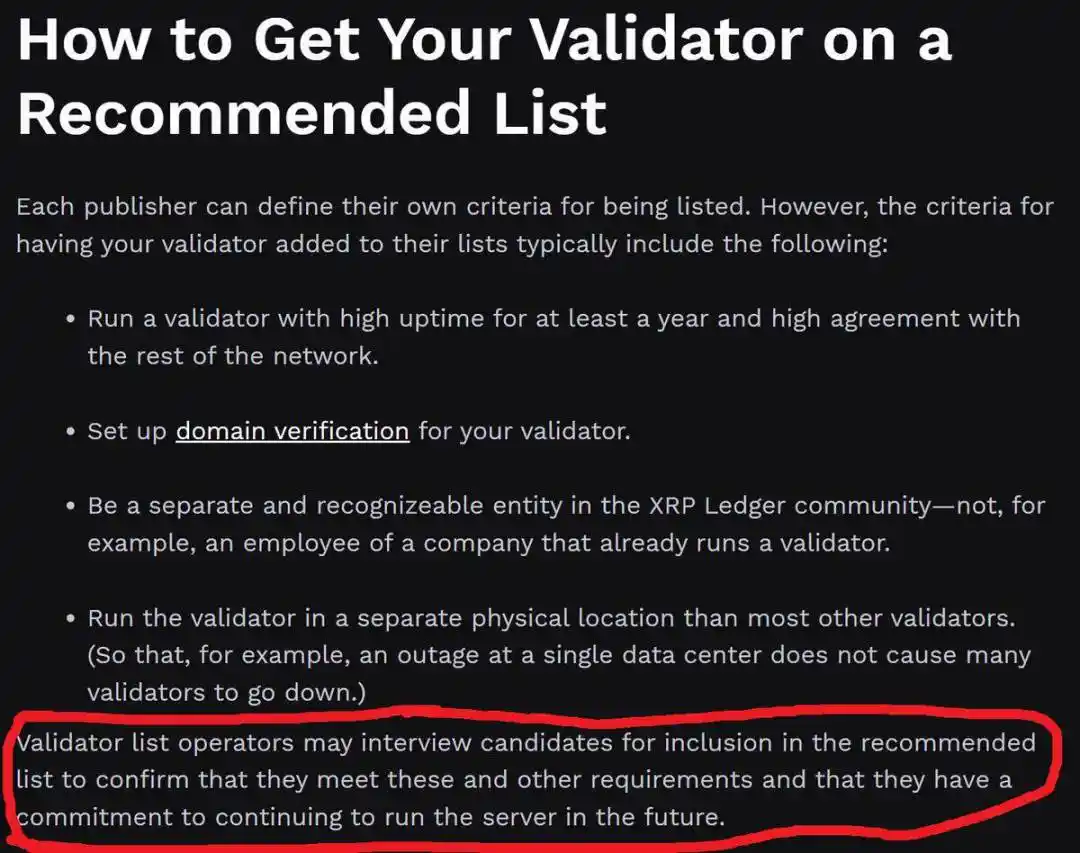
A PoA system always has a central authority to appoint validators. So, what about the fact that there are currently two "official" UNLs? This fact contradicts my assertion that different UNLs cannot coordinate. This is where things truly start to get crazy:
Upon careful inspection, I discovered that all UNLs are, in fact, identical, using the same set of validators, further proving that the foundation effectively controls the XRP network!
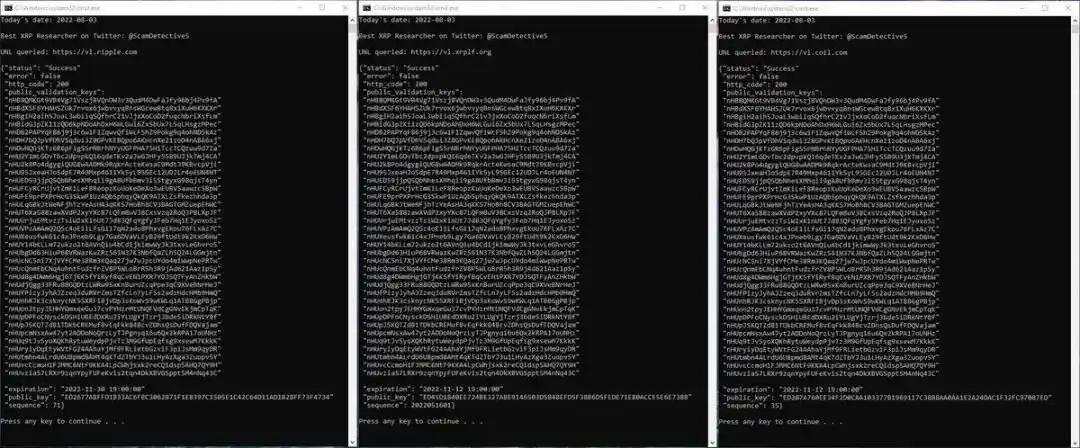
This screenshot is from 2 years ago, but I confirm the situation remains the same today, demonstrating that new UNLs cannot coordinate. Thus, the foundation's list becomes the de facto list since all UNLs must comply, or there is a risk of fork.
This also allows the foundation to conduct audits if compelled, given their high level of control. This operates drastically differently from cryptocurrencies and explains why halting the network only requires 20% of validators...
Running trusted validators also has no incentives. Unlike PoW or PoS, where the cost of attack reflects the block reward to miners/stakers, the decentralized standard heavily relies on block rewards. On XRP, this decentralization measure stands at zero.
I have been researching XRP since the early days, and I vividly remember when people recognized the trade-off of decentralization. As the community and leadership's stance became more extreme, this situation gradually changed. I say this not to disparage investors but to empower them.
Help break the XRP echo chamber and stop being someone else's liquidity out. XRP's pre-mining rate of 99.8% makes it one of the most unfairly distributed cryptocurrencies in history. As no new XRP was created, all newly circulating XRP was purchased from the founders.
I have always been intrigued by the early discussions about Ripple's decentralization, pretending that XRP is permissionless is not the right answer. The real solution is to use PoS to replace the UNL list, transforming XRP into a more traditionally decentralized blockchain.
They could also openly admit that facts are facts, and I will not dispute that. However, using lies to attract ignorant retail investors is wrong. This is where we as an industry need to draw the line and self-regulate!
XRP may currently be able to bribe or deceive the SEC, but they cannot deceive us, the cryptocurrency natives. Regardless of how complex and in-depth the rebuttals may be, it will not change some simple facts: XRP is now fully permissioned and centralized.
If you truly care about XRP, take it seriously. Because within this critical post exists a path that can help XRP succeed: owning up to its centralization or transitioning to decentralization. The truth sets us free, either walk away from XRP or exert pressure for change; nothing is irredeemable.
You may also like

Champion's Final Bow: FC Barcelona vs Real Betis – Celebrate the Title with a Home Finale

Best Oil Trading Platform for Crypto Users in 2026

5 Futures Trading Strategies Smart Traders Use to Cut Crypto Fees and Boost Futures Returns

What Is TradFi? How Crypto Traders Can Now Access Crude Oil, Gold, and Global Markets

How WEEX Bridges Crypto and Football: A Deep Look at the LALIGA Partnership Inside the WEEX App
WEEX is not just a LALIGA sponsor. It’s a true partner. From iPhone Dynamic Island to LALIGA-themed app icons and smart posters, see how WEEX brings football passion into every trade — and builds a real bridge between crypto and sports.

FC Barcelona vs Real Madrid Preview: El Clásico – Can Barça Clinch the Title at Spotify Camp Nou?
FC Barcelona vs Real Madrid El Clásico match preview for May 11, 2026. Barça need just 1 point to win LALIGA. Can Madrid delay the trophy? Full preview inside.

At the Stripe conference, I saw the future of the AI economy

Miners welcome a new life

Seven Important Judgments by Claude Code's Founder at the Sequoia Conference

The payment moment of AI agents: Who will become the Stripe of the machine economy?

Morning Report | MoonPay acquires Solana's execution layer DFlow; Strategy releases Q1 financial report; Manta Network announces the termination of Manta staking program

Rented Tracks: What is this wave of stablecoin FX hot money really paying for?

Dialogue Velocity Eric: What is the stablecoin track that the CFO really wants?

Strategy should have said that selling coins is not ruled out

How MegaETH Achieved a TVL of 700m Within a Week of TGE? Analyzing the Packaging Strategy

Futures Trading Hours: Trade Cryptocurrency 24/7 and Earn Back Up to 45% in Trading Fees
Learn futures trading hours and the best time to trade crypto futures. Discover 24/7 market insights, peak trading sessions, and how to earn back up to 45% in fees.
Why is a16z Crypto raising another $2.2 billion to heavily invest in Web3?
Polymarket Underlying Algorithm Explained
Champion's Final Bow: FC Barcelona vs Real Betis – Celebrate the Title with a Home Finale
Best Oil Trading Platform for Crypto Users in 2026
5 Futures Trading Strategies Smart Traders Use to Cut Crypto Fees and Boost Futures Returns
What Is TradFi? How Crypto Traders Can Now Access Crude Oil, Gold, and Global Markets
How WEEX Bridges Crypto and Football: A Deep Look at the LALIGA Partnership Inside the WEEX App
WEEX is not just a LALIGA sponsor. It’s a true partner. From iPhone Dynamic Island to LALIGA-themed app icons and smart posters, see how WEEX brings football passion into every trade — and builds a real bridge between crypto and sports.
FC Barcelona vs Real Madrid Preview: El Clásico – Can Barça Clinch the Title at Spotify Camp Nou?
FC Barcelona vs Real Madrid El Clásico match preview for May 11, 2026. Barça need just 1 point to win LALIGA. Can Madrid delay the trophy? Full preview inside.

Contents
Popular coins
Latest Crypto News