
 Buy Crypto
- Markets
 Futures
- Spot
- Copy Trade
- Earn
- More
Esteemed data website DappRadar has announced its shutdown, marking another bittersweet moment in time.

Original Article Title: "DappRadar, Another Tear of the Era"
Original Article Author: Eric, Foresight News
On the evening of November 17, 2025, DappRadar, which has been with the industry for nearly 8 years, announced that it would gradually shut down its service and no longer continue to track blockchain and DApp data.
It is said that "a grain of sand of the era falling on an individual is a mountain," which is a perfect description of DappRadar. Born perhaps in the most turbulent era of the "blockchain is dead" narrative, it accompanied Web3 from its stumbling infancy to its spoon dance year, but ultimately could not withstand the pains of regime change. The exit of products like this, imprinted with the mark of the era, reminds me of what the Nokia CEO said at the end of the announcement of its acquisition by Microsoft 11 years ago:
"We didn't do anything wrong, but somehow, we lost."
Those Years When We Used Data Websites Together
Many newcomers to the Web3 industry may not be aware that DappRadar was once a very important and authoritative source of data. In addition to references from sources such as CoinDesk and Chinese Web3 media, including mainstream Western media such as Bloomberg, Forbes, and the BBC have also cited DappRadar data many times.
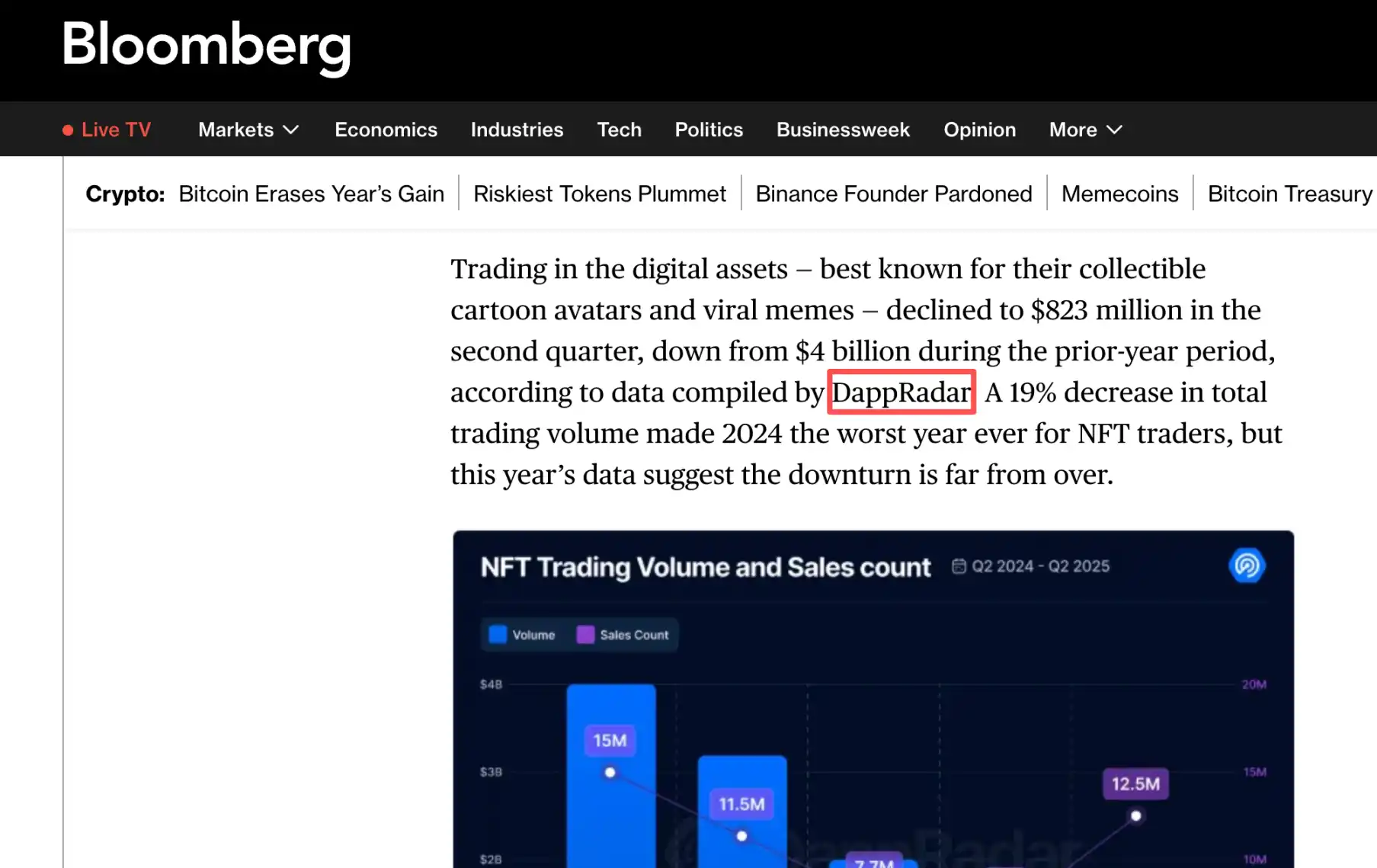
The reason it is called authoritative is that before the rise of professional data websites (such as Nansen, Arkham, DefiLlama, etc.) and professional Web3 marketing tools (such as Cyber, Kaito, etc.), DappRadar was almost the gateway website that all DApps had to be listed on in the early days. The completeness of the projects made its data incomparable in terms of completeness and credibility, almost becoming the only and best way at that time to quickly understand the basic information of new projects.
DappRadar's co-founder, Skirmantas Januskas, is from Lithuania. Unlike many industry giants who hold multiple positions, he has been solely focused on DappRadar from February 2018 to the present. Prior to that, he briefly worked as a software developer at NFQ. Another co-founder, Dunica Dragos, previously worked in operations at the American gaming giant EA in his early years and, like Skirmantas, has been single-mindedly focused on DappRadar since its founding.
DappRadar has received two rounds of investment. In September 2019, DappRadar secured a $2.23 million investment in a seed round from Naspers, Blockchain Ventures, and Angel Invest Berlin. Naspers is the South African multinational media group that famously acquired a 46.5% stake in Tencent for $32 million in 2001 from Li Ka-shing, IDG, and others. Subsequently, in May 2021, DappRadar received a $4.94 million investment in a Series A round from Blockchain.com Ventures, Prosus Ventures, and NordicNinja VC.
The author found a record of an interview with Skirmantas Januskas after completing the fundraising in 2019, at a time when Web3 was at its darkest moment. Despite this, Skirmantas was full of confidence in the industry, believing that as long as the issues of user experience and finding user needs were addressed, "centralized applications would become a thing of the past."
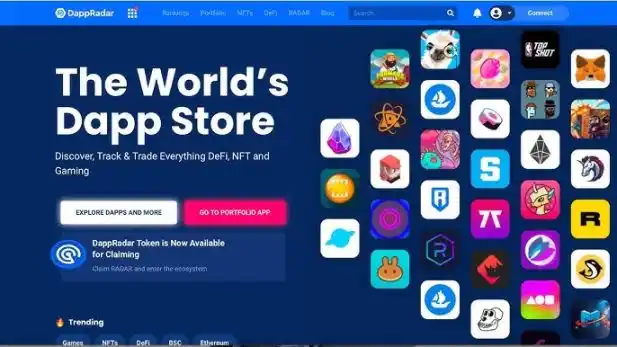
In 2019, this passionate and impulsive visionary expressed his views on DeFi, gaming, and other tracks, all of which eventually saw explosive growth in 2021. While most of the DeFi data pie was snatched by DefiLlama, DappRadar excelled in comprehensive data and deep exploration of emerging concepts such as NFTs, GameFi, and the metaverse, allowing it to have a user base in the millions at its peak. Even for small projects that some Twitter accounts can't find, you can see the DAU fluctuating between 0 and 3 on DappRadar.
Professionalism Became the Original Sin
If one must summarize the biggest reason for DappRadar's failure, it can only be attributed to being overly crypto-native and neglecting the importance of commercialization.
Today, when you open DappRadar's homepage, you will notice that besides the categories they have consistently showcased from the beginning such as gaming, DeFi, NFTs, gambling, and the newly added AI, RWA, and social, you won't see trending topics like memes. So why call Skirmantas an impulsive visionary when even in a track like NFT, they continue to persist in releasing a detailed quarterly report and tracking every nook and cranny airdrop but have almost completely missed out on all the hot trends.
DappRadar has been arguably the only platform in the past two years that has covered all Web3 long-tail sectors and projects, but the issue is that it seems to only focus on the tail.
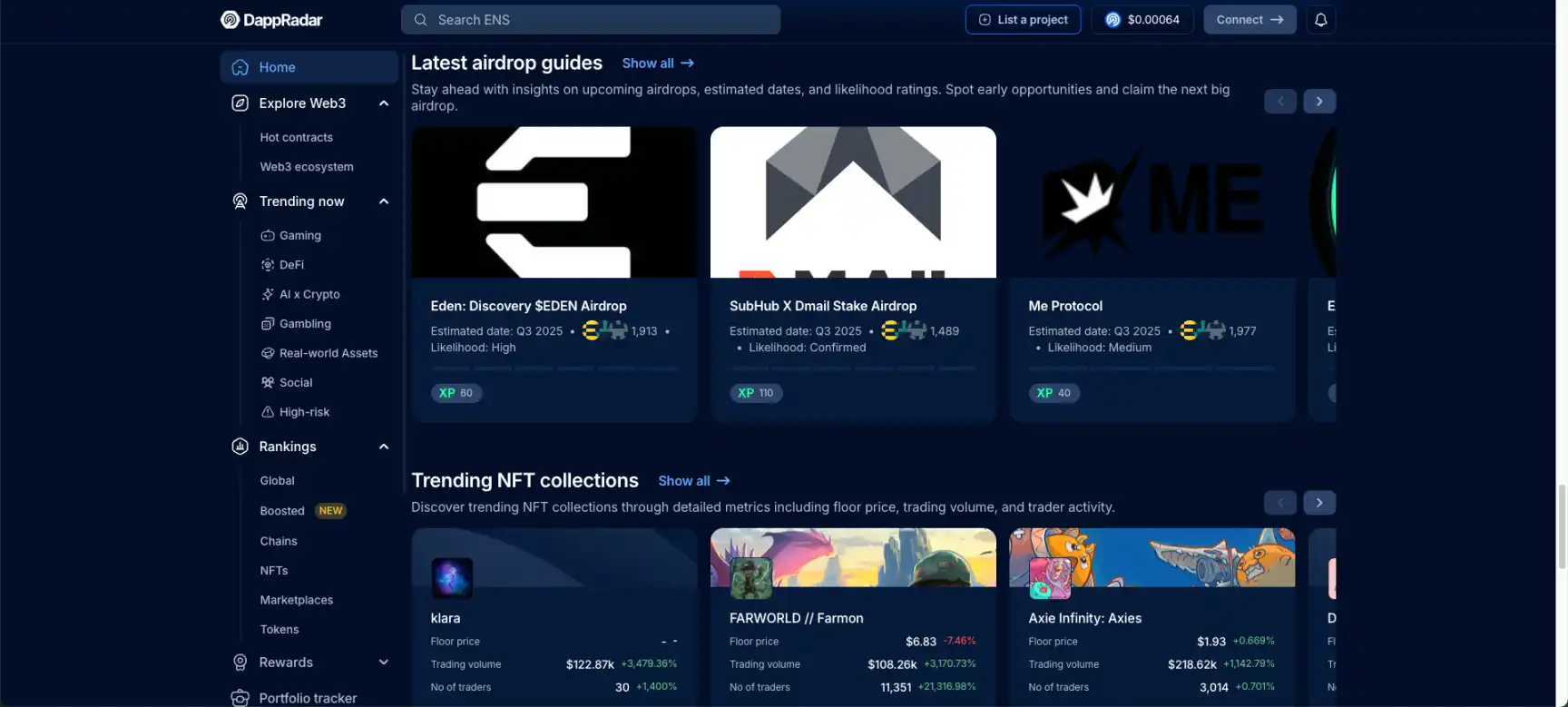
This kind of nitpicking expertise can indeed provide high-quality material for Bloomberg and Forbes, but it lacks any commercial value. The RADAR token launched after the 2021 funding round seems to have not seen a better use case other than subscribing to Pro services, staking, and voting, and it has also blocked the most premium subscription revenue source.
What was initially built on a comprehensive image has gradually turned into a shackle. Its DeFi professionalism is no match for DefiLlama, its token information seems inferior to CMC, its research depth does not reach the level of Bankless, and the only thing it excels at, the NFT sector, has become stagnant. However, I believe that DappRadar itself has long been aware of these issues, so it has also accelerated its commercialization, including providing high-quality data through an API and offering advertising space.
After the 2021 funding round, DappRadar has also been supported for 4 years. Apart from the funding itself, it has certainly generated some revenue through traffic monetization, but obviously, this revenue falls short compared to the cost needed to provide massive data for exponential growth. Moreover, since 2023, although the market has been bullish, there are not many projects with truly sufficient budgets. The limited budget has been mostly spent on KOLs, exchanges, and some emerging platforms, leaving DappRadar, which has been left high and dry, increasingly strapped for cash.
As mentioned earlier, its coverage is too long-tail, and tail-end projects may have no way of knowing what kind of user profile would refer to DappRadar's information under what circumstances. In the wilderness era, DappRadar provided a channel to understand new projects, but after the dust settled, the channel to understand the few "premium projects" has become more widespread, and the relics of the past are no longer the only best choice.
Compared to the concise website of two to three years ago, today's DappRadar is all-encompassing but seems cluttered, which is the result of excessive effort in commercialization, and it is the epitome of the "exhaust all possibilities" in the farewell letter. For DappRadar, without ongoing funding or excessive funding to spend, it needs to show on its website the balance between content curation and ad display. DappRadar's excessive insistence on professionalism or "orthodoxy," and its later realization of the mistake of content and ad stacking, have laid bare its operational shortcomings.
In addition to its own shortcomings, the Web3 data and information platform itself is a challenging business. Today, multi-chain data explosion, rising costs of indexing and servers, and a market demand for high-quality data coupled with a lack of matching payment capability make it difficult. Without other sources of revenue, relying solely on advertising and API sales will inevitably face competition. Platforms with low monetization capabilities, in order to survive, increase ad density and compromise user experience, leading to a seemingly inevitable decline.
The seven-year trajectory of DappRadar encapsulates the common commercialization challenges of such projects: high value, low payment, cost rigidity, and rapid narrative iteration. Its shutdown leaves a clear lesson for newcomers: if a business model cannot be closed-loop from day one, even the most authoritative data cannot prevent "death by hemorrhage."
You may also like

Cyber Taoist Fortune Teller: Fake Taoist, AI Fortune Telling, and Northeastern Metaphysics History

Bloomberg: Stablecoin Payments Emerge as Crypto VC's Newest Favorite Thing
BeatSwap is evolving towards a full-stack Web3 infrastructure, covering the entire lifecycle of IP rights.
BeatSwap, a global Web3 Intellectual Property (IP) infrastructure project, is attempting to overcome the current fragmentation limitations of the Web3 ecosystem, building a full-stack system that covers the entire lifecycle of IP rights.
Currently, most Web3 projects are still in the stage of functional fragmentation, often focusing only on a single aspect, such as IP asset tokenization, transaction functionality, or a simple incentive model. This structural dispersion has become a key bottleneck hindering the industry's scale application.
BeatSwap's approach is more integrated, integrating multiple core modules into the same system, including:
· IP authentication and on-chain registration
· Authorization-based revenue sharing mechanism
· User-engagement-driven incentive system
· Transaction and liquidity infrastructure
Through the above integration, the platform builds an end-to-end closed-loop path, allowing IP rights to complete a full cycle of "creation, use, and monetization" within the same ecosystem.
BeatSwap is not limited to existing crypto users but is attempting to take the global music industry as a starting point, actively creating new market demand. Its core strategies include:
Exploring and incubating music creators (Artist discovery)
Building a fan community
Igniting IP-centric content consumption demand
The current global music industry is valued at around $260 billion, with over 2 billion digital music users. This means that the potential market corresponding to the tokenization and financialization of IP far exceeds the traditional crypto user base.
In this context, BeatSwap positions itself at the intersection of "real-world content demand" and "on-chain infrastructure," attempting to bridge the structural gap between content production and financial flow.
BeatSwap's upcoming core product "Space" is scheduled to launch in the second quarter of 2026. This product is defined as the SocialFi layer in the ecosystem, aiming to directly connect creators with users and achieve deep integration with other platform modules.
Key designs include:
A fan-centric interactive mechanism
Exposure and distribution logic based on $BTX staking
User paths connected to DeFi and liquidity structures
Thus, a complete user behavior loop is formed within the platform: Discovery → Participation → Consumption → Rewards → Trading
$BTX is designed to be a core utility asset within the ecosystem, rather than just a simple incentive token, with its value directly tied to platform activity and IP use cases.
Main features include:
· Yield distribution based on on-chain authorized actions
· Value reflection based on IP usage and user engagement dynamics
· Support for staking and DeFi participation mechanisms
· Value growth driven by ecosystem expansion
With the increased frequency of IP use, the utility and value support of $BTX will enhance simultaneously, helping alleviate the "disconnect between value and utility" issue present in traditional Web3 token models to some extent.
Currently, $BTX has been listed on several mainstream exchanges, including:
Binance Alpha
Gate
MEXC
OKX Boost
As the launch of "Space" approaches, BeatSwap is actively pursuing more exchange listings to further enhance liquidity and global accessibility, laying a foundation for future market expansion.
BeatSwap's goal is no longer limited to the traditional Web3 narrative but aims to target over 2 billion digital music users and a trillion KRW-scale content market.
By integrating content creators, users, capital, and liquidity into a blockchain framework centered around IP rights, BeatSwap is striving to build a next-generation infrastructure focused on "IP tokenization."
BeatSwap integrates IP authentication, authorization distribution, incentive mechanism, transaction system, and market construction to establish a unified structure that bridges the full lifecycle path of IP rights.
With the launch of the Q2 2026 "Space," the project is expected to become a key infrastructure connecting content and finance in the IP-RWA (Real World Assets) track.

Mag 7 Evaporates $2 Trillion | Rewire News Morning Edition

Losing $19K per Coin Mined, Bitcoin Mining Firms Collective AI Defection

Morning Report | Tom Lee predicts that the cryptocurrency winter will end in April; xStocks introduces a new on-chain private equity fund; Sui mainnet upgraded to V1.68.1

Polymarket rules have changed, how should airdrop participants respond?

Crypto ETF Weekly | Last week, the net outflow of Bitcoin spot ETFs in the U.S. was $296 million; the net outflow of Ethereum spot ETFs in the U.S. was $206 million

This Week's Key News Preview | The U.S. Releases March Non-Farm Payroll Data; Polymarket Expands Fee Structure

Slow Down, That's the Answer to the Age of the Agent

From Cash to Cryptocurrency: Moving Towards a Unified Regulatory Path for Illegal Payments
Who will own the most Bitcoin in 2026

A private feud lasting 10 years, if not for OpenAI's "hypocrisy," would not have led to the world's strongest AI company, Anthropic

"Crypto Tsar" steps down: 130 days of political performance come to an end, how much of Trump's crypto promise remains?

From Utopian Narratives to Financial Infrastructure: The "Disenchantment" and Shift of Crypto VC
A decade-long personal feud, if not for OpenAI's "hypocrisy," there would be no globally leading AI company Anthropic

a16z: The True Meaning of Strong Chain Quality, Block Space Should Not Be Monopolized
a16z: The True Meaning of Strong Chain Quality, Block Space Should Not Be Monopolized
Cyber Taoist Fortune Teller: Fake Taoist, AI Fortune Telling, and Northeastern Metaphysics History
Bloomberg: Stablecoin Payments Emerge as Crypto VC's Newest Favorite Thing
BeatSwap is evolving towards a full-stack Web3 infrastructure, covering the entire lifecycle of IP rights.
BeatSwap, a global Web3 Intellectual Property (IP) infrastructure project, is attempting to overcome the current fragmentation limitations of the Web3 ecosystem, building a full-stack system that covers the entire lifecycle of IP rights.
Currently, most Web3 projects are still in the stage of functional fragmentation, often focusing only on a single aspect, such as IP asset tokenization, transaction functionality, or a simple incentive model. This structural dispersion has become a key bottleneck hindering the industry's scale application.
BeatSwap's approach is more integrated, integrating multiple core modules into the same system, including:
· IP authentication and on-chain registration
· Authorization-based revenue sharing mechanism
· User-engagement-driven incentive system
· Transaction and liquidity infrastructure
Through the above integration, the platform builds an end-to-end closed-loop path, allowing IP rights to complete a full cycle of "creation, use, and monetization" within the same ecosystem.
BeatSwap is not limited to existing crypto users but is attempting to take the global music industry as a starting point, actively creating new market demand. Its core strategies include:
Exploring and incubating music creators (Artist discovery)
Building a fan community
Igniting IP-centric content consumption demand
The current global music industry is valued at around $260 billion, with over 2 billion digital music users. This means that the potential market corresponding to the tokenization and financialization of IP far exceeds the traditional crypto user base.
In this context, BeatSwap positions itself at the intersection of "real-world content demand" and "on-chain infrastructure," attempting to bridge the structural gap between content production and financial flow.
BeatSwap's upcoming core product "Space" is scheduled to launch in the second quarter of 2026. This product is defined as the SocialFi layer in the ecosystem, aiming to directly connect creators with users and achieve deep integration with other platform modules.
Key designs include:
A fan-centric interactive mechanism
Exposure and distribution logic based on $BTX staking
User paths connected to DeFi and liquidity structures
Thus, a complete user behavior loop is formed within the platform: Discovery → Participation → Consumption → Rewards → Trading
$BTX is designed to be a core utility asset within the ecosystem, rather than just a simple incentive token, with its value directly tied to platform activity and IP use cases.
Main features include:
· Yield distribution based on on-chain authorized actions
· Value reflection based on IP usage and user engagement dynamics
· Support for staking and DeFi participation mechanisms
· Value growth driven by ecosystem expansion
With the increased frequency of IP use, the utility and value support of $BTX will enhance simultaneously, helping alleviate the "disconnect between value and utility" issue present in traditional Web3 token models to some extent.
Currently, $BTX has been listed on several mainstream exchanges, including:
Binance Alpha
Gate
MEXC
OKX Boost
As the launch of "Space" approaches, BeatSwap is actively pursuing more exchange listings to further enhance liquidity and global accessibility, laying a foundation for future market expansion.
BeatSwap's goal is no longer limited to the traditional Web3 narrative but aims to target over 2 billion digital music users and a trillion KRW-scale content market.
By integrating content creators, users, capital, and liquidity into a blockchain framework centered around IP rights, BeatSwap is striving to build a next-generation infrastructure focused on "IP tokenization."
BeatSwap integrates IP authentication, authorization distribution, incentive mechanism, transaction system, and market construction to establish a unified structure that bridges the full lifecycle path of IP rights.
With the launch of the Q2 2026 "Space," the project is expected to become a key infrastructure connecting content and finance in the IP-RWA (Real World Assets) track.


 App
App