
$Ghibli's Half-day 100x, GPT-4o's New Feature Sweeps the Entire Web with "Miyazaki Hayao Style"


From last night to this morning, a large number of meme images suddenly emerged on platforms like X that are extremely similar in style to Hayao Miyazaki's film works. For example, the image below, which is still very popular on the internet as a "super universal" meme, has taken on a new charm and vitality in Miyazaki's "Ghibli style" rendering.

Of course, some classic old series and iconic scenes also appeared in this "remake feast," turning into dark jokes such as "Thanks Soros" and "Plane hitting the tower"...

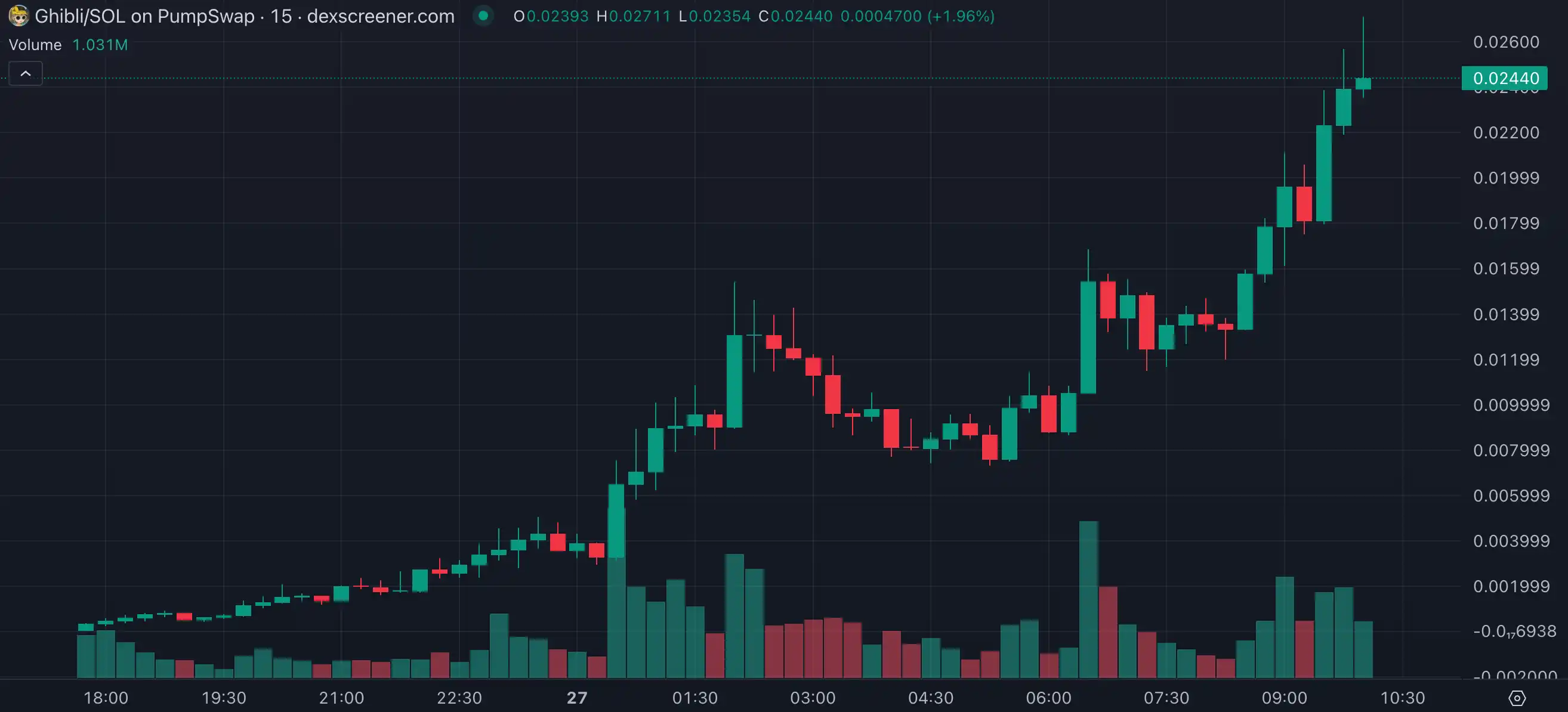
At the same time, a meme coin named $Ghibli also launched on the blockchain in express mode. It started to surge from yesterday at 6 p.m., and under the hype from all sides this morning, its market value skyrocketed. As of the time of writing, it has surpassed $24 million with a 24-hour surge of over 10824%.
What happened? What is Ghibli?
Of course, all of this is thanks to the freshly baked feature of GPT-4o.
On Tuesday, OpenAI activated the image generator built into GPT-4o, which is officially referred to as the "most advanced image generator to date" with the ability to produce "accurate, precise, and realistic native multimodal outputs." People discovered that this image generator is particularly good at replicating the anime style of Hayao Miyazaki's Studio Ghibli.
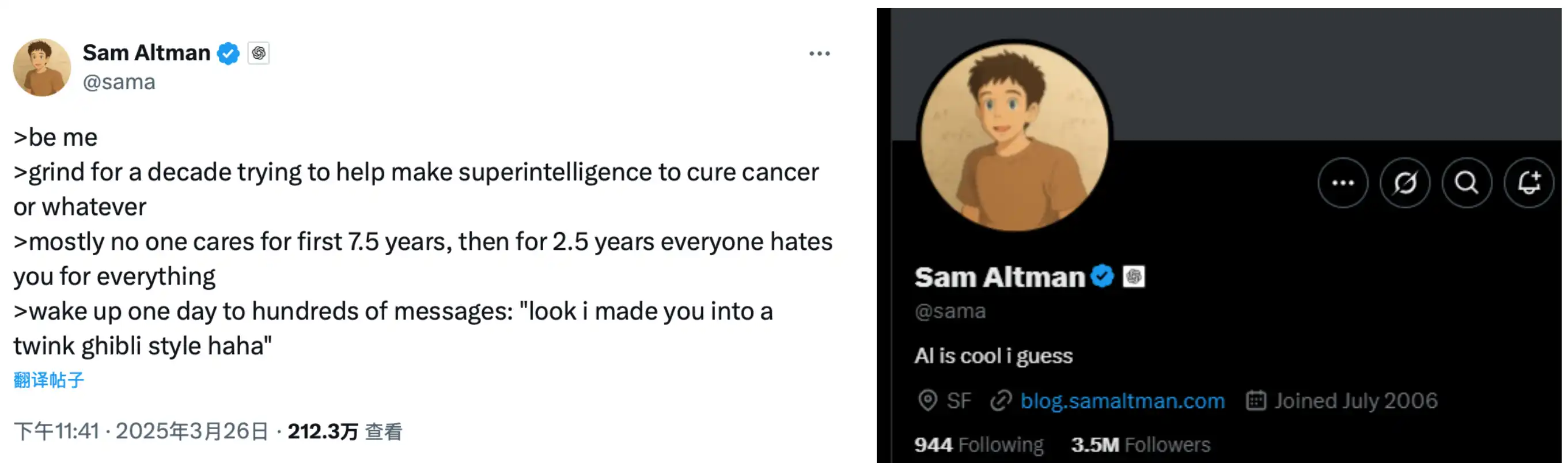
In his Wednesday tweet, OpenAI's CEO Sam Altman was the first to start this "Ghibli viral spread" and even changed his own profile picture to a Ghibli-style image.
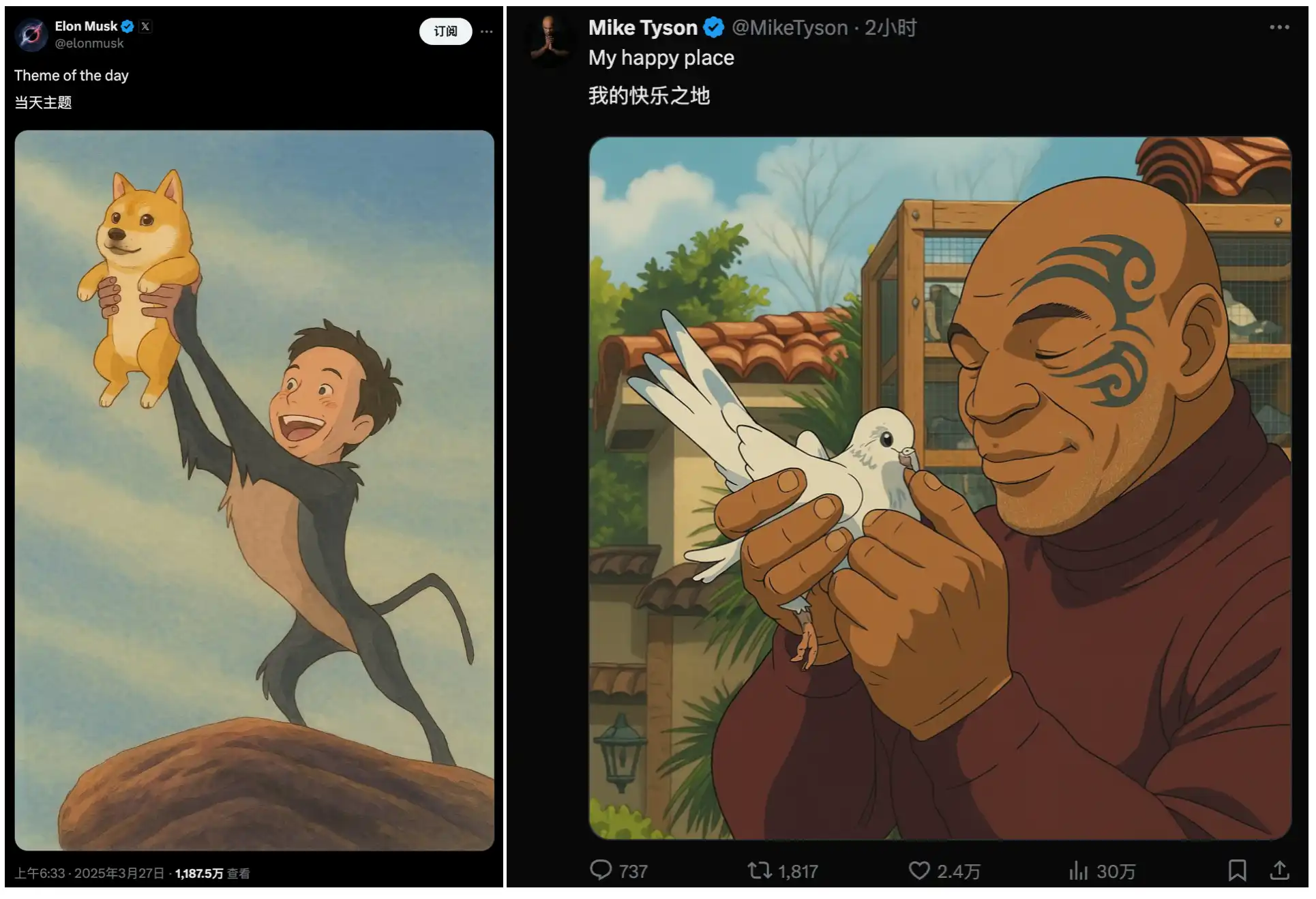
Subsequently, many Twitter personalities also began to imitate, uploading their own images rendered in Ghibli style. Even Elon Musk, the founder of Grok AI and a fierce competitor of OpenAI, wrote in his "image tweet": This is today's theme.
Although ChatGPT previously allowed users to create images from text prompts, it did so by routing them to another separate OpenAI model, DALL-E 3.
The reason the GPT-4o model is named "o" is because it is an "Omni" model. This means that OpenAI has not only trained it on text data but also on image data and even audiovisual data, enabling it to understand all these forms of media and their similarities. It can generate the given media based on user prompts without relying on any external models.
Recently, AI giants have been fiercely competing in the field of image generation models, with Google also releasing an experimental image creation model called Gemini 2.0 Flash. It is evident that having AI as your personal artist, creating an image that fully understands your intention, is becoming a very simple task.
Hayao Miyazaki, co-founder of Studio Ghibli, has expressed strong opposition to AI-generated animation in the past. At a conference in 2016, Miyazaki made a statement regarding AI animation, saying, "I feel repulsed. If you really want to create something that is eerie, you can go ahead. I never want to incorporate this technology into my work," and further described it as "an insult to life itself."
How to Generate Your Own Ghibli?
First, navigate to chat.com or chatgpt.com and make sure you are using a GPT Plus, Pro, or Team account, and the AI model selector shows "GPT-4o."
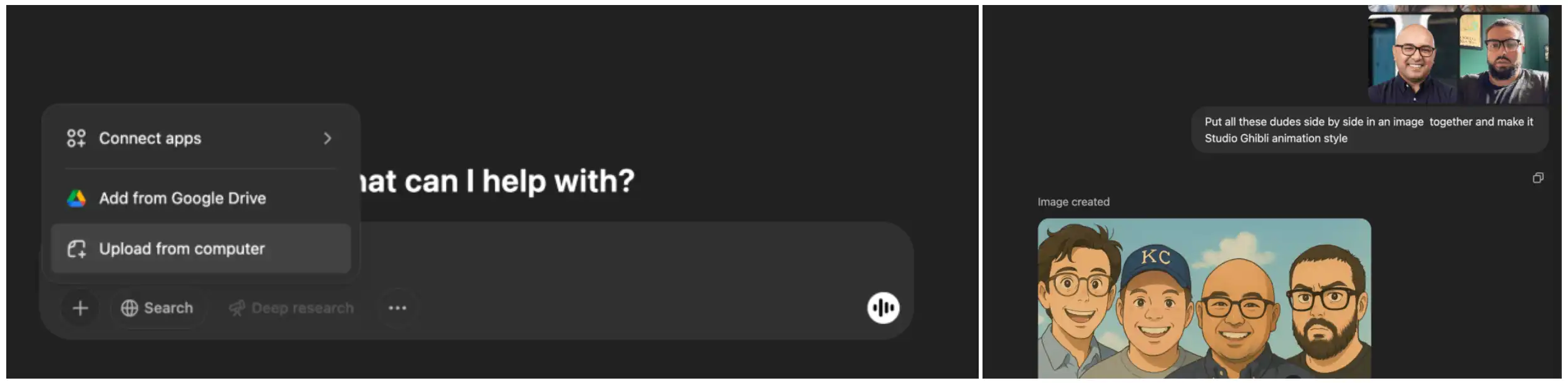
Use the "+" button at the bottom left of the real-time input text box to upload an image, and then you can instruct the new GPT-4o with an image creation model to "redraw this image in the style of Ghibli animation." You can also upload multiple images and combine them into one image using the Ghibli style. In any case, with plenty of experimentation, 4o will bring you many surprises.
Of course, the related meme token $Ghibli simply merges the artistic aesthetics of Studio Ghibli and the trend of AI-generated content in terms of narrative. Its rapid rise to fame on Twitter is attributed to this. However, the team information behind the token is currently not clear, and investors should tread carefully when considering the associated risks.
You may also like

Morning Report | CoinEx becomes a key hub for Iran to evade sanctions, involving over $3.8 billion in funds; Kalshi seeks a new round of financing, with a valuation potentially rising to $40 billion

Why do cryptocurrency projects always like to change their names?

From the white-haired stock god to the billionaire fund mogul, the smart people shorting Nvidia are all getting rich using the same framework

Morning News | The draft amendment to the People's Bank of China Law aims to clarify the legal status of digital renminbi; South Korea will transfer about 40 unregistered virtual asset service providers to law enforcement agencies

The cryptocurrency industry has entered the "Show Me" era: merely relying on vision is no longer enough
Interpreting the Ethereum Foundation's new structure: Reaffirming self-sovereignty amid institutional trends
Former SpaceX engineer reconstructs the financial execution system using first principles

Tidal Investment: We still have a positive outlook on the AI industry chain, but the reasons have changed

Standard Chartered Bank sings a 50x rhapsody again, aiming for AAVE to reach 3500 USD

The interim executive director of the Ethereum Foundation speaks out: What is our mission?
Why does OKX want to start a new company with the parent company of the New York Stock Exchange?

Why Is PAXG Price Different From Gold? 5 Reasons Crypto Traders Should Know

WEEX OpenAPI 101: 5 Powerful Modules, AI Trading Tools, and Grab Up to 70% Revenue Opportunities
Learn how WEEX OpenAPI connects traders, developers, AI agents, and trading platforms. Discover WEEX API features, Binance-compatible integration, automated trading workflows, revenue opportunities, and ecosystem possibilities.

Interview with NDV Founder Jason Huang: Popping the AI Bubble and the Myth of Microstrategy, Seeking the Ultimate Ace in the Crypto Market

Morning Report | Former Ethereum Foundation researcher establishes Ethlabs; EU Parliament Economic Committee passes digital euro regulatory proposal

Dragonfly partner Haseeb: The fastest-growing companies in the future may all be stuck at 149 people

How xBubble Breaks the Deadlock in VC's Heavy Investment in the OPC Economy

The encrypted unicorn Blockstream is deeply embroiled in a serious fraud case
Morning Report | CoinEx becomes a key hub for Iran to evade sanctions, involving over $3.8 billion in funds; Kalshi seeks a new round of financing, with a valuation potentially rising to $40 billion
Why do cryptocurrency projects always like to change their names?
From the white-haired stock god to the billionaire fund mogul, the smart people shorting Nvidia are all getting rich using the same framework
Morning News | The draft amendment to the People's Bank of China Law aims to clarify the legal status of digital renminbi; South Korea will transfer about 40 unregistered virtual asset service providers to law enforcement agencies
The cryptocurrency industry has entered the "Show Me" era: merely relying on vision is no longer enough
Interpreting the Ethereum Foundation's new structure: Reaffirming self-sovereignty amid institutional trends


