
Has the "Whale" Accelerated Bitcoin Sell-Off, But Still Not Considered a Panic Signal?


Original Title: "Whale Accelerates Bitcoin Sell-off, but Still Not Considered a Panic Signal?"
Original Source: Golden Finance
Last week, Bitcoin fell below the key $100,000 mark, and the sell-off behavior of "whales" (investors holding a large amount of cryptocurrency) and other long-term holders has become a significant driver of the recent price weakness.
Most blockchain analytics companies define "whales" as individuals or institutions holding 1000 or more bitcoins. Although the identities of most "whales" are unknown, blockchain data can still provide clues to their activities by tracking their cryptocurrency wallets.
Data shows that some "whales" have recently accelerated their Bitcoin sell-off pace. Some analysts say that while this phenomenon is worth noting, it may not necessarily be a panic signal. They point out that recent sell-offs may reflect a steady profit-taking rather than panic selling, a pattern consistent with previous bull market cycles.
Martin Leinweber, Director of Digital Asset Research and Strategy at MarketVector Indexes, said that such sell-offs may reflect "planned asset allocation." "Some Bitcoin investors bought in when the price was only in the single digits and have been waiting for so long. Now there is finally enough liquidity to sell without completely disrupting the market," he told MarketWatch.
Despite recent complaints from cryptocurrency bulls about market illiquidity, Bitcoin's ease of buying and selling has greatly improved compared to ten years ago.
However, analysts from blockchain analytics firm CryptoQuant expressed concern that recent "whale" sell-offs coincided with worsening market sentiment and a slowdown in buying, which could further pressure the Bitcoin price. Dow Jones market data showed that the largest cryptocurrency fell to nearly $19,400 last Friday, its lowest level since May 6.
Comparison of Past and Present
The sell-off of Bitcoin by long-term and large-scale holders is not unique to the current cycle. Analysts from the blockchain data platform Glassnode wrote in a recent report that there are indications that recent sell-offs are being primarily driven by profit-taking rather than panic.
Specifically, the wallets of "whales" holding Bitcoin for over seven years and selling over 1000 coins per hour have shown a consistent and steady pattern of selling behavior for a period of time (see the chart below, data as of last Thursday, November 13th).
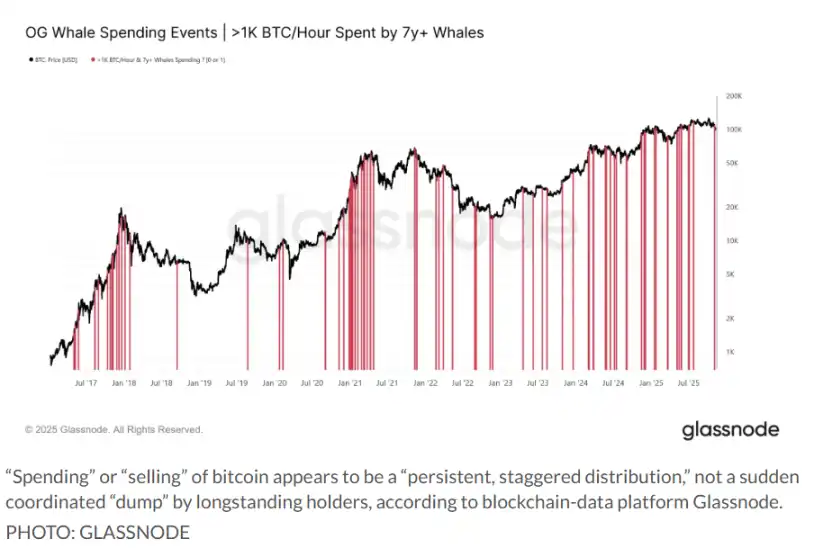
The selling behavior of a "whale" has shown a regular and steady pattern for a period of time
The Significance of the $100,000 Threshold
At the same time, Cory Klippsten, CEO of Bitcoin-focused financial services company Swan Bitcoin and a long-term Bitcoin investor, stated that the significant selling by "whales" in recent months appears to be related to the $100,000 Bitcoin threshold—many early adopters have long seen this level as a psychological profit-taking threshold.
“Since entering this field in 2017, many early holders I know have discussed the $100,000 figure,” Klippsten told Market Watch. “For some reason, people always say they will sell some of their holdings at this price.”
Glassnode data shows that since Bitcoin first broke $100,000 in December 2024, the selling behavior of long-term holders has intensified.
Potential Warning Signals
However, CryptoQuant analysts wrote in a recent report that one changing factor is the market's capacity to absorb selling pressure. When long-term holders sold Bitcoin at the end of last year and earlier this year, other buyers stepped in to support the price, but this trend seems to have shifted.
Investment product flows can reflect weak demand—data from Dow Jones Market shows that as of last Thursday, Bitcoin exchange-traded funds (ETFs) saw outflows of $311.3 million for the whole week, potentially marking the fifth consecutive week of outflows since the week ending March 14 (which saw five consecutive weeks of outflows).
In the past five weeks, Bitcoin ETFs have seen outflows of $2.6 billion, the largest five-week outflow since the week ending March 28 (which saw outflows of $3.3 billion).
The recent price trend has once again brought the $100,000 threshold into focus. As of writing, Bitcoin is still trading below this threshold. Some technical analysts suggest that as the market has failed to reclaim this key level, it could trigger more profit-taking behavior.
Adding to the pressure, the overall macroeconomic environment does not favor risk assets. Joel Kruger, market strategist at LMAX Group operating foreign exchange and cryptocurrency exchanges, pointed out that this has led to the liquidation of some long positions. “We believe that the market had gotten ahead of itself as we headed into the fourth quarter, which was based largely on the seasonal trend analysis—the historical outperformance seen during this period,” Kruger wrote in a note to Market Watch.
Kruger pointed out that as investors revised down their expectations for a December rate cut by the Fed, and weak labor market data raised economic concerns, overall risk assets including Bitcoin once again faced pressure.
Saylor Continues to Accumulate
Nevertheless, one of the best-known Bitcoin "whales" is still continuing to buy.
Software company Strategy Inc. (now widely seen as a leveraged Bitcoin investment target) Chairman Michael Saylor said on CNBC last Friday that the company has been "accelerating" its Bitcoin purchases and will announce its purchases on Monday morning.
As of last Friday, Strategy held over 640,000 bitcoins, representing over 3% of the current circulating supply of 19.9 million bitcoins. Strategy did not immediately respond to an email seeking comment.
You may also like

Morning Report | Illinois signs the strictest digital asset tax law in the U.S.; RWA tokenization market size surpasses $43 billion, institutions accelerate the migration of on-chain assets

Full version of the debut Q&A! Federal Reserve Chairman Waller: Sticking to the 2% inflation target, establishing five special working groups, individual did not submit the dot plot

From Disruptor to Shadow Market: The Crypto Market is Becoming a Colony of Traditional Finance
Dalio's important long article: How to position in the current market environment?

OKX Star analyzes Binance's competitive advantages: when regulation levels the playing field, competition has just begun

New gameplay for participating in initial offerings on cryptocurrency exchanges
Why Is Bitcoin Down Today? What the Hawkish FOMC Means for SpaceX, Gold and Nasdaq

DeepSeek Financing Story

Morning Report | DeepSeek completes over $7 billion in financing, with a valuation exceeding $50 billion; Musk's personal wealth has surpassed the total market value of Bitcoin

Cursor, why did you get on Musk's spaceship?
In the name of charity, for the benefit of the family: How the Trump family turned charity into profit?

Will Gold Break $4,500 After Tonight's Fed Decision? What XAUT and PAXG Traders Need to Know

SharpLink CEO: How to understand that Ethereum developers have just surpassed 1 million?

Morning Report | MiCA grace period expires on July 1; Kalshi's trading volume in the first week of the World Cup breaks $5.1 billion, setting a record

The foundation of SpaceX's trillion-dollar valuation: Who is dividing Musk's annual capital expenditure of tens of billions?
How to exit after asset tokenization?

The stablecoin positioning battle escalates: When compliance is just a ticket to entry, will USD1 become the biggest winner?

A16Z: The sun bears witness, SpaceX is worth 7.5 trillion
Morning Report | Illinois signs the strictest digital asset tax law in the U.S.; RWA tokenization market size surpasses $43 billion, institutions accelerate the migration of on-chain assets
Full version of the debut Q&A! Federal Reserve Chairman Waller: Sticking to the 2% inflation target, establishing five special working groups, individual did not submit the dot plot
From Disruptor to Shadow Market: The Crypto Market is Becoming a Colony of Traditional Finance
Dalio's important long article: How to position in the current market environment?
OKX Star analyzes Binance's competitive advantages: when regulation levels the playing field, competition has just begun
New gameplay for participating in initial offerings on cryptocurrency exchanges


