
 Buy Crypto
- Markets
 Futures
- Spot
- Copy Trade
- Earn
- More
Key Market Intelligence on November 13th, how much did you miss out on?

Featured News
1. Trump Signs Bill, Ending U.S. Government Shutdown
2. Polymarket Quietly Relaunches U.S. Trading Platform in Beta Mode
3. "Hakimi" Surges Over 50% in 24 Hours, Reaching a Market Cap of $25.91 Million
4. Shitcoin ETF Candidate Sees Massive Surge in 24-Hour Trading Volume, XRP Volume Up Over 60%
5. Pre-Market Crypto Concept Stocks in U.S. Rise Across the Board, SharpLink Up 3.28%
Trending Topics
Source: Overheard on CT (tg: @overheardonct), Kaito
Here is the English translation of the original content:
[HYPERLIQUID]
Hyperliquid became the focus of the market today due to a significant event: a $3 million withdrawal from OKX was split among 19 wallets and used to leverage long on POPCAT on the platform. This ultimately led to rapid liquidation resulting in a $4.9 million loss for HLP. Following the event, Hyperliquid paused its cross-chain bridge for maintenance.
Additionally, Hyperliquid launched NVDA-PERP, the first-ever permissionless perpetual contract for an individual stock in the crypto space, seen as a significant innovation. The platform's innovative features and collaboration with Polymarket's prediction markets have also sparked discussions, highlighting its impact in the crypto ecosystem.
[POPCAT]
POPCAT experienced intense fluctuations today, stemming from malicious manipulation on Hyperliquid. A trader withdrew $3 million USDC from OKX, split it among 19 wallets, and established long positions ranging from $20 million to $30 million, creating a false buy wall at $0.21. After the buy wall was removed, the price plummeted, resulting in a total of $63 million in liquidations and a $4.9 million loss for HLP. The event is linked to previous manipulation activities, prompting Hyperliquid to pause the Arbitrum cross-chain bridge and sparking widespread discussions on high leverage risks and the security of decentralized exchanges.
[POL]
Today's POL discussion focuses on the integration of Polygon, a leading global fund network Calastone, aiming to tokenize fund shares for 4,500 financial institutions across 58 markets. This move highlights Polygon's role in on-chain institutional finance, providing faster settlement, lower costs, and greater transparency. Additionally, Polygon's impact in the Latin American market, stablecoin adoption, and rising transaction fees (indicating increased network activity) are also under scrutiny.
[ORD]
ORD's hot topic today is the launch of ZapApp, a self-custodial crypto app based on Solana that supports KYC-free, gas-free transactions. Following the launch of ZapApp, the official distribution of $DOG tokens as part of the celebration has sparked market enthusiasm. The app aims to streamline the trading process and challenge the traditional exchange model by waiving listing fees, sparking discussions on exchange fairness and the potential disruptive nature of ZapApp.
Featured Articles
1. "A New Era of Token Financing: Milestone in U.S. Compliance Financing"
The upcoming ICO of Monad on Coinbase has been a hot topic this week. Apart from discussions on whether the sale at a $25 billion fully diluted valuation is worth participating in, the "compliance level" as Coinbase's first ICO has also sparked widespread discussions, seen as a landmark event of compliance in the crypto world. Stablecoin issuer Circle mentioned in its recent Q3 financial report that it is exploring the possibility of issuing native tokens on the Arc Network. Coinbase also hinted at launching the Base token in an interview with Jesse Pollak, co-founder of Base Chain, around 2 years after its collaboration. All signs point to a compliant new era in asset issuance in the crypto world.
2. "Major Adjustment in U.S. Crypto Regulation: CFTC May Fully Take Over the Spot Market"
The long-standing ambiguous regulatory boundaries of crypto in the U.S. are being redrawn. With Mike Selig nominated as CFTC chairman and new legislation advancing in Congress, the delineation between the SEC and CFTC is emerging at the policy level for the first time, showing a rare clear trend in regulatory structure: SEC focusing on securities; CFTC focusing on the digital commodity spot market.
On-chain Data
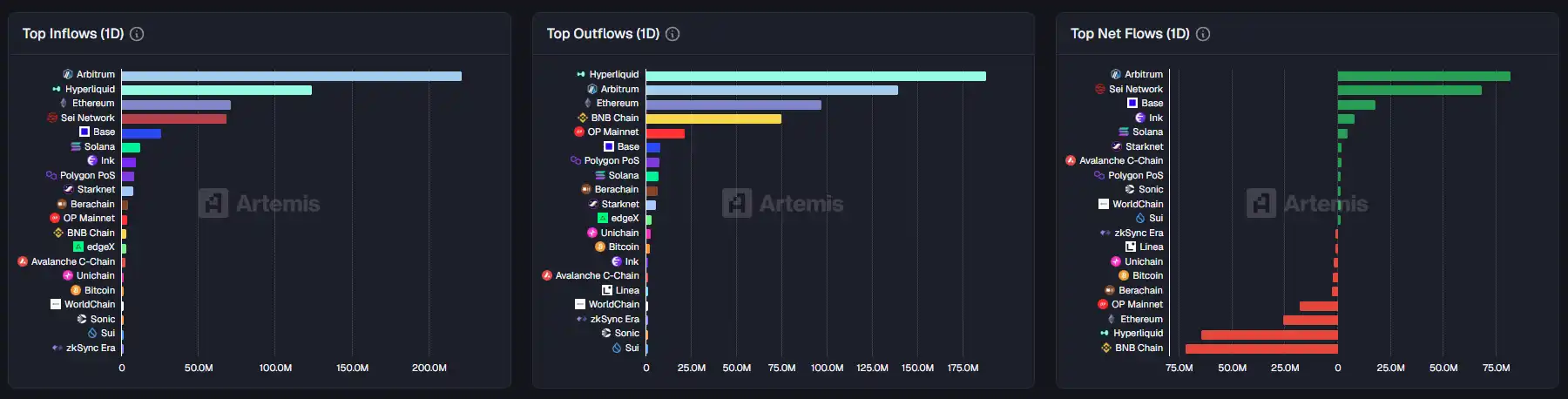
On-chain Fund Flow for the week of November 13
You may also like

60 Essential Skills, Workflows, and Open Source Projects, the Ultimate Claude Advancement Checklist

SpaceX to Raise $75 Billion | Rewire News Nightly

PUMP Valuation Breakdown: On-chain Data Disproves the "Fake Volume" Theory, Where Does the Real Discount Come From?

Tiger Research: What AI services do cryptocurrency companies offer?

The war not only drives up oil prices but also causes Circle's stock price to soar

When agents become consumers, who will rewrite the underlying logic of internet commerce?

AI Agents in Action Summit: March 31, Hong Kong Cyberport, focusing on the deep waters of AI implementation

29 Days In, What Are America’s Options on Iran?

Flash Crash Down 97%+ with Ongoing Unlocking, WLD Completes $65 Million Off-chain Funding: Who Is Still Buying?

Bitcoin for Real Estate? Fannie Mae Teams Up with Coinbase to Launch Crypto Mortgage
Tether Hires Big Four Auditor, USDT Enters First Attestation Phase

Google AI Paper Destroys $900B Storage Stock, Accused of Faking Experiment
Evaporate $2 Trillion, U.S. Stocks See Worst Start in 4 Years, Why is the Market Bearish?

The speed at which AI discovers vulnerabilities has surpassed the speed at which it patches vulnerabilities.
AI Crypto Trading Bot Explained: Aurora's Multi-Factor Strategy in WEEX Hackathon
Aurora demonstrates how structured, multi-agent AI Trading systems can deliver more adaptive and resilient performance in the WEEX AI Trading Hackathon.

Cyber Taoist Fortune Teller: Fake Taoist, AI Fortune Telling, and Northeastern Metaphysics History

Bloomberg: Stablecoin Payments Emerge as Crypto VC's Newest Favorite Thing
BeatSwap is evolving towards a full-stack Web3 infrastructure, covering the entire lifecycle of IP rights.
BeatSwap, a global Web3 Intellectual Property (IP) infrastructure project, is attempting to overcome the current fragmentation limitations of the Web3 ecosystem, building a full-stack system that covers the entire lifecycle of IP rights.
Currently, most Web3 projects are still in the stage of functional fragmentation, often focusing only on a single aspect, such as IP asset tokenization, transaction functionality, or a simple incentive model. This structural dispersion has become a key bottleneck hindering the industry's scale application.
BeatSwap's approach is more integrated, integrating multiple core modules into the same system, including:
· IP authentication and on-chain registration
· Authorization-based revenue sharing mechanism
· User-engagement-driven incentive system
· Transaction and liquidity infrastructure
Through the above integration, the platform builds an end-to-end closed-loop path, allowing IP rights to complete a full cycle of "creation, use, and monetization" within the same ecosystem.
BeatSwap is not limited to existing crypto users but is attempting to take the global music industry as a starting point, actively creating new market demand. Its core strategies include:
Exploring and incubating music creators (Artist discovery)
Building a fan community
Igniting IP-centric content consumption demand
The current global music industry is valued at around $260 billion, with over 2 billion digital music users. This means that the potential market corresponding to the tokenization and financialization of IP far exceeds the traditional crypto user base.
In this context, BeatSwap positions itself at the intersection of "real-world content demand" and "on-chain infrastructure," attempting to bridge the structural gap between content production and financial flow.
BeatSwap's upcoming core product "Space" is scheduled to launch in the second quarter of 2026. This product is defined as the SocialFi layer in the ecosystem, aiming to directly connect creators with users and achieve deep integration with other platform modules.
Key designs include:
A fan-centric interactive mechanism
Exposure and distribution logic based on $BTX staking
User paths connected to DeFi and liquidity structures
Thus, a complete user behavior loop is formed within the platform: Discovery → Participation → Consumption → Rewards → Trading
$BTX is designed to be a core utility asset within the ecosystem, rather than just a simple incentive token, with its value directly tied to platform activity and IP use cases.
Main features include:
· Yield distribution based on on-chain authorized actions
· Value reflection based on IP usage and user engagement dynamics
· Support for staking and DeFi participation mechanisms
· Value growth driven by ecosystem expansion
With the increased frequency of IP use, the utility and value support of $BTX will enhance simultaneously, helping alleviate the "disconnect between value and utility" issue present in traditional Web3 token models to some extent.
Currently, $BTX has been listed on several mainstream exchanges, including:
Binance Alpha
Gate
MEXC
OKX Boost
As the launch of "Space" approaches, BeatSwap is actively pursuing more exchange listings to further enhance liquidity and global accessibility, laying a foundation for future market expansion.
BeatSwap's goal is no longer limited to the traditional Web3 narrative but aims to target over 2 billion digital music users and a trillion KRW-scale content market.
By integrating content creators, users, capital, and liquidity into a blockchain framework centered around IP rights, BeatSwap is striving to build a next-generation infrastructure focused on "IP tokenization."
BeatSwap integrates IP authentication, authorization distribution, incentive mechanism, transaction system, and market construction to establish a unified structure that bridges the full lifecycle path of IP rights.
With the launch of the Q2 2026 "Space," the project is expected to become a key infrastructure connecting content and finance in the IP-RWA (Real World Assets) track.


 App
App