
「Money Printer」 PUMP.FUN Establishes Investment Arm, Can $3 Million Keep a Good Project?

 Prefer us on Google


Original Article Title: "Making 9 Billion with Only 3 Million Invested, How Does Pump.fun's Math Work?"
Original Article Author: angelilu, Foresight News
On January 20, Pump.fun, the most profitable Meme coin platform in the Solana ecosystem, announced the establishment of an investment department, Pump Fund, and kicked off its first hackathon with an initial investment of $3 million to fund 12 projects. This figure, compared to its total revenue of nearly $9 billion, presents a subtle contrast: for every approximately $300 earned by the platform, only $1 is allocated to invest in the ecosystem, representing about 0.33%.
A New Attempt Under Competitive Pressure
The timing of Pump Fund's launch is intriguing. According to Solana Launchpads' transaction volume data, while Pump.fun still maintains its dominance, the recent upstart platform Bags has quickly captured over 10% market share, directly causing a decline in Pump.fun's market share.
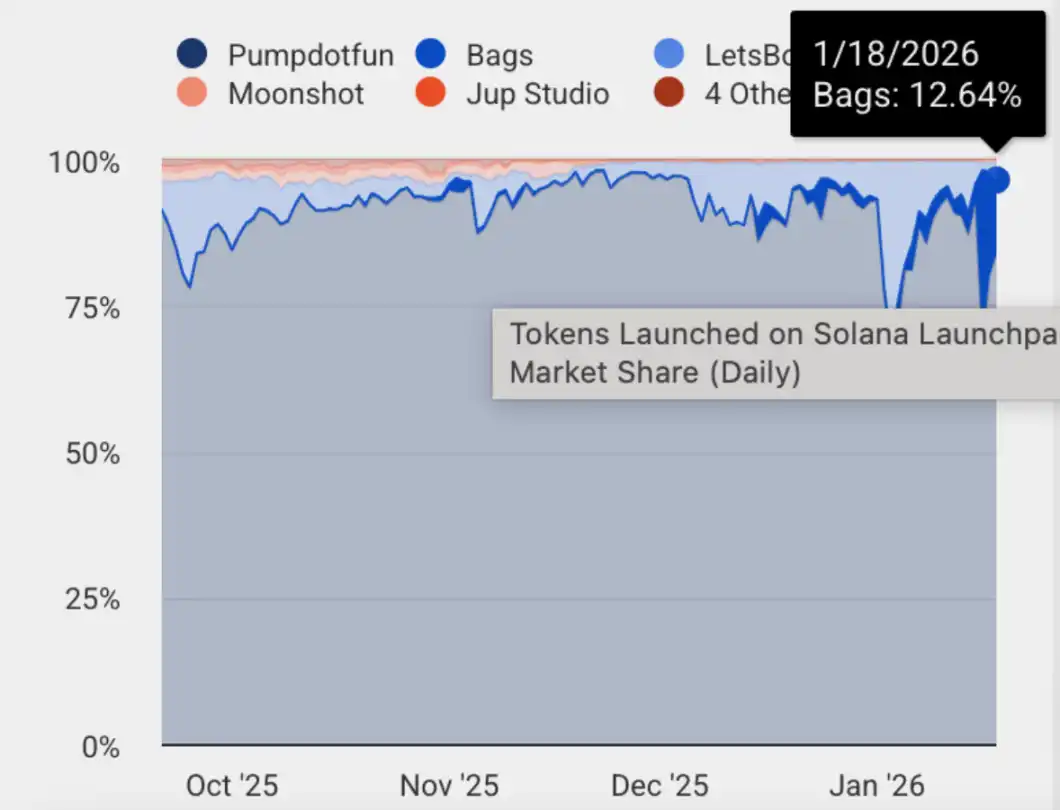
In this context, the $3 million ecosystem investment can be seen as an attempt at differentiation in competition. When the technical barrier between platforms is extremely low, and user loyalty is also extremely limited, Pump.fun chooses to establish new brand awareness through ecosystem investments—not just as a trading platform but also as a project incubator.
However, the question remains: is a 0.33% investment ratio sufficient to support this positioning? In comparison, even in relatively conservative technology companies, the investment ratio is many times higher than this number. From a business logic perspective, this is closer to an exploratory market experiment rather than a comprehensive strategic transformation.
Let the Market Be the Judge
The question that Pump Fund's experiment seeks to answer is: in the Web3 world, who should define what a "good project" is?
This global hackathon, called "Build in Public," adopts a set of rules that are completely different from traditional start-up competitions: no expert judges to score, no Demo Day pitches; instead, the market decides directly.

Specifically, participating teams must issue tokens on Pump.fun, publicly share their development progress daily, and showcase the building process through social media. The ultimate criterion is one—market response. If a project garners attention, trust, and trading volume, it proves worthy of investment; otherwise, it naturally gets eliminated. From the opening of applications on January 19 to the announcement of the first batch of winners on February 18, during these four weeks, all projects will undergo a real-time assessment in the open market. On February 18, at least one project will be selected and funded.
In the hackathon rules, the platform explicitly states that "in addition to the project's social media appeal, the long-term sustainability of the project will also be evaluated." However, it is currently unclear how to find a balance between market hype and long-term value, and what specific criteria will be used to judge.
As Pump.fun co-founder Alon puts it, "this framework creates a new path for founders who cannot access traditional capital." In a sense, this is a challenge to traditional VC investment logic—since Web3 emphasizes decentralization, why should the success of a project still be determined by a few investors.
A Deeper Business Dilemma
Aside from the mechanism design, Pump Fund also faces a more fundamental problem: even if high-quality projects are successfully incubated, will these projects stay on Pump.fun?
This is the structural dilemma of Meme coin platforms. The Nasdaq invests in tech companies going public, and companies like Microsoft and Apple continue to trade on the Nasdaq after listing, contributing long-term value to the platform. But Meme coin projects operate under different logic. If a project achieves initial success on Pump.fun, builds a user base and market recognition, what will be the next step? It is likely to migrate to a platform with greater liquidity, such as Binance or Coinbase, or even establish its own independent community.
Pump.fun is essentially a "launchpad," and projects will naturally seek a broader market as they mature. More fatally, the platform's revenue model makes it difficult to truly retain high-quality projects. Pump.fun relies on early high-frequency trading to earn fees, but as a project matures, the trading frequency tends to decrease, long-term hodlers increase, and speculative trading diminishes. From a revenue perspective, the platform always makes the most money from those "fast-moving consumer goods" that are short-term pumps, rather than the "value projects" built for the long term.
This may explain why the investment ratio is only 0.33%. In the current business model, large-scale investment ecosystems not only have uncertain returns but may even be making a wedding dress for others. This is not simply "stinginess" but a manifestation of business rationality.
Four weeks later, when the first batch of award-winning projects is announced, we may get a preliminary answer. However, the longer-term question remains: in the Meme coin field with low technical barriers and weak user loyalty, can ecosystem investment truly become a moat? As competitors like Bags continue to eat away at market share, can this $3 million experiment help Pump.fun maintain its position?
-- Price
This content is provided for general informational purposes only and doesn't constitute financial, investment, legal, or tax advice. Any events, rewards, online promotions, or related information mentioned herein should not be considered a recommendation, solicitation, or invitation to purchase, sell, trade, or otherwise deal in any crypto assets. Crypto assets are highly volatile and may result in loss. The availability of WEEX services, products, and related events may vary by region. You are responsible for ensuring that your participation is in accordance with applicable local laws and regulations.
You may also like

PENGUIN Memecoin Surges 564% Following Viral White House Social Media Post
Key Takeaways The Nietzschean Penguin (PENGUIN) memecoin skyrocketed by 564% after a White House social media post went…
Pump.fun Co-founder: PENGUIN Successfully Proves On-Chain Transactions Have Never Died, Still Plenty of Opportunities

Pump Fun Co-Founder Cites Fee Model Failures and Announces System Overhaul
Key Takeaways Pump.fun admits its fee model failed, leading to a major system revamp where traders decide token…
The Most Profitable App in the Crypto World Starts to Decline
The SSV team has published an analysis of two slashing incidents, which were related to validator key management rather than protocol issues.

Why is Solana (SOL) Price Down Today on August 6, 2025?
Pump.fun’s recent ban and rising geopolitical tensions in the Middle East are key factors pushing Solana’s price lower…
Why Moderna (MRNA) Stock More Than Doubled: The INTerpath-001 Cancer Vaccine Result, Explained
Moderna shares more than doubled on 19 August 2026 after Merck and Moderna said the Phase 3 INTerpath-001 trial of intismeran autogene plus KEYTRUDA met its recurrence-free survival endpoint in resected melanoma. This page explains what the result is, why the stock reacted this hard, what is still unknown, which dates come next (presentation and earnings, both unconfirmed), and what a trader can actually do on WEEX — which does not list Moderna; the nearest instrument is the XBI-USDT biotech ETF perpetual. No price targets, no forecasts.
Web3: Foreign Media Reports that the Altcoin Market in 2026 May Depend on ISM Recovery
CoinFerenceX and the best event join forces to launch “CoinFerenceX The Best Event Singapore,” the decentralized summit

BCCC Introduces JPYC for Annual Membership Fee Payments

Modernizing Financial Infrastructure for Digital Assets by 2026
Web3: Foreign Media Reports Three Changes That May Boost SHIB
"I received an airdrop, but will I have to pay taxes next year?"... How to calculate in advance with a coin calculator
Critical Patch for Decred: Those Who Don't Update Risk a Network Fork
UnitedHealth Discloses Tax Dispute with the IRS
HeyBreez Raises $2.5 Million for Global Expansion in Voice AI
Web3 Wallets in a "Season of Turmoil": Understanding the Evolution of Crypto Security's "Sword and Shield" in the AI Era
Congress Members Raise Concerns Over AI Errors in New Legislation — Politico

Unitree Robotics Stock: How to Buy 688836 After Its 629% IPO Surge

DGrid AI: Reconstructing AI Infrastructure with On-Chain Verification and Open Markets
Ripple Prioritizes Institutional Financial Infrastructure Strategy Over IPO
Treasury Yields Surge to 5.3%, Hitting Tech Stocks WEEX TradFi Daily | Aug 19
Long-end U.S. Treasury yields surged to multi-year highs, pressuring technology, semiconductor, storage, and optical communication stocks and driving a clear cooling in market risk appetite. At the same time, Anthropic’s revenue came in below some bullish expectations, prompting investors to reassess the AI growth narrative; Unitree Robotics officially listed on the STAR Market, extending momentum in robotics and embodied AI; while SpaceX and other commercial space names showed relative resilience. Investors are now focused on tonight’s Federal Reserve minutes for clearer signals on the policy path and broader market sentiment.

ServiceNow Expands Security Portfolio with $7.75 Billion Acquisition

Ethereum’s 12-GPU proving problem just got a 4-GPU answer
How to Join WEEX 牛来 Airdrop: 50,000 USDT Rewards Guide
Fabrinet Earnings Beat Expectations: Why Did FN Stock Fall?
Non-consensus Decisions in the Robotics Sector: Why Sequoia Chose to Double Down on Yushu at Its Most Difficult Time?
牛来 Coin After the Rally: Opportunity or Meme Coin Risk?
AI: Five ECB Economists Consider a Correction of Tech Values Likely
Toyota Tokenized Bonds: Is 1 Billion Yen Finance Coming to Your Smartphone?
PENGUIN Memecoin Surges 564% Following Viral White House Social Media Post
Key Takeaways The Nietzschean Penguin (PENGUIN) memecoin skyrocketed by 564% after a White House social media post went…
Pump.fun Co-founder: PENGUIN Successfully Proves On-Chain Transactions Have Never Died, Still Plenty of Opportunities
Pump Fun Co-Founder Cites Fee Model Failures and Announces System Overhaul
Key Takeaways Pump.fun admits its fee model failed, leading to a major system revamp where traders decide token…
The Most Profitable App in the Crypto World Starts to Decline
The SSV team has published an analysis of two slashing incidents, which were related to validator key management rather than protocol issues.
Why is Solana (SOL) Price Down Today on August 6, 2025?
Pump.fun’s recent ban and rising geopolitical tensions in the Middle East are key factors pushing Solana’s price lower…

Contents
Latest articles


Latest coin listings on WEEX


