
 Buy Crypto
- Markets
 Futures
- Spot
- Copy Trade
- Earn
- More
Robinhood Impressive Q3 Financial Report: Profit Triples, 'Event Contracts' Emerge as a New Growth Engine

Original Title: "Revenue Doubled, Profit Tripled: Robinhood's Earnings Report Exceeds Expectations, Explosive Growth in Options Trading | Earnings Insight"
Original Authors: He Hao, Long Yue, Wall Street News
The "American Retail Investor Hub" Robinhood has delivered an impressive third-quarter performance.
The online brokerage's third-quarter earnings report released on Wednesday showed that both its revenue and profit exceeded Wall Street's expectations. Thanks to the overall growth in cryptocurrency, options, and stock trading volumes, the company's transaction-based revenue more than doubled year-over-year, driving net profit from $150 million in the same period last year to $556 million. Meanwhile, cryptocurrency revenue surged by 300%, but fell short of expectations.
Despite strong performance, Robinhood's stock price still saw a slight decline in after-hours trading. The company also announced a significant senior leadership change, with its CFO of over seven years, Jason Warnick, planning to retire in 2026. The company has appointed Shiv Verma, Senior Vice President of Finance and Strategy, as his successor. This smooth transition is aimed at ensuring the continuity of the company's strategy.
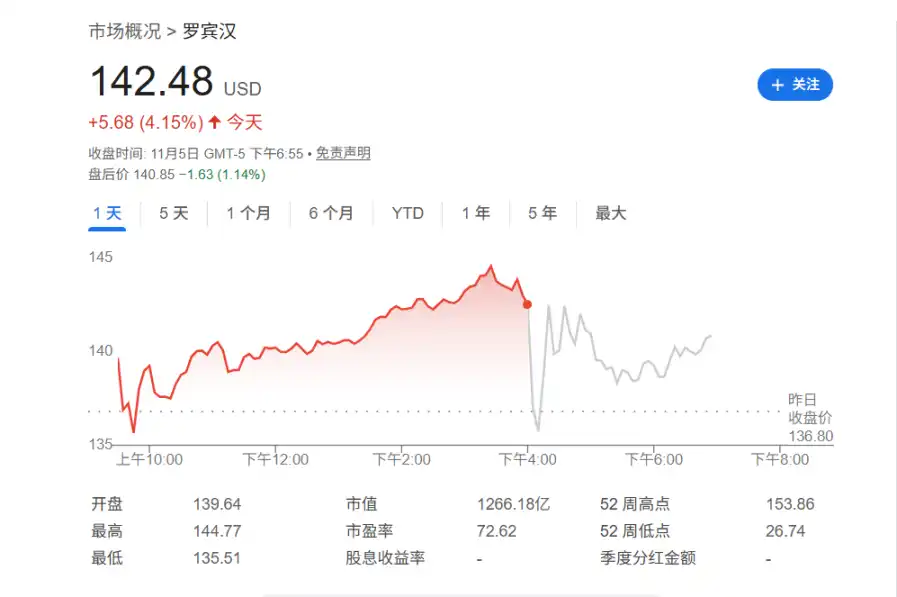
So far this year, Robinhood's stock price has risen by nearly 270% and was included in the S&P 500 Index in the third quarter. What was once seen as a retail investor frenzy during the pandemic now seems to have evolved into a force shaping the market, and Robinhood has successfully capitalized on this trend.
Robinhood Third-Quarter Earnings Report Highlights: Performance Significantly Exceeds Expectations, Trading Revenue Doubles
Key Financial Data:
· Revenue: Net revenue for the third quarter was $1.27 billion, analysts expected $1.21 billion.
· EBITDA: Adjusted EBITDA for the third quarter was $742 million, analysts expected $726.9 million.
· Earnings Per Share: $0.61, exceeding expectations of $0.53, compared to earnings per share of $0.17 in the same period last year.
· Net Profit: Net profit increased to $556 million, significantly higher than the net profit of $150 million in the same period last year.
· ARPU: Third-quarter ARPU (Average Revenue Per User) was $191, analysts expected $182.
· Monthly Active Users: Q3 monthly active users were 13.8 million, compared to analysts' expectations of 13.31 million.
Segment Data:
· Q3 Transaction-Based Revenue: $730 million, compared to analysts' expectation of $725.8 million.
· Q3 Cryptocurrency Revenue: $268 million, a 300% increase, but below analysts' expectation of $287.2 million.
· Q3 Options Revenue: $304 million, compared to analysts' expectation of $301.3 million.
The core driver of performance growth came from the strong recovery in the transaction business. In the third quarter, the company's transaction-based revenue reached $730 million, more than doubling year-over-year. Stock trading revenue grew by 132%, options trading revenue grew by 50%, and cryptocurrency trading revenue surged by 300% to $268 million, slightly below the analysts' expectation of $287.2 million.
“Event Contracts” Emerging as a Growth Engine
One of the most striking highlights in the financial report was the explosive growth of the “Event Contracts” (Prediction Markets) business. In the third quarter, the trading volume of event contracts on the platform surged to 2.3 billion shares, more than doubling from the previous quarter.
According to the soon-to-retire CFO Jason Warnick, the start of the fourth quarter has been even stronger, with the trading volume in just October surpassing 2.5 billion shares. This included approximately $25 million from the platform's prediction market business.
Recently, Robinhood expanded the scope of event contracts from the original sports and finance to further include politics, entertainment, and technology. Robinhood, in partnership with Kalshi, allows users to bet on the “yes/no” outcomes of future events related to sports, politics, entertainment, and technology.
Warnick stated in the announcement that the prediction market business has become one of the company's new business lines contributing approximately $100 million in annualized revenue. The incoming CFO Shiv Verma also emphasized in an interview: “This is a new asset class, and we want to be at the forefront. This is one of the areas we are focusing our investments on.”
Event contracts still represent only a small part of Robinhood's overall revenue. However, the prediction market business has seen rapid growth in recent weeks: Piper Sandler's analysts estimate that the trading volume on Kalshi and the competing platform Polymarket nearly doubled in October. Analysts also note that these two platforms saw their two most active trading days since the 2024 election this past weekend.
However, such prediction market contracts—especially those related to sports and entertainment—have also sparked controversy as they blur the line between investment and gambling.
Executive Insights: Banking, Venture Business to Roll Out Successively
Robinhood CEO Vlad Tenev stated:
"Our team continues to rapidly roll out new products, driving record-breaking business performance in the third quarter, and we won't slow down—prediction market business is growing rapidly, Robinhood banking business is starting to roll out gradually, and Robinhood venture business is also about to launch."
CFO Jason Warnick commented in the announcement:
"The third quarter once again saw strong and profitable growth, as we continue to drive business diversification, adding two new business lines with annualized revenues of approximately $1 billion or more—Prediction Markets and Bitstamp."
CFO Announces Retirement Plan, Internal Promotion of Successor
Robinhood announced in its earnings report that Chief Financial Officer Jason Warnick will retire in 2026. This executive, who previously worked at Amazon, has been with Robinhood for over seven years and has been a key figure in the company's development.
As per the plan, Warnick will complete the transition in the first quarter of 2026 and will continue to serve as a strategic advisor until September 1, 2026. The company has appointed Senior Vice President of Finance and Strategy Shiv Verma as the next CFO. This move is seen as an internal promotion to ensure a smooth transition of financial strategy within the company.
Analysis and Commentary: Diversification Strategy Pays Off, Moving Towards a FinTech Company
Robinhood has been striving to diversify its revenue streams to reduce reliance on its trading business. Earlier this week, the company announced a partnership with Sage Home Loans to allow its customers to access home loans. Additionally, the company also plans to launch a closed-end fund to give U.S. retail investors exposure to pre-IPO companies.
Analysts note that Robinhood's third-quarter performance, announced on Wednesday, exceeded Wall Street expectations, continuing its strong performance this year and making it one of the standout companies among large U.S. tech stocks this year. Robinhood is betting that the new generation of investors will want to not only trade stocks on the same platform but also bet on sports, culture, and political events. So far, it seems this bet is paying off.
As Robinhood expands its business to comprehensive wealth management, the company is gradually narrowing the gap with Coinbase. The company has been attracting Fidelity and Schwab customers by actively offering deposit match incentives and has been driving its AUM growth through the acquisition of TradePMR.
Robinhood primarily targets retail investors. Robinhood was originally known for its user-friendly platform that made it easy for beginners to buy and sell stocks. However, today, its trading business has expanded significantly: in the third quarter, nearly 90% of Robinhood's trading-related revenue came from categories other than stocks, including options, futures, and cryptocurrencies.
David Bartosiak, a stock strategist at Zacks Investment Research, wrote in a morning report, "This is no longer the Robinhood of the pandemic era. It is now leaner, more diverse, and quietly growing into a true fintech contender."
You may also like

The New Yorker in-depth investigation interpretation: Why do OpenAI insiders consider Altman untrustworthy?
Two Divided Worlds: Insights from the New York Digital Asset Summit, the Most Institutionalized Blockchain Conference

Top Ten Reveals of CZ's New Book: Advance Knowledge of "94", the Inside Story of Huobi's Change of Ownership Made Public for the First Time

Ceasefire Overnight Erases War Premium, Three Fault Lines Only One Sealed | Rewire News Morning Brief

Robinhood Secures 'Trump Account': Enabling Millions of Newborns to Access the Stock Market

Afraid to Open the Pandora's Box? Anthropic's Most Powerful Model Ever Dares Not Be Disclosed

US-Iran Ceasefire: A Temporary Pause or Prelude to Renewed Conflict? Market Outlook for Oil, Gold, and Bitcoin
April 8, 2026 – A temporary ceasefire between the U.S. and Iran has provided some immediate relief to the global markets, but the fundamental question remains: Will the cessation of hostilities hold, or is this merely a brief reprieve before a resumption of conflict? As the situation unfolds, market observers are closely monitoring how key assets like oil, gold, and Bitcoin will react in the coming weeks. This article explores whether the ceasefire is a sign of lasting peace, assesses the short-term market implications, and delves into the evolving role of Bitcoin in the global financial landscape.

WEEX Market Update: U.S.-Iran Ceasefire Sparks Bitcoin Price Surge
April 8, 2026 – In a significant shift in global geopolitics, U.S. President Donald Trump has announced a temporary two-week ceasefire with Iran, resulting in a notable market reaction across various asset classes. This development comes after discussions between Trump, Pakistani Prime Minister Shahbaz Sharif, and Army Chief General Asim Munir. The announcement is already reverberating through markets, particularly in oil, gold, and cryptocurrencies.
Morning Report | South Korean financial institutions pilot stablecoin payments for foreign users; Morgan Stanley Bitcoin ETF is about to be listed; CME plans to launch AVAX and SUI futures contracts

EigenCloud Founder: AI and Cryptocurrency are Creating the Next Trillion-Dollar Asset Class
From Panic to Pumps: How Bitcoin Traders Are Playing the 2-Week US-Iran Ceasefire
For most people, the two-week US-Iran ceasefire is about geopolitics, oil prices, and whether World War III gets postponed. But for crypto traders glued to their screens late Sunday night, it was something else entirely: the clearest risk-on signal in months.

US-Iran Ceasefire Triggers Oil Plunge, Bitcoin Surge, and Gold Rally
Despite the sharp rally, caution is warranted. The $70,000–$72,000 zone has historically been strong resistance. The ceasefire is only temporary (two weeks), and any breakdown in negotiations could trigger a sell-off toward the $62,000–$65,000 support zone. For now, Bitcoin needs to close decisively above $72,500 to confirm a true breakout; failure to do so within 48–72 hours could lead to a swift retracement.

OpenAI has no "New Deal," a blueprint for AI that refuses to pay.

Wall Street Flash Mob Run? Mega-Cap Stock Plunge, Goldman's Great Escape, Illustrated Guide to Private Credit Crisis

OpenAI Feud: Power, Trust, and the Uncontrollable Boundaries of AGI
「AI Doomsday Cult」 Sends Operatives into the Strait of Hormuz: What Did They Find?
Everyone is waiting for the war to end, but is the oil price signaling a prolonged conflict?


 App
App