
Shiba Inu Skyrockets, Is the Bull Market Back?


During Bitcoin's stabilization period, the altcoin season saw a long-lost intense fluctuation.
Tokens with a circulating market value of less than $20 million experienced a three-fold and five-fold increase in just a few days, with some approaching a ten-fold increase. Without any significant developments, ecological breakthroughs, or new institutional participation, prices were driven up in this manner.
This phenomenon has a ready-made explanation: altcoins are high-beta assets, so when Bitcoin rises, altcoins surge even higher. While this statement holds true statistically, it does not provide a complete explanation. High beta can explain why altcoins outperform Bitcoin, but it cannot explain why some have increased in value by tens of times. This multiple comes from another factor.
The current Altcoin Season Index is 34, with BTC dominance at 58.5%. Both numbers simultaneously tell you that this market is still far from a true altcoin season. However, in this market without a true altcoin season, certain tokens are moving at the magnitude typically seen only during an altcoin season.
From December 2024 to April 2026, excluding Bitcoin and Ethereum, the total market value of altcoins plummeted from a peak of approximately $1.16 trillion to around $700 billion, evaporating nearly 40%. When the market value shrinks low enough, the rules of the game change, and the price is no longer determined by market consensus but by who holds enough chips.
This is a vulnerability created by overselling, not a signal sent out by a bull market.
Altcoins Have Truly Dropped Too Much
In the blockchain space, there is a concept of a 51% attack, where controlling over half of the network's hash rate allows one to manipulate records, double-spend coins, and rewrite history. The capital version of this concept is simpler, requiring no technical expertise or hash rate, just money. In this round, the altcoin market saw nearly a 40% decrease in market value, reducing the barrier to entry by 40% year-on-year.
As of early April 2026, the total market value of altcoins was approximately $700 billion, down about 40% from the peak of around $1.16 trillion in December 2024. If measured until the end of 2025, the decline is about 44%. While the two measurements have different time points, the direction is consistent: the overall size of this market has been almost halved.
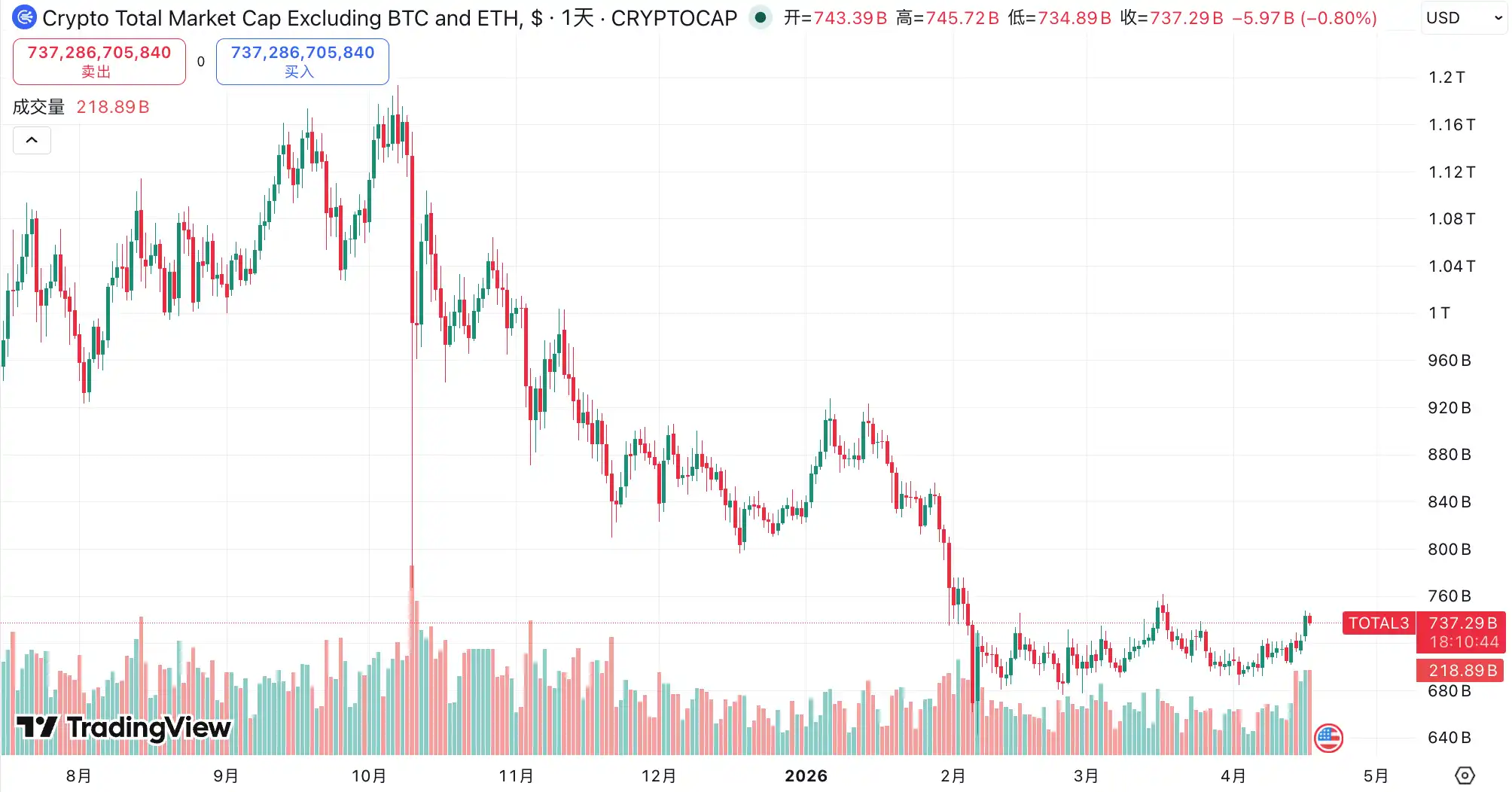
What does halving in market value mean? A $10 million asset in a $500 million market cap market represents 2% of the circulating supply, while in a market cap of $50 million, it represents 20%. The threshold has decreased tenfold, but the amount of money remains the same. After overselling, the cost of controlling the market becomes calculable. And if it's calculable, it's executable.
In the past few days, the sharp rise of the SIREN token has provided an analysis case study. SIREN experienced a rapid surge in late March, marking a notable uptrend. On March 24, on-chain analyst EmberCN issued a warning: an entity may have controlled up to 88% of SIREN's circulating supply, equivalent to around $1.8 billion at the time's price. As the news spread, SIREN plummeted from $2.56 to $0.79 on the same day, a drop of over 70%. During the rapid price plunge, almost no one could exit at a reasonable price as that price was never determined by the market.
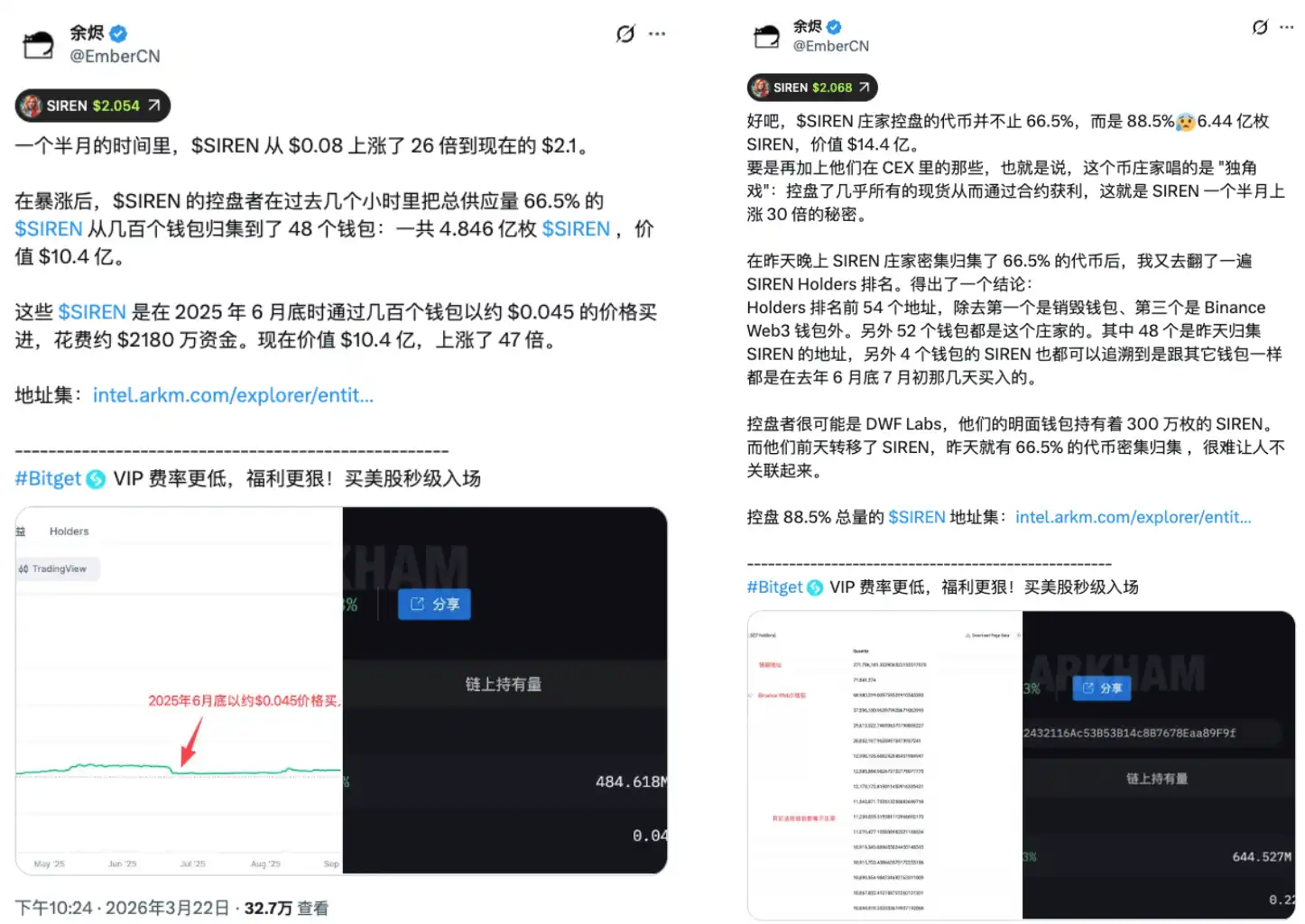
A conservative estimate suggests that 48 wallets hold approximately 66.5% of the circulating chips. Even based on this lower bound, a very limited set of addresses already has the structural conditions to control the price trajectory. From the moment price formation began, the symmetry of this game was already broken. Retail investors, holding money they thought was participating in free-market trading, entered a container with a pre-set exit path.
SIREN is not an isolated case, nor a black swan; it is the structural norm of oversold altcoins. The deeper the plunge, the less money needed, and the easier it is to hijack. Overselling is not a discount; it is fragility. With this round of overall market cap decline of 40%, this fragility has systematically expanded across the entire market.
Shorts as Fuel
If the story stopped here, the logic would be unidirectional: the big players lock in profits, drive up the price, retail investors buy in, followed by a crash. However, the market of microcap altcoins usually has another layer of structure on top, where shorts become the kindling.
During SIREN's rapid price surge, the funding rate reached -0.2989% every 8 hours, implying an annualized rate of about -328%. In essence, shorting SIREN and holding a position required shorts to pay about 0.3% of the principal every 8 hours to longs. Holding the position for a month, this fee alone could devour over 25% of the principal, not to mention the paper losses from price appreciation.
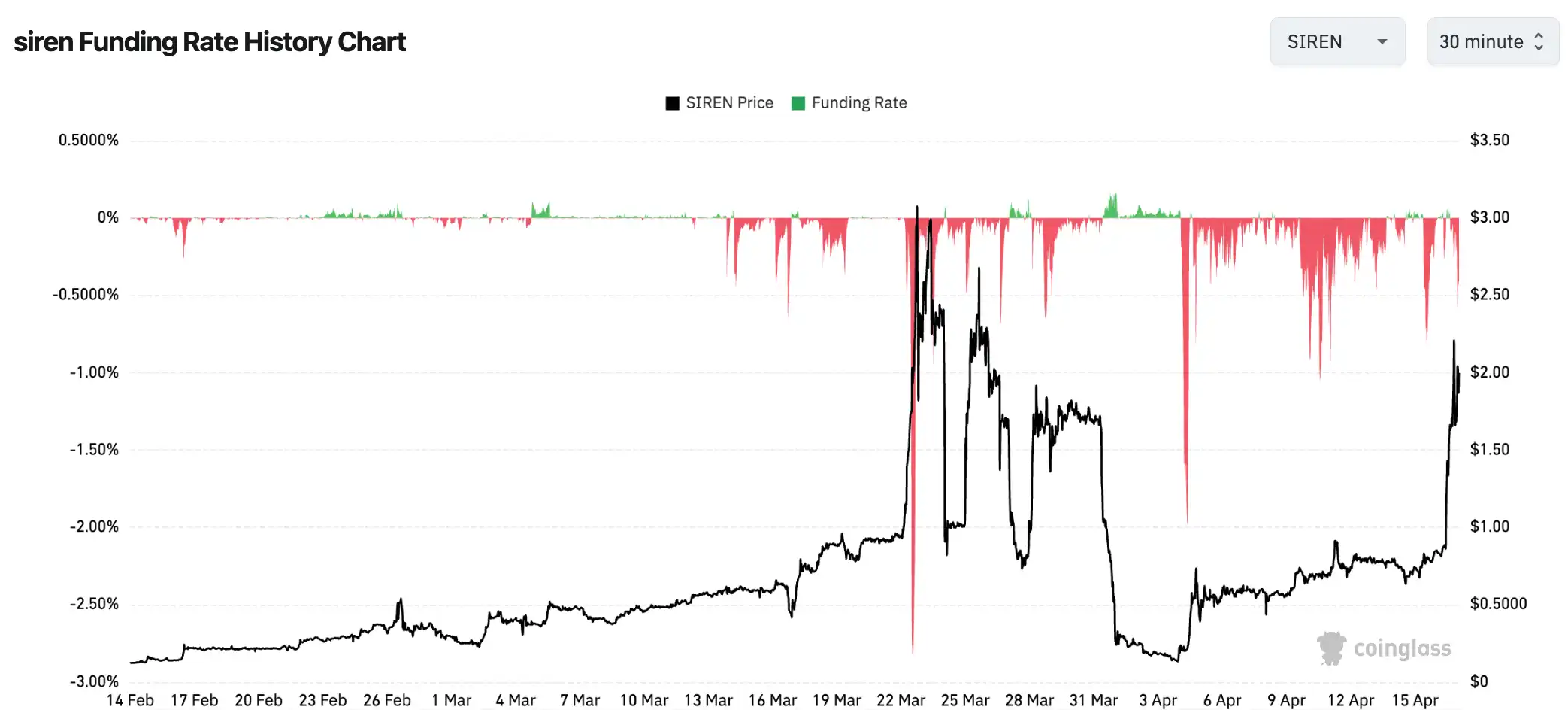
This figure is not uncommon in the small-cap altcoin market. Some tokens have seen funding rates drop to as low as -0.4579% every 8 hours, implying an annualized rate of around -501%. At this level, shorts face not the risk of being wrong in direction but the certainty of being slowly ground down by a machine. Even if the final direction turns out to be correct, they are exhausted long before the day of vindication arrives.
When you see a meme coin pump 80% and decide to short it for a retracement, each of your short positions incurs an interest payment to the long side. At the same time, once the price continues to rise and hits your liquidation price, the system automatically executes a market order to close your position, which, in turn, further drives up the price due to the forced buy liquidation.
The cascading effect of forced liquidations operates in this manner. As the price goes up, short positions face paper losses, the losses hit the liquidation threshold, the system automatically market buys to close the position, this buy order further boosts the price, triggering more short positions, and initiating a new round of buy liquidations. In a low-liquidity small-cap market, each order can fuel larger price movements, and the efficiency of this cascading effect is much higher compared to high-cap assets.
There is an often overlooked asymmetry here. Someone who sees a token surge 90% and decides to short it usually believes they are making a probabilistically sound judgment: "After such a big rise, there must be a pullback." However, in a market highly concentrated with locked-in positions, this judgment must not only battle price movement but also contend with a 0.3% funding cost every 8 hours and the chain reaction of passive buy orders triggered after hitting the liquidation price. This game was asymmetrical from the start.
An extreme negative funding rate is the gauge on this machine's dashboard. Shorts have been accumulated, ammunition is loaded, and at this moment, the acceleration is pushing the price higher fast. The group standing on the other side only has two choices: get liquidated and exit, or chase the price higher. Both choices add fuel to the price. This is not a market-driven uptrend; it is a unidirectional consumption designed structure.
A Market without New Money
On BSC Chain, weekly DEX trading volume increased by 97% YoY, the altcoin season index stands at 34/100, and BTC dominance is at 58.5%. These three numbers can coexist while also being contradictory.
The on-chain activity is indeed scorching, but the latter two numbers tell you that this market is still in the "Bitcoin season," where less than half of the mainstream altcoins have outperformed Bitcoin, the dominant funds are highly concentrated in Bitcoin, far from being widely diversified. However, the three numbers all point to the same reality: existing funds are circulating rapidly, not new money pouring in. The excitement is real, but excitement does not equate to expansion.
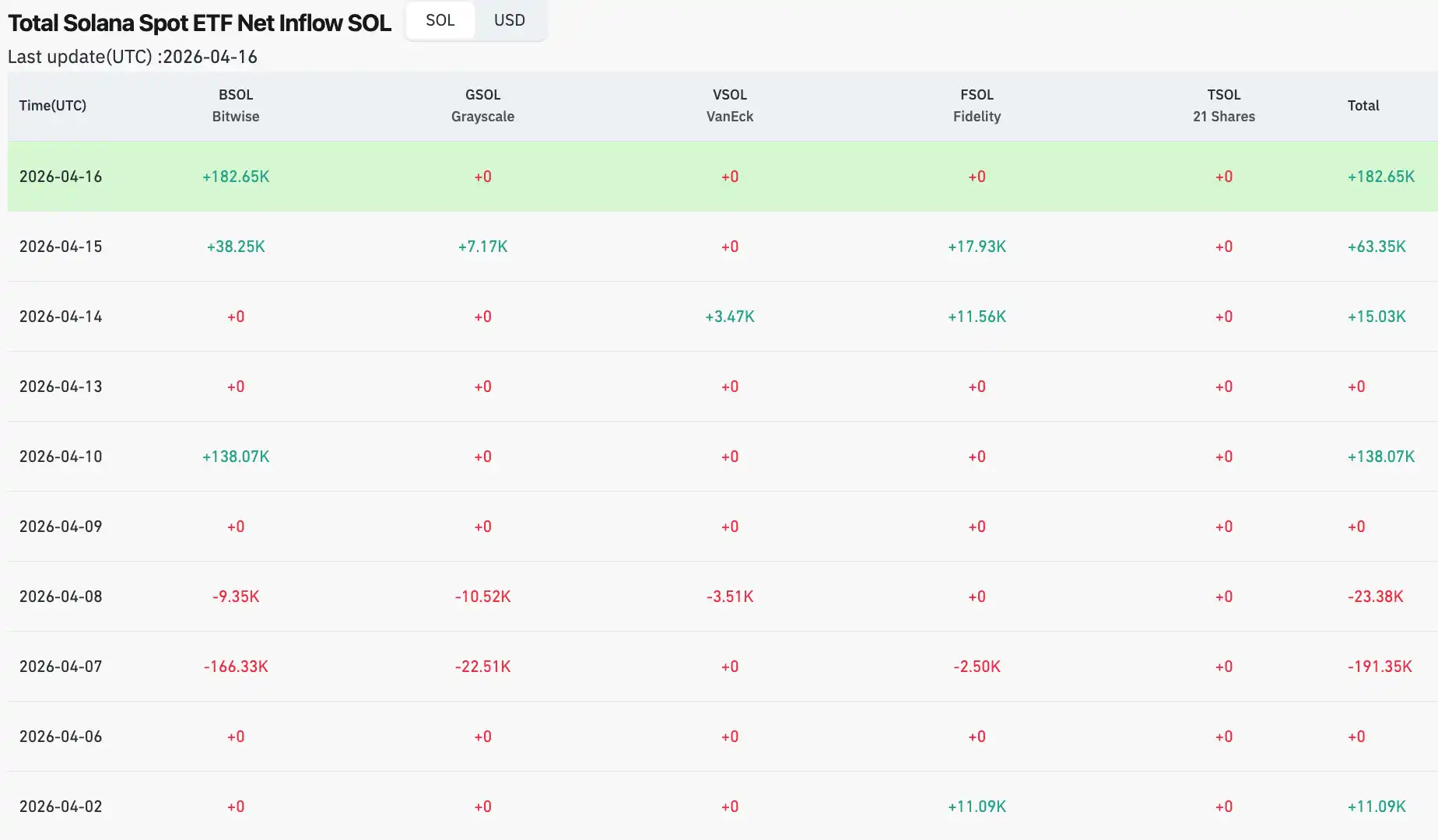
The movements of institutional funds provide evidence. In early April, the Solana ETF saw net inflows return to zero on a single day after recording a net outflow of $6.2 million on March 30, with the XRP ETF continuously experiencing net outflows at the beginning of the month, seeing only a tiny inflow of about $64,600 on April 2, and although the Ethereum ETF witnessed a $120 million net inflow on April 6, the day prior had seen an outflow of $71 million. The overall pattern of institutional funds in the altcoin direction is one of caution rather than rotation.
Compared to the real altcoin season in 2021, the difference is structural. That round from the beginning of the year to May saw BTC dominance drop from over 70% to below 40%, hitting a low of around 39%. The rotation of funds between Bitcoin and altcoins was clearly visible, with the altcoin season index surpassing 90 at one point. It was a comprehensive expansion driven by macro liquidity flooding, the lingering heat of DeFi summer, retail FOMO entering massively, stablecoin supply rapidly expanding during the same period, and incremental funds continuously flowing into the entire ecosystem. Today's 34 and 58.5% paint a different picture, with the engine just starting to warm up and still far from running at full speed.
There is also a unique variable in this round of the cycle. The institutional funds entering the market through ETFs follow internal logic of asset allocation, not the emotional logic of the crypto market. Institutions are making adjustments like "adjust Bitcoin exposure to X%," not "the altcoin season is coming, increase exposure to altcoins." This batch of funds structurally will not spontaneously rotate into the altcoin market unless a clear order is given. This is the most fundamental structural difference between 2021 and 2026. The money that came in 2021 included a large amount of retail funds that followed the hot trends, whereas today, institutional funds are anchor-based, following a fixed path and not drifting with market sentiment.
The on-chain transaction volume surge of 97% is real, but a market without new money is a zero-sum game. Every winner's gain corresponds to another player's loss, and the total amount in the pool remains the same. Stock game theory may not necessarily collapse, but it determines the structure of the game. The excitement belongs only to those who are already in, who already have chips. Latecomers typically use their own money to complete the final mile of others' profit-taking.
Epilogue
Going back to that set of data from the beginning, Bitcoin rose by about 0.85% in four days, while several small-cap tokens surged several times in the same period. Now you have a framework. Bitcoin's rise is one thing; the macro environment is catching its breath, institutional funds are testing the waters, and the market is waiting for the next clear signal. The sudden surge of altcoins is another matter; the low market cap after the oversell created structural vulnerabilities, with a small amount of capital levering the price in thin liquidity containers, and extreme negative funding rates turning shorts into longs' fuel. Both events happening simultaneously does not mean they are telling the same story.
The altcoin season index is at 34, BTC dominance is at 58.5%. By 2021 standards, this machine hasn't even completed its warm-up program. BTC dominance needs to drop from 58% to around 39% as it did that year, institutional funds need to expand from "Bitcoin allocation" to "crypto asset portfolio allocation," incremental funds need to keep flowing in instead of cashing out at the peak. None of these can be solved by a single circuit breaker.
There are two kinds of people in this world: those who know what this machine is for, and those who are the fuel for it to operate.
Bitcoin's rise is a signal, while the frenzy of altcoins is just an echo. Differentiating between the two is key to making a decision in this market that is not predetermined by the machine.
You may also like

Morning Report | BitMine increased its holdings by 126,971 ETH last week; trader Eugene announced his exit from the crypto market

Wang Chuan: How can one not feel anxious after the neighbor Old Wang made thirty times profit by investing in storage stocks? (Seven) - A quarter-century cycle

Cryptocurrency CEXs are flocking to sell US stocks, and traditional brokerages are facing an "uninvited guest."

$75 billion in foreign capital has fled, and South Korean retail investors have absorbed it all using leverage

Japan’s Three Megabanks Plan Joint Stablecoin Issuance in Fiscal 2026
MUFG, SMBC, and Mizuho reportedly plan to jointly issue fiat-pegged stablecoins in fiscal 2026, signaling Japan’s growing push into bank-led digital payment infrastructure.

Humanity Discloses H Token Dual-Chain Attack Details, With Losses on Ethereum and BSC Exceeding $36 Million
Humanity said the H token attack across Ethereum and BSC caused more than $36 million in losses after leaked ProxyAdmin keys enabled malicious contract upgrades and token minting.
White House Discusses CLARITY Act With Law Enforcement Ahead of Senate Vote
The White House discussed the CLARITY Act with law enforcement ahead of a Senate vote, focusing on illicit finance risks and developer protections.

Bitcoin Trading Guide 2026: Strategies for Experienced Traders

What Is XAUT and PAXG? Why Tokenized Gold Is Booming in 2026

Will the SpaceX IPO Hurt Bitcoin? Here's What Traders Are Watching

Foreign selling in the South Korean stock market accelerates, with cumulative net sales reportedly reaching $75 billion this year
On June 9, The Kobeissi Letter, citing Goldman Sachs data, reported that global investors are selling South Korean stocks at an unusually rapid pace. In the latest trading session, foreign investors sold about $801 million worth of Kospi constituent stocks again; total foreign outflows last week reached about $10 billion, and the market has been in net foreign selling on nearly every trading day over the past month. According to the data cited in the report, foreign investors have sold about $75 billion worth of South Korean stocks so far this year. Meanwhile, South Korean retail and institutional investors together recorded roughly $69 billion in net buying over the same period, suggesting that the market’s main buying support has come from domestic capital rather than returning overseas funds. The information currently disclosed still mainly comes from The Kobeissi Letter’s retelling and Goldman Sachs data summaries, while public details on the statistical period and the specific definition of “selling” remain relatively limited.

Fortune Warns of Strategy’s Financing Structure Risks as Bitcoin Premium Narrows
Fortune warned that Strategy’s Bitcoin treasury model faces growing financing risks as MSTR’s net asset premium narrows and preferred stock dividend pressure increases.

Ferrari Challenge Le Mans: Carl Moon to Dominate in WEEX Livery

Sahara AI Responds to SAHARA’s Sharp Drop: No Contract or Product Security Issues Found, Internal Investigation Underway
Sahara AI responded to SAHARA’s 60% price drop, saying no token contract or product security issues have been found and an internal investigation is underway.

WEEX Deposit/Withdrawal Dynamic Island: Your Asset Status, Always in Sight
Scaling Crypto Derivatives: The Digital Asset Infrastructure Behind High-Volume Trading
In the fast-moving digital asset ecosystem, derivatives platforms face an extreme architectural test. High-leverage futures markets demand more than just standard security—they require absolute operational precision, zero-latency matching engines, and ironclad structural scalability, all while navigating intense market volatility.
As global platforms scale to meet these demands, the industry is shifting away from rigid, monolithic setups toward a more agile, "decoupled" infrastructure philosophy.
The Blueprint for High-Volume Copy TradingFor elite global exchanges like WEEX (founded in 2018), this architectural choice becomes critical when scaling high-volume retail features like social copy trading. When thousands of users automatically mirror the real-time strategies of elite traders simultaneously, it triggers sudden, monumental spikes in concurrent transactional volume.
To prevent execution latency or settlement bottlenecks during these peak volatility events, a platform's primary engine must remain entirely dedicated to risk management, copy-trade synchronization, and order matching.
The Architectural Rule: New-generation platforms must separate front-end user execution engines from heavy backend infrastructural overhead to eliminate operational friction.
By separating these layers, platforms can maintain complete sovereignty over their trading environments and user experiences while strategically aligning with institutional-grade infrastructure ecosystems. This strategic framework allows modern exchanges to leverage advanced Digital Asset Custody infrastructure such as Cobo’s behind the scenes, ensuring that backend wallet management scales elastically alongside trading spikes.
Capitalizing on Market Momentum and 400× LeverageIn a derivatives arena where platforms offer up to 400× leverage on perpetual contracts, capital efficiency and market agility are core business metrics. To capture market momentum, an exchange needs the ability to rapidly expand its asset offerings, supporting everything from legacy crypto assets to sudden, trending altcoins across a massive library of trading pairs.
Adopting a flexible, scalable Wallet-as-a-Service (WaaS) solution such as Cobo’s could completely rewrite the development timeline for high-growth exchanges. Instead of spending months of engineering capital building out custom backend wallet architectures for every new blockchain network, platforms can deploy localized infrastructure in days.
This agility allows platforms to instantly scale their listings to over a thousand trading pairs without compromising security or delaying time-to-market. It mirrors the exact operational advantages seen during high-velocity market events, similar to how advanced wallet infrastructure empowers platforms during sudden asset surges; allowing exchanges to pass that speed and liquidity directly to their global user base.
A Mature Foundation for GrowthThe synergy between trusted infrastructure ecosystems and global trading platforms represents the natural evolution of a maturing crypto market. As WEEX continues to scale its global spot and derivatives offerings for over 6 million users, adopting robust backend paradigms proves that platforms no longer have to compromise between cutting-edge trading velocity and uncompromised structural security.

Get Paid to Onboard? Try WEEX’s New Homepage with Rewards for Registration, Deposit & Trade
WEEX Custom Layout: Build Your Perfect Trading Workspace in Seconds
Morning Report | BitMine increased its holdings by 126,971 ETH last week; trader Eugene announced his exit from the crypto market
Wang Chuan: How can one not feel anxious after the neighbor Old Wang made thirty times profit by investing in storage stocks? (Seven) - A quarter-century cycle
Cryptocurrency CEXs are flocking to sell US stocks, and traditional brokerages are facing an "uninvited guest."
$75 billion in foreign capital has fled, and South Korean retail investors have absorbed it all using leverage
Japan’s Three Megabanks Plan Joint Stablecoin Issuance in Fiscal 2026
MUFG, SMBC, and Mizuho reportedly plan to jointly issue fiat-pegged stablecoins in fiscal 2026, signaling Japan’s growing push into bank-led digital payment infrastructure.
Humanity Discloses H Token Dual-Chain Attack Details, With Losses on Ethereum and BSC Exceeding $36 Million
Humanity said the H token attack across Ethereum and BSC caused more than $36 million in losses after leaked ProxyAdmin keys enabled malicious contract upgrades and token minting.


