
 Buy Crypto
- Markets
 Futures
- Spot
- Copy Trade
- Earn
- More
Tokenization Era of Fundraising, a Milestone in US Regulatory Financing

The hot topic this week is that Monad will conduct an ICO on Coinbase. In addition to discussing whether the sale at a $25 billion FDV is worth participating in, as Coinbase's first ICO, its "compliance level" has also sparked widespread discussion, seen as a landmark event in the cryptocurrency industry's compliance.
Stablecoin USDC issuer Circle mentioned in its recent third-quarter financial report that it is exploring the possibility of issuing a native token on the Arc Network. Coinbase also, almost 2 years later, in an interview in October this year by Jesse Pollak, co-founder of Basechain, said that it will launch the Base token. All signs indicate that the asset issuance in the cryptocurrency industry is entering a new era of compliance.
Coinbase's Historic First ICO, What Did Monad Disclose?
For this historic first ICO on Coinbase, the Monad Foundation subsidiary MF Services (BVI), Ltd. provided an 18-page disclosure document. This document clarifies Monad's legal structure, financing details, and liquidity plan, and includes an 8-page investment risk disclosure. Compared to past ICOs, this is unprecedented and of significant progress.
At the legal structure level, Monad clarified the following:
- The seller of Monad tokens is MF Services (BVI) Ltd., a subsidiary of the Monad Foundation, with the Monad Foundation as the sole director of that company
- Monad's three co-founders are Keone Hon, James Hunsaker, and Eunice Giarta. Monad's key contributors are the Monad Foundation and Category Labs.
- Category Labs, based in New York, is responsible for Monad's technical development, with James Hunsaker serving as the CEO of Category Labs
- The Monad Foundation is a memberless foundation based in the Cayman Islands, responsible for community engagement, business development, developer and user education, and marketing services. Keone Hon and Eunice Giarta are co-managers of the Foundation. The Foundation is overseen by a board of directors including Petrus Basson, Keone Hon, and Marc Piano
These legal framework-level disclosure details provide investors with a stronger protection mechanism, enhancing investor accountability and legal recourse.
At the funding details level, Monad has clarified the following:
- Pre-Seed Funding: A funding amount of $19.6 million, conducted between June and December 2022
- Seed Round Funding: A funding amount of $22.6 million, conducted between January and March 2024
- Series A Funding: A funding amount of $220.5 million, conducted between March and August 2024
- In 2024, the Monad Foundation received a $90 million donation from Category Labs to cover operational costs before the public launch of the Monad Network. This donation is intended to cover the expected expenses of the Monad Foundation until 2026 and is part of the $262 million raised by Monad Labs in its various funding rounds
The disclosure of funding details avoids the funding fabrication and resulting misvaluation often seen in past projects in the crypto space.
At the market making scheme level, Monad has clarified the following:
- MF Services (BVI) Ltd. has signed loan agreements with five market makers, CyantArb, Auros, Galaxy, GSR, Wintermute, lending a total of 160 million MON tokens. Wintermute has a lending period of one year, while the rest are for one month and renewable monthly
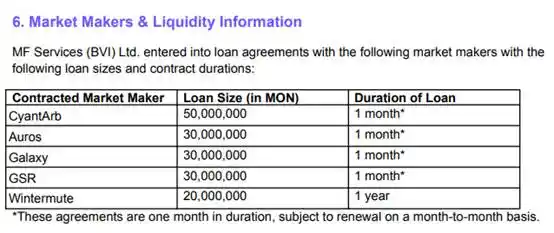
- Monitored by a third-party expert (Coinwatch) to verify the usage of lent tokens, including the idle balances of CyantArb, Auros, Galaxy, and GSR
- MF Services (BVI) Ltd. can also deploy up to an initial 0.20% of the total initial MON token supply in one or more decentralized exchange (DEX) pools
- The tokens in the market maker loans and initial liquidity are included in the ecosystem development allocation of the tokenomics
This is the first time seeing a crypto project transparently disclose specific market making schemes before the TGE. Combining all the above information, it is also the first time we have seen ICO transparency in the crypto space aligning closer to traditional market asset issuance.
The Challenging Journey of ICO Compliance
In 2017, Ethereum emerged, and the ERC-20 standard brought about the ICO frenzy, leading to a surge in projects and the industry's first boom. However, it was also in that year, July 2017, that the SEC first released guidance on ICOs. At that time, the SEC announced that any sale of a new cryptocurrency to investors with profit expectations, conducted by a centralized company, would be considered a security and must therefore comply with securities regulations.
According to this guidance, ICOs taking place in the United States after this time were likely to violate securities regulations and faced the risk of SEC prosecution. Since the publication of the guidance, there have been multiple cases brought to light. According to the SEC's 2018 annual report, in just that year, there were dozens of investigations launched involving ICOs and digital assets, "many of which remained ongoing at the close of the 2018 fiscal year."
In November 2018, the SEC issued its first civil penalties for ICOs conducted without proper securities registration. The projects Paragon (PRG) and Airfox (AIR) were fined $250,000 each and were also required to register their tokens as securities and file periodic reports.
In June 2019, Canadian social media company Kik Interactive found itself entangled in a lawsuit with the SEC due to its ICO. To fight the SEC, Kik even established a new fund called crypto.org to raise enough funds for their legal defense.
The two largest ICOs in crypto history, EOS with $4.2 billion and Telegram with $1.7 billion, were both caught up in legal disputes with the SEC. Block.one paid a $24 million fine to settle with the SEC, while Telegram reached a $1.24 billion settlement regarding the issuance of its Gram tokens under its subsidiary TON Issuer. The $1.24 billion Telegram settlement includes $1.22 billion in ill-gotten gains and a $18.5 million civil penalty.
Celebrities and KOLs have also been sued by the SEC for alleged ICO-related issues. John McAfee, the founder of the popular antivirus software McAfee, was sued for failing to disclose income he received for promoting ICO tokens, and crypto KOL Ian Balina was sued for participating in the promotion of unregistered cryptocurrency ICOs.
On July 10, 2019, the SEC approved the secondary market offering of blockchain company Blockstack PBC, marking the first SEC-qualified offering (ICO) under securities law. Another project, Props, also received approval from the U.S. Securities and Exchange Commission (SEC) in July of that year. However, two years later, Props announced plans to cease further issuance of its Props token after December 2021 based on the SEC's Reg A+ and to discontinue support for the Props Loyalty program. Props stated at the time that they had determined they could not sustain or further develop the Props Loyalty program within the existing securities regulatory framework due to a lack of relevant authorized domestic trading venues such as Alternative Trading Systems (ATS), restricting American holders of Props tokens from trading them. Similar factors hindered the development of Props.
For a long time, the ICO model has been plagued by compliance issues, so it has gradually been replaced by VC investments, exchange IEOs, and retroactive airdrops after the 2017 frenzy. Therefore, Coinbase's reintroduction of ICOs this time is not regarded by the market as a simple "nostalgic" move, but as a "rebirth" of ICOs in a whole new market structure after years of cryptocurrency compliance advancement.
The Rebirth of ICOs
On November 12, Matt Hougan, Chief Investment Officer of Bitwise, stated that Coinbase's newly launched Launchpad marks the strong return of crypto-based capital formation. Compliant ICOs are expected to become a core theme in 2026 and reshape the startup financing model to become the fourth pillar disrupting traditional finance with cryptocurrency. The previous three pillars were Bitcoin's reshaping of gold, stablecoins' reshaping of the dollar, and tokenization's reshaping of trading and settlement.
Matt Hougan stated that early ICO experiments proved that blockchain technology could connect entrepreneurs and investors faster and at a lower cost than traditional IPOs, even though the previous hype failed. The key difference this time lies in regulation and structure. Current SEC Chairman Paul Atkins (who previously co-chaired the Token Alliance, a crypto advocacy group supporting ICOs, and served on the board of tokenization company Securitize) recently called for new rules and safe harbor mechanisms to support compliant token issuance, and Coinbase's new platform is the first major practical step in this direction.
By 2025, ICOs had accounted for about one-fifth of all token sale transaction volume, a significant increase from almost negligible two years ago. Platforms such as Echo, Kraken Launch, and Buidlpad have made significant progress in all aspects compared to the past rough ICO processes or simple gas wars by adapting to current compliance requirements, incorporating features such as self-custody, multi-chain issuance support, and access control mechanisms. Successful cases like Plasma and Falcon Finance have already been seen on these platforms.
The rebirth of ICOs is a manifestation of the cryptocurrency market's flowering after years of compliance exploration. We will see more serious ICO cases like Monad, and retail investors will receive better protection. As mentioned at the beginning of the article, projects like Arc from Circle and Base from Coinbase, previously widely believed to have a low probability of issuing coins, are sending new signals in the current era of maturity in compliance.
We are entering a new era.
You may also like

A plunge of over 97% continues to unlock, yet WLD has completed $65 million in over-the-counter financing: who is still footing the bill?

Potential Bitcoin Crash Below $60K May Delay Recovery to 2027
Key Takeaways: Bitcoin’s deep drawdown phase may extend recovery to the second quarter of 2027. Historical data shows…

BTC USD Price Drops Below $67K Amid Rising Treasury Yields
Key Takeaways: BTC USD slumped to $66,300, its first drop below $67K since March 9, driven by macroeconomic…

Second Bill Targets Insider Trading in Prediction Markets
Key Takeaways: The Public Integrity in Financial Prediction Markets Act of 2026 prohibits government officials from using insider…

India Apprehends Key Figure in Myanmar Crypto Fraud Complex
Key Takeaways: India’s Central Bureau of Investigation (CBI) arrested a key player in a scam that trafficked Indian…

Bitcoin and Profit Metrics: Will History Repeat Itself?
Key Takeaways: Historical patterns reveal that when Bitcoin’s supply in profit falls below 50%, significant price rallies ensue.…

Bitcoin ‘Compression’ Outcome Could Propel BTC Towards $80K: An Analyst’s Perspective
Key Takeaways: Bitcoin’s price is testing a critical $71,500 level, hinting at a possible rally to $80,000. Traders…
Data Points to Accelerating Ether Supply Crunch: Will ETH Price Follow?
Key Takeaways: As of now, 33.1% of Ethereum’s circulating supply is staked, resulting in a tighter liquid supply.…

XRP Risk-Reward Improves as Whale Accumulation Surges: Will the Price Mirror This Trend?
Key Takeaways: XRP’s Sharpe Ratio turned positive on March 26, 2026, indicating a potential for returns outweighing associated…

Cryptocurrency Price Predictions for March 27: BTC, ETH, BNB, XRP, SOL, DOGE, HYPE, ADA, BCH, and LINK
Key Takeaways: Bitcoin is struggling to maintain its position above the $66,000 threshold, amplifying concerns of a further…
Bitcoin ETFs Face Capital Outflow as Market Treads with Caution
Key Takeaways: Bitcoin ETFs experienced a $296 million outflow, ending a four-week inflow run. Total net assets for…

Crypto Market Predictions: BTC, ETH, BNB, XRP, SOL, DOGE, HYPE, ADA, BCH, LINK
Key Takeaways: Bitcoin struggles at the $72,000 level as bulls aim for $80,000, while resistance remains strong. Ethereum…

Bitcoin Returns to $71K as Oil Prices Plummet with Trump Halting Iran Strikes
Key Takeaways: Bitcoin rallies 5% to surpass $71,000 following Trump’s delay of US military action against Iran. Liquidations…

Ether Taker Volume Reaches Three-Year Peak: Can ETH Sidestep a 19% Price Drop?
Key Takeaways: An Ether on-chain indicator has surged to its highest in over three years, signaling potential stabilization…

Bitcoin Spot Volumes Reach 2023 Lows While BTC Rallies Stay News-Driven
Key Takeaways: Bitcoin’s price surged to $71,600 during a US market open, but the rise lacked consistent spot…
Unifying Ethereum: Tackling Fragmentation and Embracing Onchain Trading
Key Takeaways: Ethereum developers propose a groundbreaking ‘Economic Zone’ to address fragmentation in layer-2 networks. Onchain commodity trading…
Lummis Affirms CLARITY Act as DeFi’s Strongest Shield Yet
Key Takeaways: The CLARITY Act is touted by Senator Cynthia Lummis as providing unparalleled protections for DeFi developers.…
US Probes Bitmain over Security Concerns Amidst Crypto Mining Dominance
Key Takeaways: US authorities have initiated “Operation Red Sunset” to investigate potential security threats posed by Bitmain’s Chinese-manufactured…
A plunge of over 97% continues to unlock, yet WLD has completed $65 million in over-the-counter financing: who is still footing the bill?
Potential Bitcoin Crash Below $60K May Delay Recovery to 2027
Key Takeaways: Bitcoin’s deep drawdown phase may extend recovery to the second quarter of 2027. Historical data shows…
BTC USD Price Drops Below $67K Amid Rising Treasury Yields
Key Takeaways: BTC USD slumped to $66,300, its first drop below $67K since March 9, driven by macroeconomic…
Second Bill Targets Insider Trading in Prediction Markets
Key Takeaways: The Public Integrity in Financial Prediction Markets Act of 2026 prohibits government officials from using insider…
India Apprehends Key Figure in Myanmar Crypto Fraud Complex
Key Takeaways: India’s Central Bureau of Investigation (CBI) arrested a key player in a scam that trafficked Indian…
Bitcoin and Profit Metrics: Will History Repeat Itself?
Key Takeaways: Historical patterns reveal that when Bitcoin’s supply in profit falls below 50%, significant price rallies ensue.…


 App
App