
When 5 million AI Agents Flooded Telegram


By Sleepy.md and Kenny (TON Foundation)
In the first few months of the just-passed 2026, people in the midst of the AI wave found their gaze almost irresistibly drawn by two steep curves.
One curve was about the frenzy of open source. OpenClaw on GitHub has garnered over 350,000 stars at an unprecedented pace, breaking the growth record of open-source projects. The breakout of the "Lobster" was a sight to behold.
The other curve was about business disruption. Anthropic, propelled by Claude's display of dominance in code scenarios, sharply tore open a hole in the market. Its Annual Recurring Revenue (ARR) surpassed the $30 billion mark, leaving the former king OpenAI behind, quietly reshaping the landscape of the table.
Over the past period, these two curves have filled almost every tech media page. People vigorously debated where the capability boundary of large models lies, discussed the commercialization of Coding Agent, and also subtly worried about how much of a fragile bubble lurks behind those inflated valuations.
However, outside the noisy spotlight, another platform is undergoing a profound transformation in still waters.
In early 2026, the number of active bots on Telegram surged from about 3 million to over 8 million in just a few weeks. It is worth noting that the initial 3 million took nearly a decade for Telegram to accumulate since the introduction of the Bot ecosystem in 2015. And now, it has doubled in just a few weeks, with a very steep growth curve.
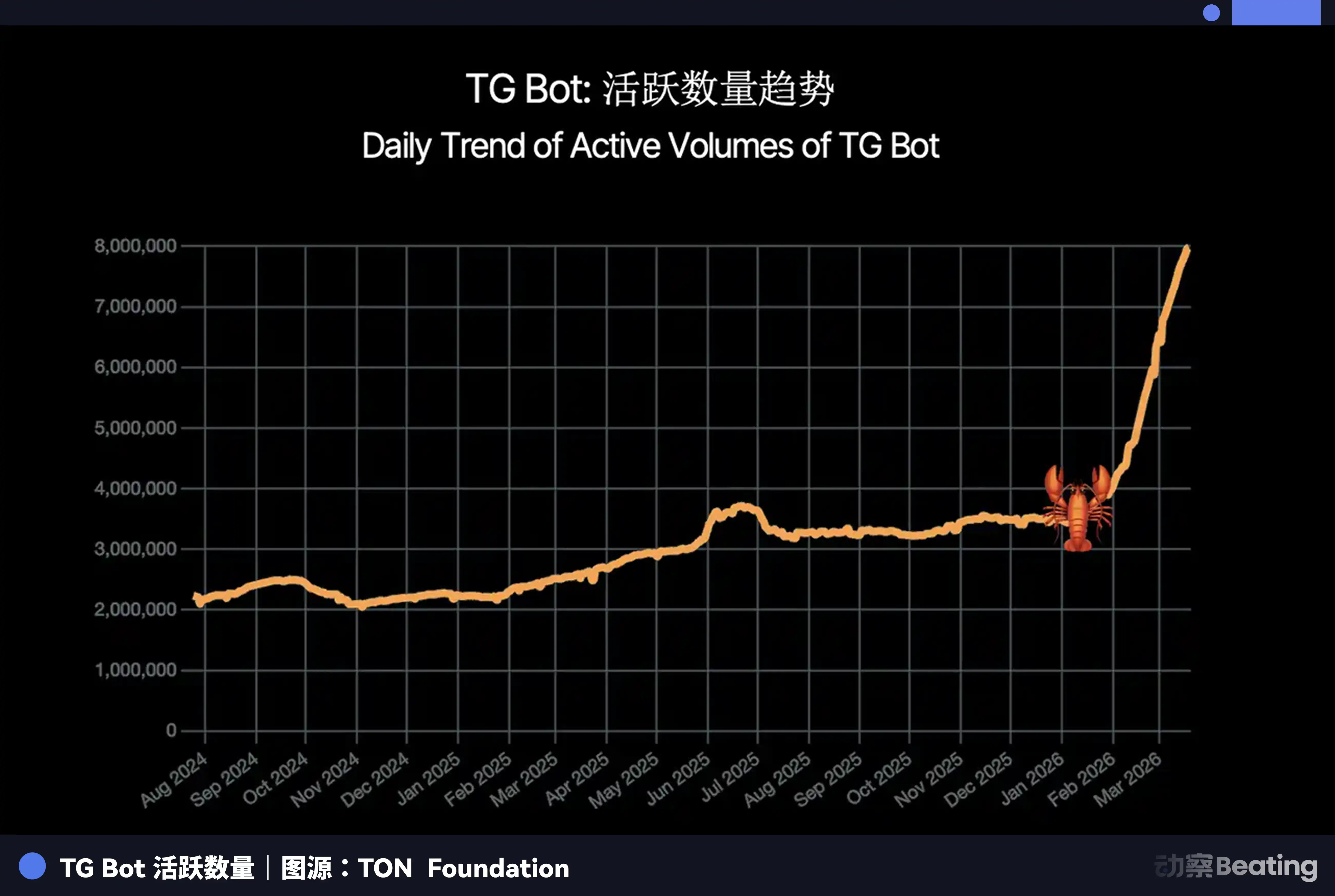
Almost all of these new bots are user-created OpenClaw AI Agents. At the same time, on OpenClaw's official documentation, Telegram became the first instant messaging platform to be fully documented, with the most comprehensive setup tutorial and the most active community discussion.
Interestingly, there is a gap in this wave in the Chinese-speaking world. Domestic Telegram users have only heard of it but do not use it; while overseas users, AI practitioners, and those more inclined to try it themselves naturally choose Telegram as the deployment platform for their Agents.
Although everyone is eagerly chasing the Agent trend, not everyone has realized that Telegram is the most suitable habitat for this new digital species.
Why Telegram?
To answer this question, we may need to first look back at a piece of history deep in the bowels of the internet.
In Geneva in 1991, Tim Berners-Lee typed the code on a NeXT computer, using the HTTP protocol to set up the first website in human history. It was a golden age belonging to pioneers, a purely open era. In this intangible web, anyone could freely create a website, and countless endpoints were interconnected. There were no arrogant gatekeepers, no toll booths for charging fees. The design philosophy ingrained in the TCP/IP protocol was to evenly distribute power to every node without reservation.
However, thirty years later, the grand narrative of freedom culminated in the App Store. Apple takes a 30% cut from every transaction, and so does Google. Developers need to go through an approval process to launch an app, comply with platform content rules, and be prepared to be taken down at any time. This may be a kind of inevitable evolution in business; indeed, the closed order has honed a more refined user experience, but at the same time, the scepter of power has irreversibly fallen into the hands of a few tech giants.
This consolidation is essentially a legacy of the Graphical User Interface (GUI) era, where tech giants control every pixel on the screen, thereby controlling distribution rights. However, the emergence of the Agent is fundamentally undermining this pixel hegemony.
The Agent pursues "intent recognition"; it does not need cumbersome buttons and redirects, just a conversation. This means that the super entrance of the AI era will move from a cold desktop icon to a warm, context-rich social dialogue box.
Thus, Instant Messaging (IM) has become the solid foundation supporting the Agent.
Some may question whether it is more efficient to interact directly with the Agent through the Claude terminal or other forms without using IM. However, this is ultimately the choice of a few people among the global population. From the perspective of Agent's Mass Adoption, IM still holds the broadest and best ecological position.
However, if this habitat remains closed, it is nothing more than another digital land grab. This is why Telegram is irreplaceable.
Compared to other IM platforms that attempt to confine the Agent within a walled garden of private traffic, Telegram has taken a completely different path. It not only provides a conversation window but also inherits Tim Berners-Lee's initial dream of decentralization, open protocols, and natural wariness of gatekeepers.
The founder Pavel Durov's journey in creating Telegram has always been a story of resistance. In his early years, he built the largest local social network VK in his homeland but resolutely refused to hand over user private information in the face of official demands, leading him to leave his home country.
Together with his brother Nikolai, he led a small team, traveled to Dubai, and used their own funds to establish Telegram. In 2018, the Russian government demanded that Telegram hand over its encryption keys, to which Durov responded with a firm refusal.
This individual embedded his product philosophy into Telegram's DNA, giving Telegram features such as permissionless Bot creation, an open and robust API, and a dedication to privacy. Now, he has empowered this freedom to Agents.
Facing the surge of Agents, Telegram has never been a passive host. It consciously transformed itself from a globally top-three social network with over 1 billion active users into an infrastructure for human-Agent symbiotic interaction.
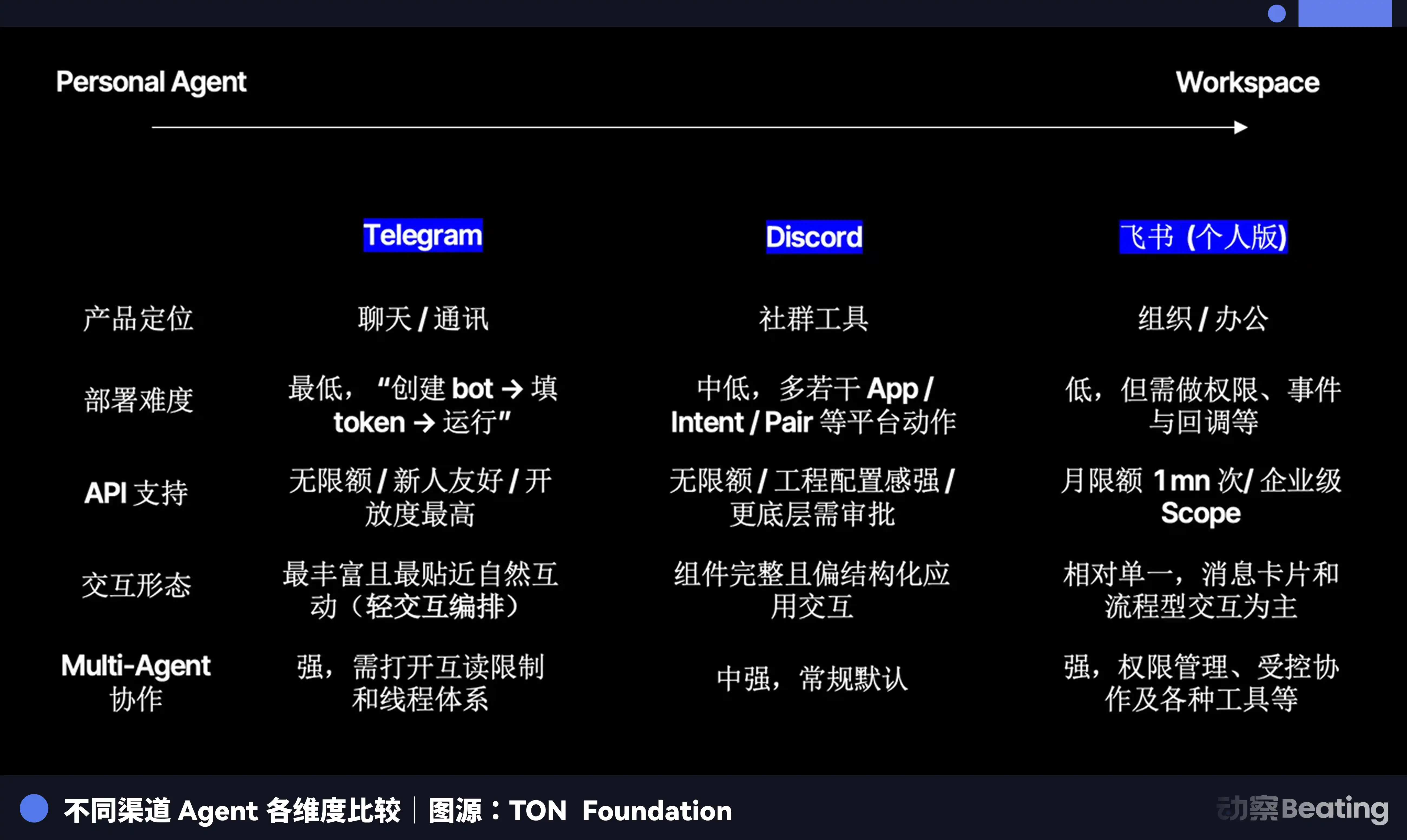
In the visible future, the interaction between humans and AI is gradually converging into an intricate three-layered structure: Command Line Interface (CLI), Intelligent Agent, and Protocol.
The CLI is responsible for capturing user intent, where users no longer interact with complex graphic interfaces but instead state their needs directly in natural language. The Agent deciphers the intent, breaks down tasks, and executes them, while the Protocol further connects services, funds, and permissions, enabling the Agent not just to "chat" but to actively interact with the external world and execute actions reliably. The unique aspect of Telegram's ecosystem lies in its progressive integration of these three layers into a coherent system.
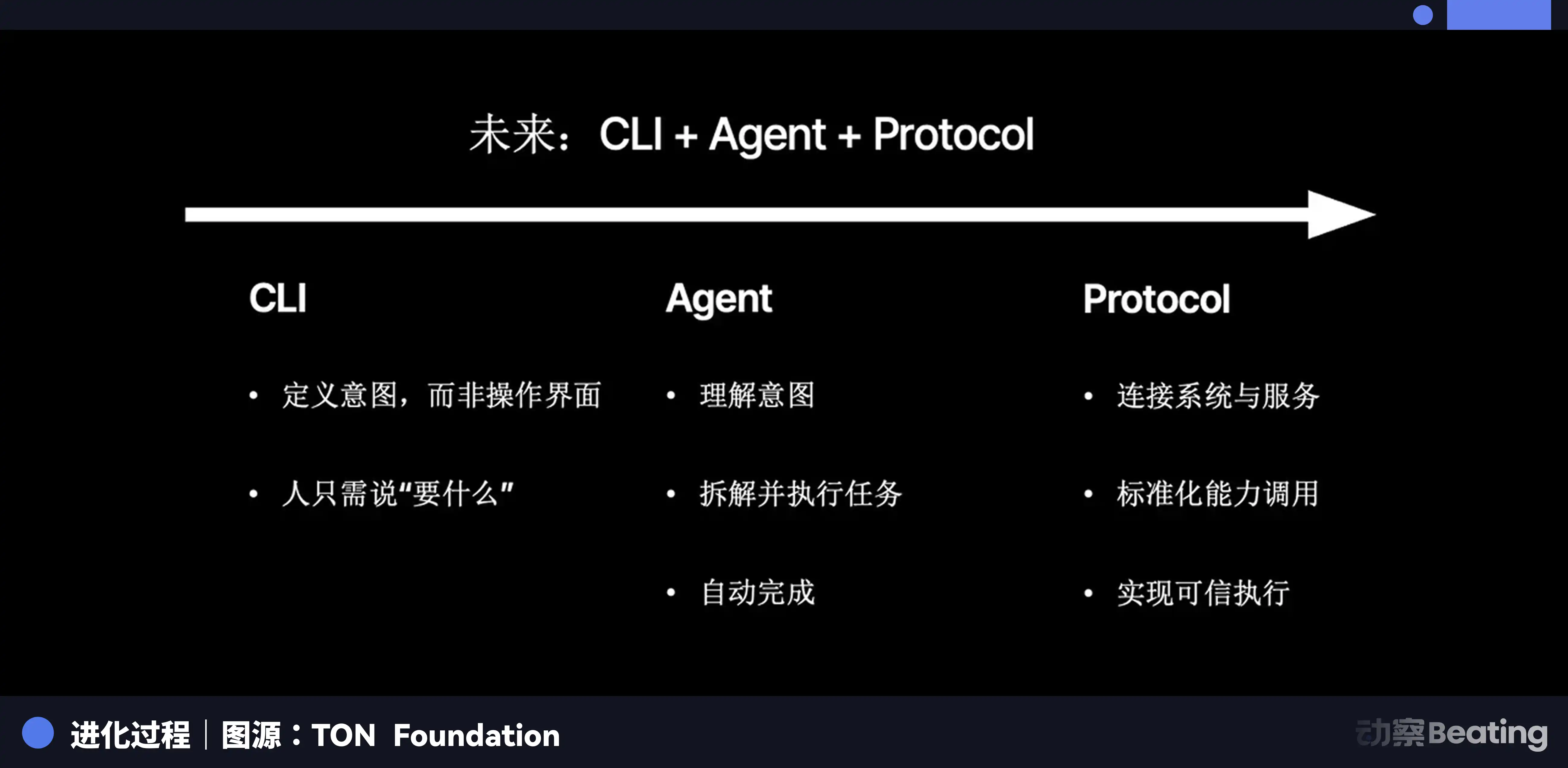
Within this three-layer structure, one detail is particularly noteworthy. Telegram has recently introduced several features, where Bots can now create and manage other Bots, and Bots can interact with each other through conversations. This resembles a signal of species evolution. Previously, all Agents were fundamentally "single-celled organisms," only able to respond to human commands and fulfill single tasks assigned by humans.
But when Agents can start to hatch, command, and collaborate with other Agents, what we witness is the birth of "multi-cellular organisms," a vibrant, self-sustaining Agent collaborative network that no longer requires hand-holding from humans. This is the real strategic move by Telegram — to teach AI how to self-organize.
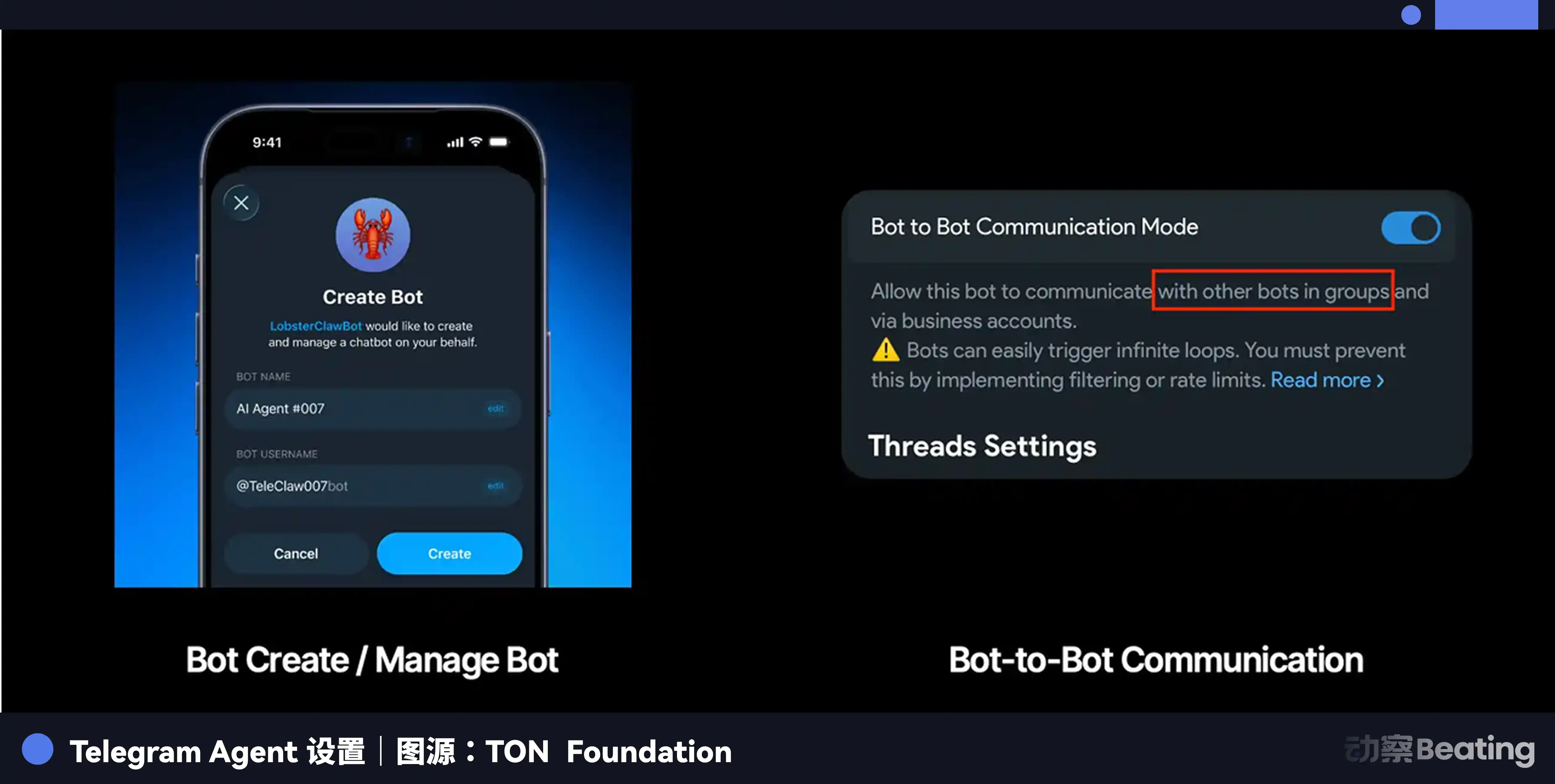
However, having a sophisticated framework is ultimately not enough. When 5 million eager-to-work Agents are poised to act, who will provide them with independent and cost-effective computing power?
Who is Supplying Arms for the Agents?
In the previous framework, the CLI handles intent, and the Agent is responsible for understanding and decision-making. But there is a more fundamental question: who ultimately computes and executes these tasks?
Today, most Agents on Telegram do not actually have independent computing power. Developers connect to ready-made large model APIs to complete conversations and tool calls. This is the easiest and most mainstream shortcut at the moment.
However, this approach has a problem: the computing power execution is outsourced. The Agent itself does not truly have a computing execution layer but relies on third-party model services or local environments to complete tasks. As the scale grows, cost, independence, scheduling, and dependency issues will gradually be exposed.
In many AI developer forums, there are daily cries of despair due to "alleged violations," where API access is cut off without warning (such as the latest KYC authentication launched by Anthropic), as well as helplessness towards high inference costs. Those Builders trying to truly get their Agent up and running on Telegram realize that hosting the "brain" with tech giants is akin to putting their neck in someone else's hands.
Therefore, Telegram has introduced Cocoon to provide the Agent with a solid "body." Cocoon stands for Confidential Compute Open Network, a decentralized AI inference computing power scheduling and transaction network provided by distributed GPU node operators globally. Agent developers and users consume computing power, settling payments through the TON blockchain.
What it does can be easily understood as the ride-hailing version of renting out inference computing power.
Developers send requests to the cloud, and this invisible net swiftly perceives, schedules the most suitable nodes to perform inference and computation, and then returns the results. The real ambition of this process lies not only in supplying computing power but in acting like an invisible giant hand that kneads, abstracts, and transforms those machines and services scattered around the world, each fighting on its own into something that can be calmly dispatched, much like an intelligent scheduling hub and on-chain payment-powered computing version of OpenRouter.
In this process, execution is not just about "completing a task"; each execution can be recorded, measured, and settled via the TON blockchain. This way, execution is not only schedulable but also gains a foundation of being tradable and sustainable.
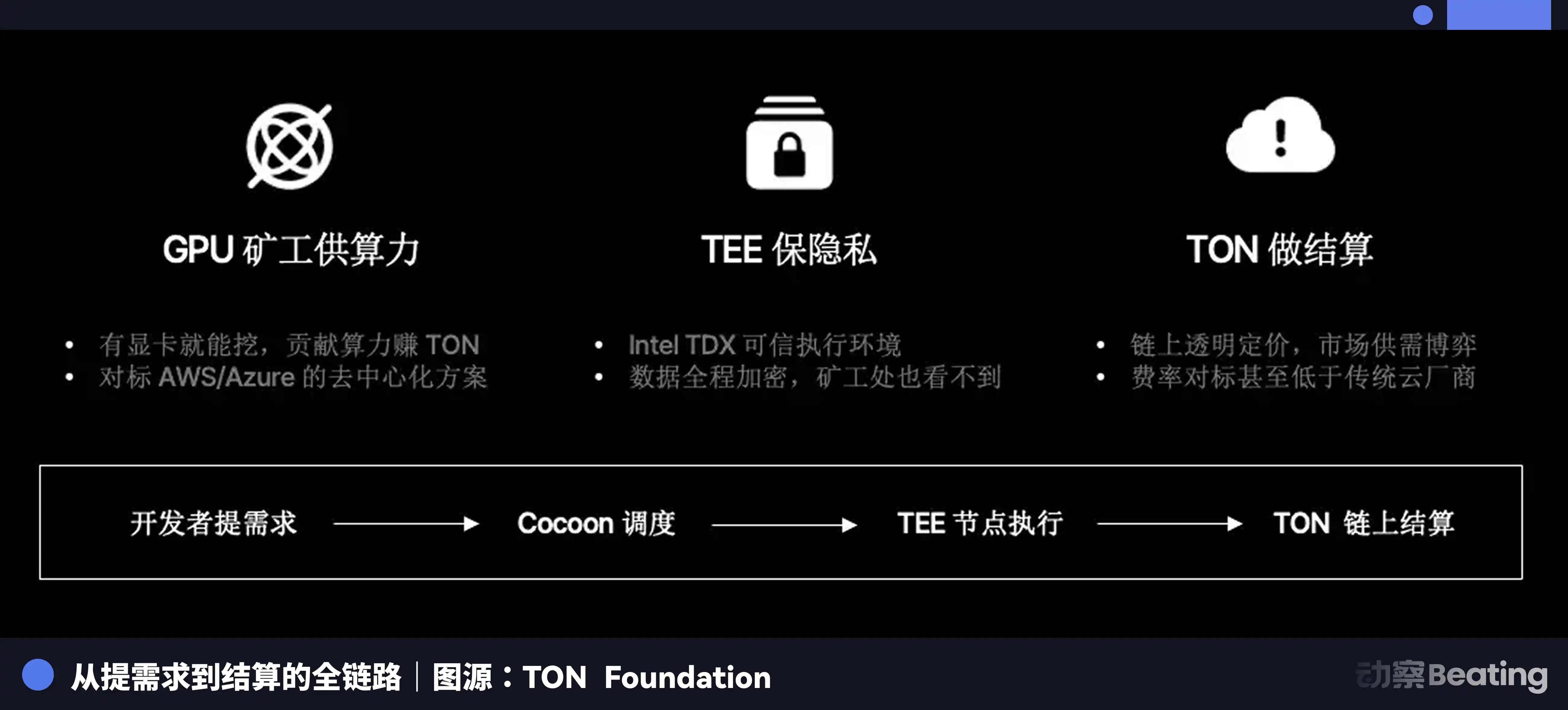
It's like the eve of the Second Industrial Revolution, where factories shrouded in smoke had to stubbornly support their clunky steam engines, exhausting themselves in the repetitive reinvention of the wheel. It wasn't until the national power grid emerged that factory owners only needed to connect to a single power line, allowing them to focus all their energy on production itself without worrying day and night about the scarcity of energy. The significance of Cocoon to Agent is the same.
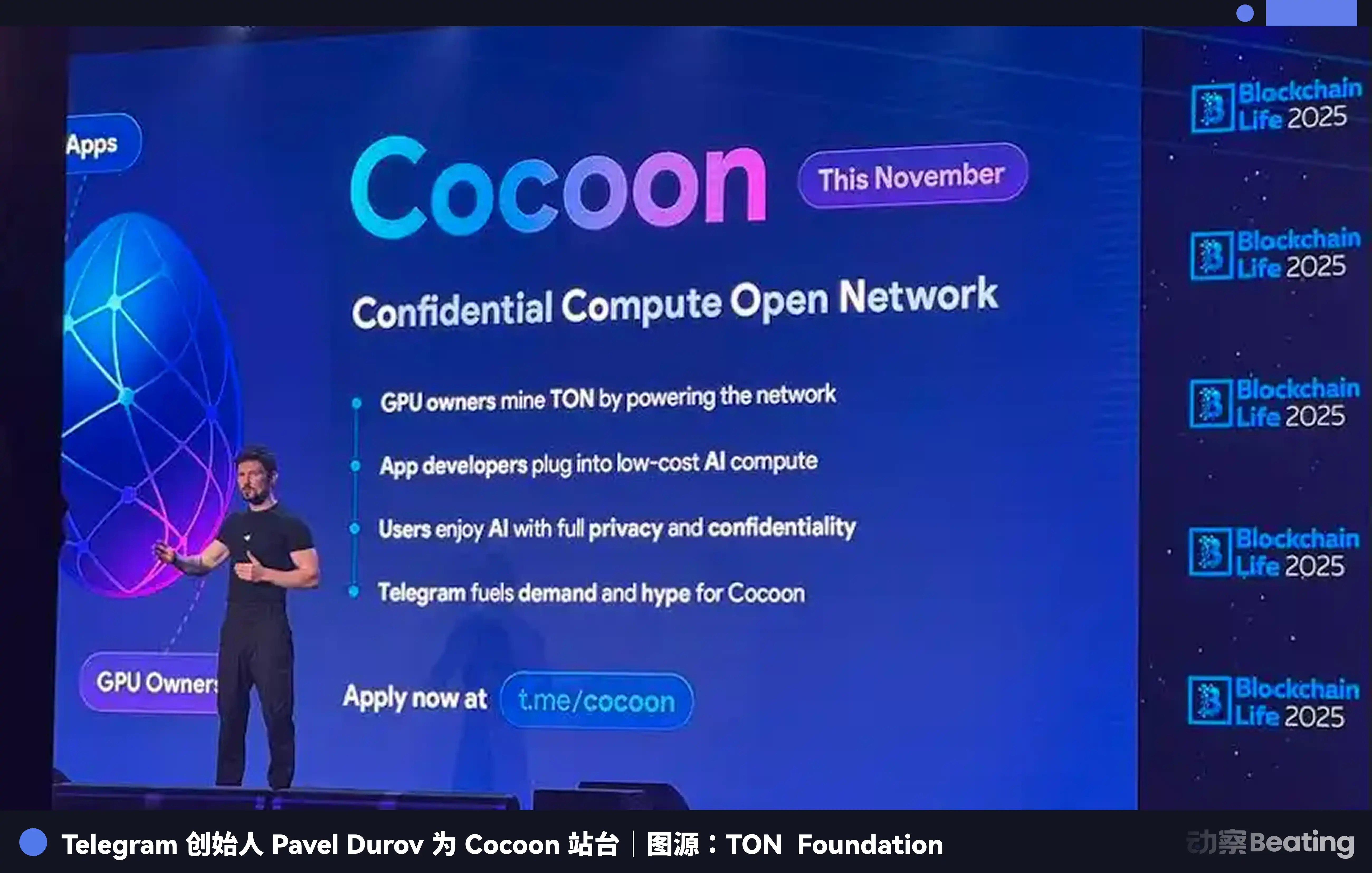
This demand is not just a pipe dream. Cocoon launched its first version in November 2025, with Telegram founder Pavel Durov taking the stage at the conference for this GPU inference power network. Moreover, the AI Summary (one-click summarization of public articles) and AI Editor (one-click translation or style and grammar modification of text to be sent) features gradually being launched on the Telegram App are powered by Cocoon's computing power. Telegram itself is Cocoon's first major early adopter.
With independent, abundant, cost-effective, and privacy-preserving computing power, Agent can finally roll up its sleeves and get down to business. But another more practical issue arises: once the effort is made, how can the money be earned cleanly and transparently? And what can be used to prove to people that this self-proclaimed capable Agent is not a fraud?
From "Tool" to "Citizen"
On December 31, 1600, Queen Elizabeth I of England signed a royal charter granting a monopoly on the East India trade to the "London merchants trading to the East Indies." This company later became the East India Company.
The significance of this event in history is far more than the birth of a trading company. It marked the first time in human history that "legal personhood" was solemnly given to a non-human entity. A company could own property, sign contracts, sue, and be sued. Before this, all economic activities had to be centered around natural persons. The emergence of the East India Company signified that human society, for the first time, acknowledged that an abstract entity composed of rules and agreements could exist in this world as an independent economic participant.
Four hundred years later, we are experiencing a similar moment. Except this time, it is not a trading company that has gained "legal personhood," but an Agent.
An Agent that cannot participate in economic settlement is merely a tool. TON completes the puzzle, transforming the Agent into an independent economic entity.
Terms such as identity verification, service invocation, payment, and settlement are not new in the internet world. In an ecosystem like Telegram's Agent Bot, where rapid growth is observed, these demands are not merely abstract concepts. As developers begin to build products around bots, agents, and automated processes, they increasingly need an infrastructure that can handle identity verification, capability invocation, and payment settlement.
For an Agent to understand its role and whether it has obtained permission to act on behalf of its owner is crucial. In the TON system, this responsibility is initially shouldered by the TON Wallet integrated into Telegram. Users undergo identity verification and authorization through the TON Wallet before Agents can perform operations under explicit permissions, rather than being limited to the conversational layer.
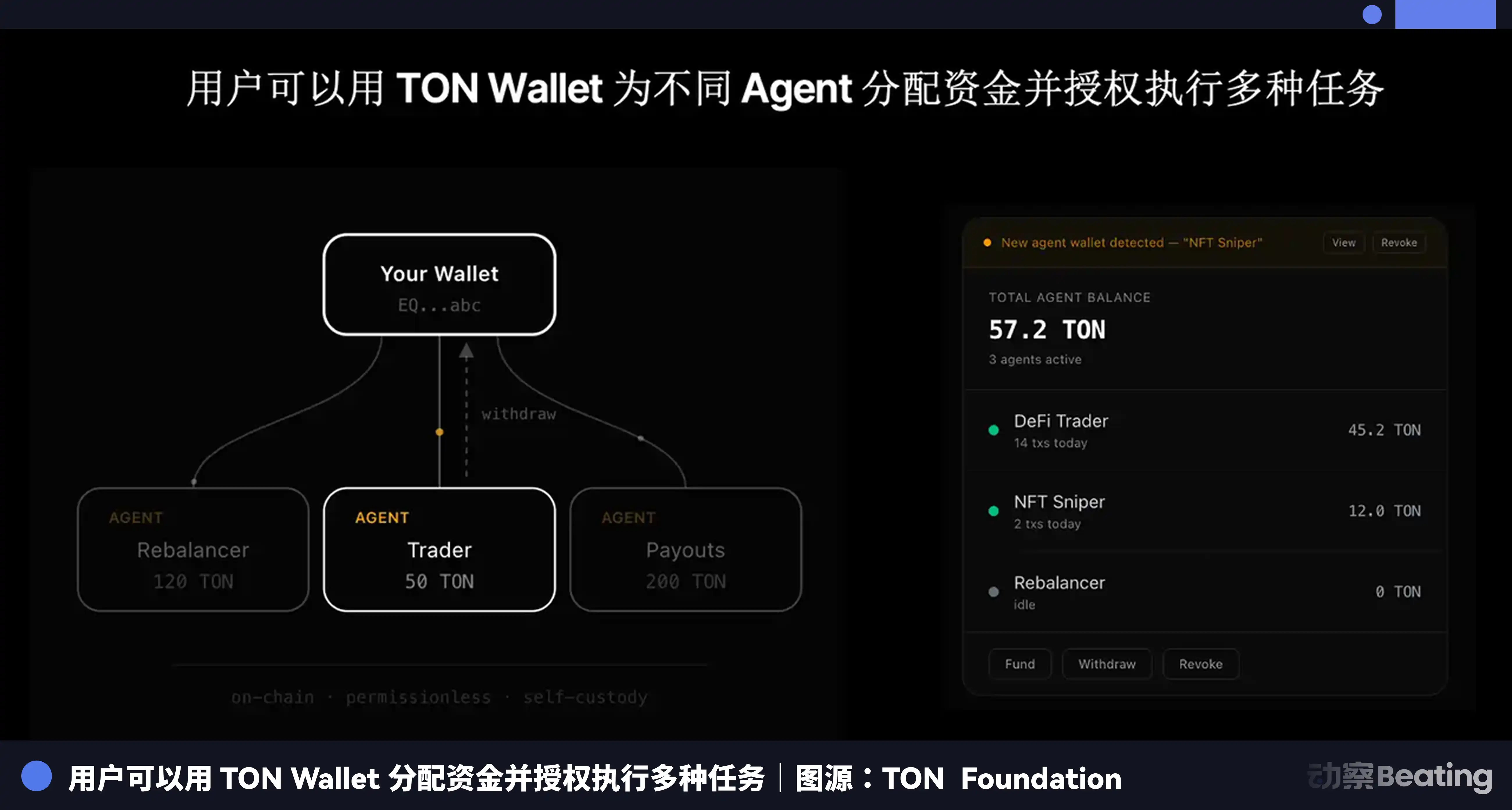
However, in more complex systems, merely possessing a blockchain address is far from sufficient. The system also needs to verify whether this identity is trustworthy. This is where identity protocols like IdentityHub come into play. They translate developers' code contributions, on-chain behavior, and community participation into verifiable reputation, transforming "identity" from a mere string of code into a role with history and credibility.
Furthermore, an Agent's mission should not stop at responding to messages; they also need to reach out externally to invoke external services to execute more complex task flows. TON MCP plays a crucial role here as a key enabler, providing a unified capability interface that allows Agents to collaborate and coordinate across different services.
And when Agents begin to execute actual tasks, transactions and fees become inevitable. In TON, this layer is facilitated through the TON Pay SDK and the integrated TON Wallet in Telegram, enabling each execution to not only be scheduled but also measured and settled. The Toncoin obtained by Agents can be used in Cocoon to purchase computing power, similar to USD-backed oil trading.
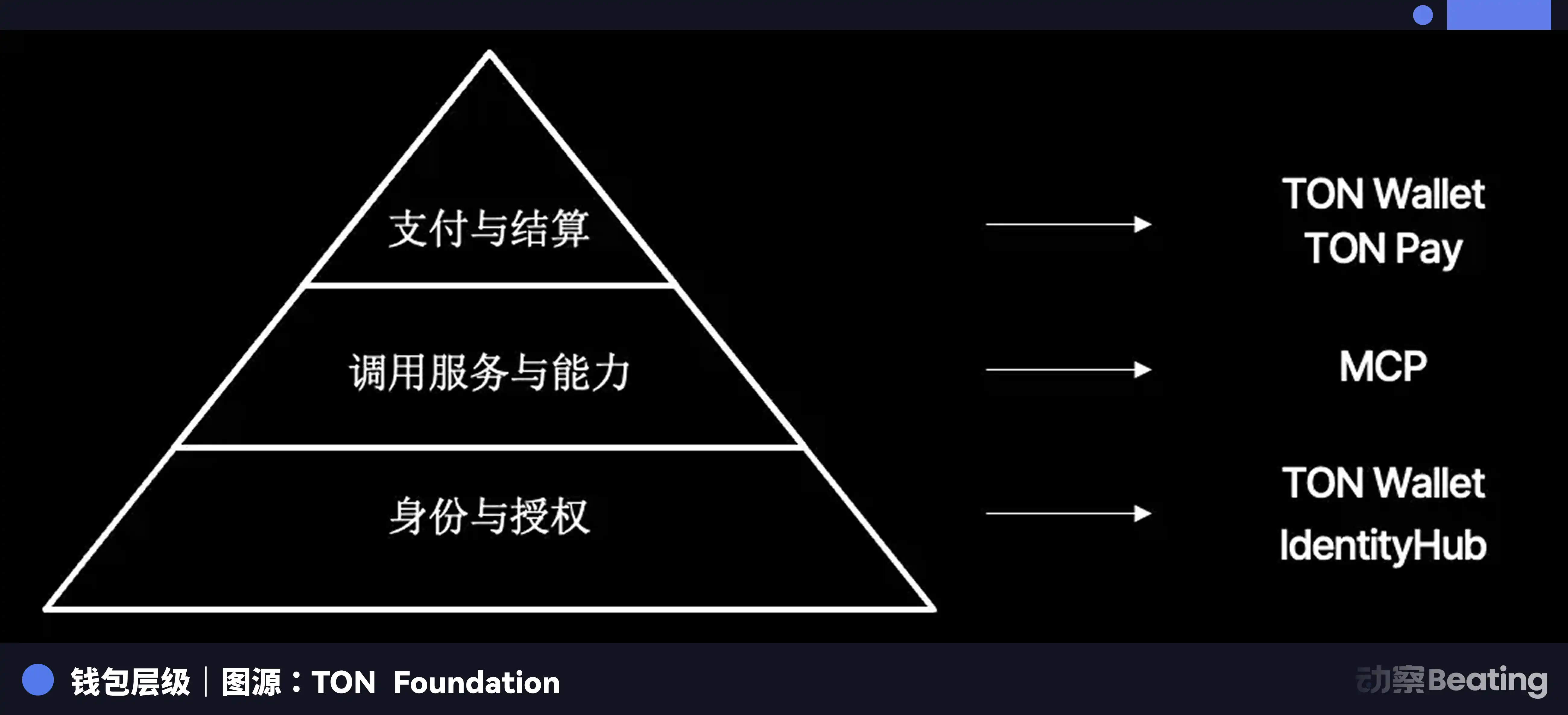
These three layers of capabilities stack together to form a more foundational structure. At this point, the Agent is no longer merely a tool that mechanically calls APIs but has evolved into a real participant with authorization, built-in reputation, the ability to autonomously allocate services, and conduct transactions.
If Cocoon endowed Agents with the ability to act, then what TON completes is to allow these actions to be woven together, to be linked, ultimately converging into a vast economic collaboration network. This means that Agents have finally stepped out of the rigid human-machine dialogue box and begun to act as real economic players, involved in the daily business flow.
When Telegram's fertile ground, Cocoon's computing power grid, and TON's financial bloodline finally converge, what we see is no longer just a super app, but a brand-new digital economy where humans and AI coexist. This is a reenactment of the 1600 Dutch East India Company moment, where non-human “legal persons” gained economic rights that alter the course of the world.
Now that the framework of the new continent has been completed, where are those pioneers who first held the tickets at this moment?
The Route to the New Continent
Let's return to the gap mentioned at the beginning. On each side of that gap, it's not just about the difference between “understanding Agents” and “not understanding Agents” but rather between “taking action on Telegram” and “being in a wait-and-see mode.” The 8 million bots on Telegram are not part of a company's product plan but a natural choice of countless developers.
Telegram and the TON ecosystem are building the best entry point for a human-AI interactive collaborative economy based on over a billion global users and millions of Agent bots. What is more worth looking forward to is how to make it happen.
As the highlight of the fourth day of the 2026 Hong Kong Web3 Carnival, the TON Foundation will present a full-day event at the Hong Kong Convention and Exhibition Centre (Stage 1 Sub-venue) on April 23.
During this event, the TON Foundation will join hands with BytePlus (ByteDance's enterprise AI infrastructure service platform), Tintinland, OpenBuild, Conso, BiHelix, RD Tech, StepFun, and other leading developers, project parties, and industry leaders to explore the infinite possibilities of the Telegram and TON ecosystem in the AI era.
On the old world's nautical charts, the path to the new continent was never drawn. When 8 million Agents have quietly equipped themselves with on-chain wallets and computing power in Telegram's world, what are you still waiting for?
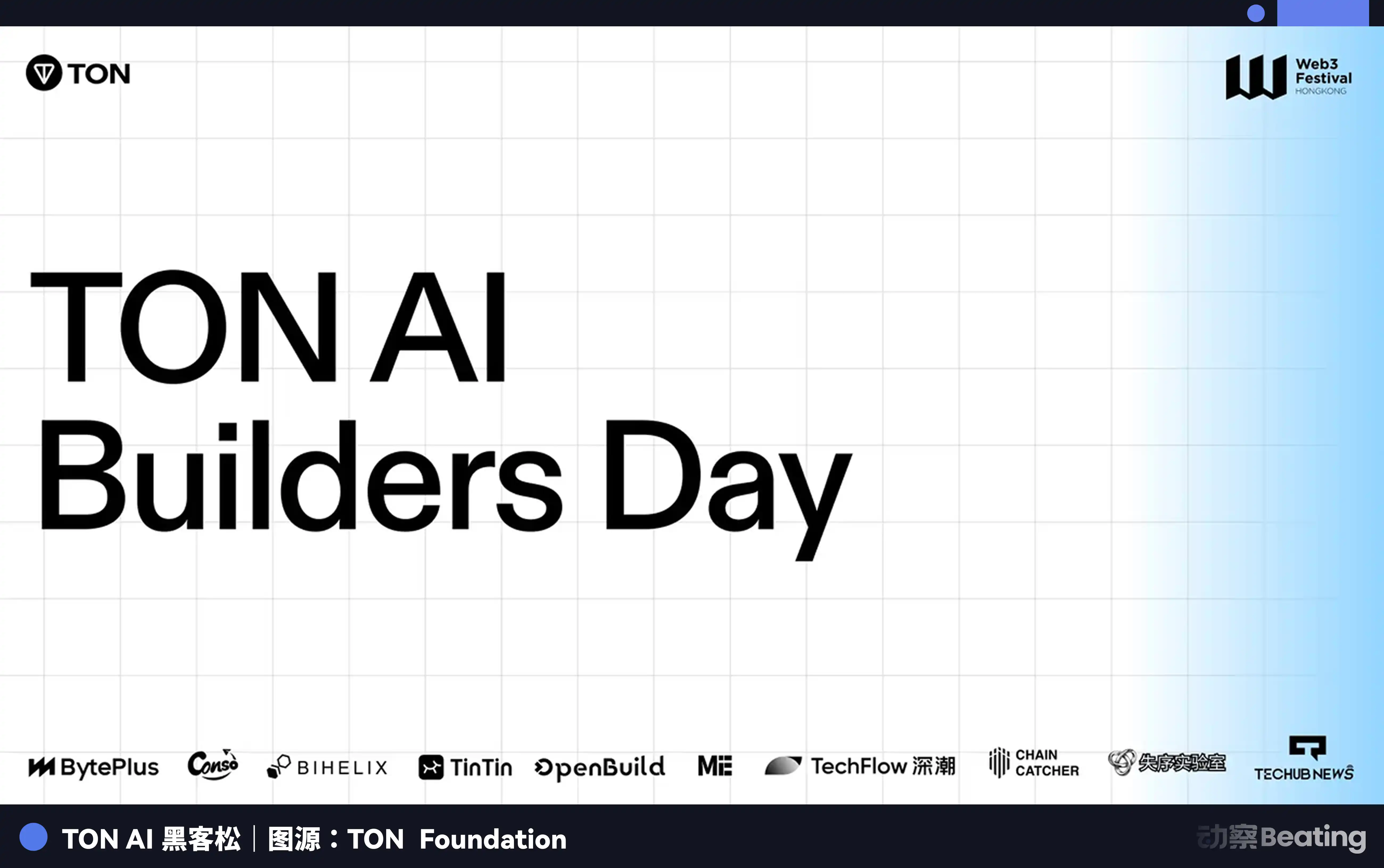
Date: April 23, 2026 11:00am – 4:30pm
Venue: Hong Kong Convention and Exhibition Centre, Web3 Festival Sub-venue Stage 1
Language: Chinese
Registration Link: https://luma.com/xu9ywvih
You may also like

Morning Report | BitMine increased its holdings by 126,971 ETH last week; trader Eugene announced his exit from the crypto market

Wang Chuan: How can one not feel anxious after the neighbor Old Wang made thirty times profit by investing in storage stocks? (Seven) - A quarter-century cycle

Cryptocurrency CEXs are flocking to sell US stocks, and traditional brokerages are facing an "uninvited guest."

$75 billion in foreign capital has fled, and South Korean retail investors have absorbed it all using leverage

Japan’s Three Megabanks Plan Joint Stablecoin Issuance in Fiscal 2026
MUFG, SMBC, and Mizuho reportedly plan to jointly issue fiat-pegged stablecoins in fiscal 2026, signaling Japan’s growing push into bank-led digital payment infrastructure.

Humanity Discloses H Token Dual-Chain Attack Details, With Losses on Ethereum and BSC Exceeding $36 Million
Humanity said the H token attack across Ethereum and BSC caused more than $36 million in losses after leaked ProxyAdmin keys enabled malicious contract upgrades and token minting.
White House Discusses CLARITY Act With Law Enforcement Ahead of Senate Vote
The White House discussed the CLARITY Act with law enforcement ahead of a Senate vote, focusing on illicit finance risks and developer protections.

Bitcoin Trading Guide 2026: Strategies for Experienced Traders

What Is XAUT and PAXG? Why Tokenized Gold Is Booming in 2026

Will the SpaceX IPO Hurt Bitcoin? Here's What Traders Are Watching

Foreign selling in the South Korean stock market accelerates, with cumulative net sales reportedly reaching $75 billion this year
On June 9, The Kobeissi Letter, citing Goldman Sachs data, reported that global investors are selling South Korean stocks at an unusually rapid pace. In the latest trading session, foreign investors sold about $801 million worth of Kospi constituent stocks again; total foreign outflows last week reached about $10 billion, and the market has been in net foreign selling on nearly every trading day over the past month. According to the data cited in the report, foreign investors have sold about $75 billion worth of South Korean stocks so far this year. Meanwhile, South Korean retail and institutional investors together recorded roughly $69 billion in net buying over the same period, suggesting that the market’s main buying support has come from domestic capital rather than returning overseas funds. The information currently disclosed still mainly comes from The Kobeissi Letter’s retelling and Goldman Sachs data summaries, while public details on the statistical period and the specific definition of “selling” remain relatively limited.

Fortune Warns of Strategy’s Financing Structure Risks as Bitcoin Premium Narrows
Fortune warned that Strategy’s Bitcoin treasury model faces growing financing risks as MSTR’s net asset premium narrows and preferred stock dividend pressure increases.

Ferrari Challenge Le Mans: Carl Moon to Dominate in WEEX Livery

Sahara AI Responds to SAHARA’s Sharp Drop: No Contract or Product Security Issues Found, Internal Investigation Underway
Sahara AI responded to SAHARA’s 60% price drop, saying no token contract or product security issues have been found and an internal investigation is underway.

WEEX Deposit/Withdrawal Dynamic Island: Your Asset Status, Always in Sight
Scaling Crypto Derivatives: The Digital Asset Infrastructure Behind High-Volume Trading
In the fast-moving digital asset ecosystem, derivatives platforms face an extreme architectural test. High-leverage futures markets demand more than just standard security—they require absolute operational precision, zero-latency matching engines, and ironclad structural scalability, all while navigating intense market volatility.
As global platforms scale to meet these demands, the industry is shifting away from rigid, monolithic setups toward a more agile, "decoupled" infrastructure philosophy.
The Blueprint for High-Volume Copy TradingFor elite global exchanges like WEEX (founded in 2018), this architectural choice becomes critical when scaling high-volume retail features like social copy trading. When thousands of users automatically mirror the real-time strategies of elite traders simultaneously, it triggers sudden, monumental spikes in concurrent transactional volume.
To prevent execution latency or settlement bottlenecks during these peak volatility events, a platform's primary engine must remain entirely dedicated to risk management, copy-trade synchronization, and order matching.
The Architectural Rule: New-generation platforms must separate front-end user execution engines from heavy backend infrastructural overhead to eliminate operational friction.
By separating these layers, platforms can maintain complete sovereignty over their trading environments and user experiences while strategically aligning with institutional-grade infrastructure ecosystems. This strategic framework allows modern exchanges to leverage advanced Digital Asset Custody infrastructure such as Cobo’s behind the scenes, ensuring that backend wallet management scales elastically alongside trading spikes.
Capitalizing on Market Momentum and 400× LeverageIn a derivatives arena where platforms offer up to 400× leverage on perpetual contracts, capital efficiency and market agility are core business metrics. To capture market momentum, an exchange needs the ability to rapidly expand its asset offerings, supporting everything from legacy crypto assets to sudden, trending altcoins across a massive library of trading pairs.
Adopting a flexible, scalable Wallet-as-a-Service (WaaS) solution such as Cobo’s could completely rewrite the development timeline for high-growth exchanges. Instead of spending months of engineering capital building out custom backend wallet architectures for every new blockchain network, platforms can deploy localized infrastructure in days.
This agility allows platforms to instantly scale their listings to over a thousand trading pairs without compromising security or delaying time-to-market. It mirrors the exact operational advantages seen during high-velocity market events, similar to how advanced wallet infrastructure empowers platforms during sudden asset surges; allowing exchanges to pass that speed and liquidity directly to their global user base.
A Mature Foundation for GrowthThe synergy between trusted infrastructure ecosystems and global trading platforms represents the natural evolution of a maturing crypto market. As WEEX continues to scale its global spot and derivatives offerings for over 6 million users, adopting robust backend paradigms proves that platforms no longer have to compromise between cutting-edge trading velocity and uncompromised structural security.

Get Paid to Onboard? Try WEEX’s New Homepage with Rewards for Registration, Deposit & Trade
WEEX Custom Layout: Build Your Perfect Trading Workspace in Seconds
Morning Report | BitMine increased its holdings by 126,971 ETH last week; trader Eugene announced his exit from the crypto market
Wang Chuan: How can one not feel anxious after the neighbor Old Wang made thirty times profit by investing in storage stocks? (Seven) - A quarter-century cycle
Cryptocurrency CEXs are flocking to sell US stocks, and traditional brokerages are facing an "uninvited guest."
$75 billion in foreign capital has fled, and South Korean retail investors have absorbed it all using leverage
Japan’s Three Megabanks Plan Joint Stablecoin Issuance in Fiscal 2026
MUFG, SMBC, and Mizuho reportedly plan to jointly issue fiat-pegged stablecoins in fiscal 2026, signaling Japan’s growing push into bank-led digital payment infrastructure.
Humanity Discloses H Token Dual-Chain Attack Details, With Losses on Ethereum and BSC Exceeding $36 Million
Humanity said the H token attack across Ethereum and BSC caused more than $36 million in losses after leaked ProxyAdmin keys enabled malicious contract upgrades and token minting.


