
 Buy Crypto
- Markets
 Futures
- Spot
- Copy Trade
- Earn
- More
Why Is the Money Not Here in Bitcoin?

Original Article Title: Crypto Exodus: Why Capital Is Leaving Bitcoin
Original Article Author: @PillageCapital
Translation: Peggy, BlockBeats
Editor's Note: If the first decade of Bitcoin resolved the "right to exist," the next decade will resolve the "ownership of value."
In the early days of the crypto world, Bitcoin represented rebellion and freedom, delivering a comprehensive blow to the rigid financial system. However, as the rebels won the battle, a new era quietly emerged: regulation began to embrace innovation, capital migrated to more efficient paths, stablecoins and tokenization of real-world assets rapidly expanded, and the mythos of Bitcoin faded away.
This article, from Bitcoin's historical mission and the breakdown of network effects to the rise of stablecoins, regulation, and tokenization of real-world assets, incisively points out the new turning point in the crypto industry.
Below is the original text:
Bitcoin was never the future of money. It was a battering ram in the regulatory war. Now, as this war nears its end, the capital that once propelled it is quietly exiting.
For the past 17 years, we have convinced ourselves that the "magic internet money" was the ultimate form of finance. This is not the case. Bitcoin is a regulatory battering ram, a single-function siege engine designed to destroy a particular high wall—the nation's absolute intolerance of "digital bearer assets."
This mission is now largely accomplished.
The tokenization of U.S. stocks has begun; gold tokenization is also legal and growing; the market capitalization of the U.S. dollar tokenization (stablecoins) has reached billions of dollars.
In times of war, a battering ram is invaluable; in peacetime, it is merely a heavy and expensive relic.
As financial infrastructure is upgraded and legitimized, the narrative of "Gold 2.0" is collapsing, reverting to what we truly desired in the 1990s: tokenized representations of real assets.
I. Prehistoric Era: E-gold
To understand why Bitcoin is becoming obsolete, one must first understand why it was created. It was not a "flawless birth" but rather the product of a series of digital currency experiments that were destroyed in the same way.
In 1996, E-gold was launched. By the mid-2000s, it had around 5 million accounts and processed transactions worth billions of dollars.
It proved one thing: the world does indeed need digital asset holdings backed by real value.
Then, the state stepped in and destroyed it. In December 2005, the FBI raided E-gold. In July 2008, the founder pleaded guilty.
The message conveyed couldn't be clearer: a centralized digital gold currency was too easy to destroy—a knock on a door, a server shutdown, a single prosecution, and it was all over.
Three months later, in October 2008, Satoshi Nakamoto released the Bitcoin whitepaper.
Prior to this, he had been contemplating these issues for years. In his own writing, he said the fundamental flaw of traditional currency and early digital currencies was their excessive reliance on central banks and commercial banks. Experiments like E-gold also demonstrated how simple it was to attack these "trust nodes."
Satoshi Nakamoto had just witnessed a true digital currency innovation being decapitated.
If you wanted a digital asset holding to survive, you couldn't allow it to be destroyed with just a "knock on some door."
Bitcoin was engineered for this—it was designed to remove those attack vectors that destroyed E-gold.
It wasn't created for efficiency but for "survival."
II. War: A Necessary Illusion
In the early days, introducing a newcomer to the world of Bitcoin was almost like performing magic. We would have them download a wallet on their phone. When the first coin arrived, you could see that moment on their face—they had just opened a financial account, instantly received value, without permission, without forms, without regulation.
It was a slap in the face. The traditional banking system seemed so antiquated at that moment, and you suddenly realized that you had been under a subtle oppression without even realizing it.
At the Money 20/20 conference in Las Vegas, a speaker projected a QR code onto a huge screen, running a Bitcoin raffle live. The audience sent coins to it, and the grand prize was generated on the spot. A traditional finance professional next to me leaned in and said that guy probably violated fifteen laws at once. He might have been right. But no one cared—that was the point.
This was not just finance; this was rebellion. A post on the early Reddit Bitcoin board once hit the top spot, perfectly capturing the mood at the time: buy Bitcoin because "it's a big F U to those blood-sucking parasites and thieves who live off the sweat of my brow."
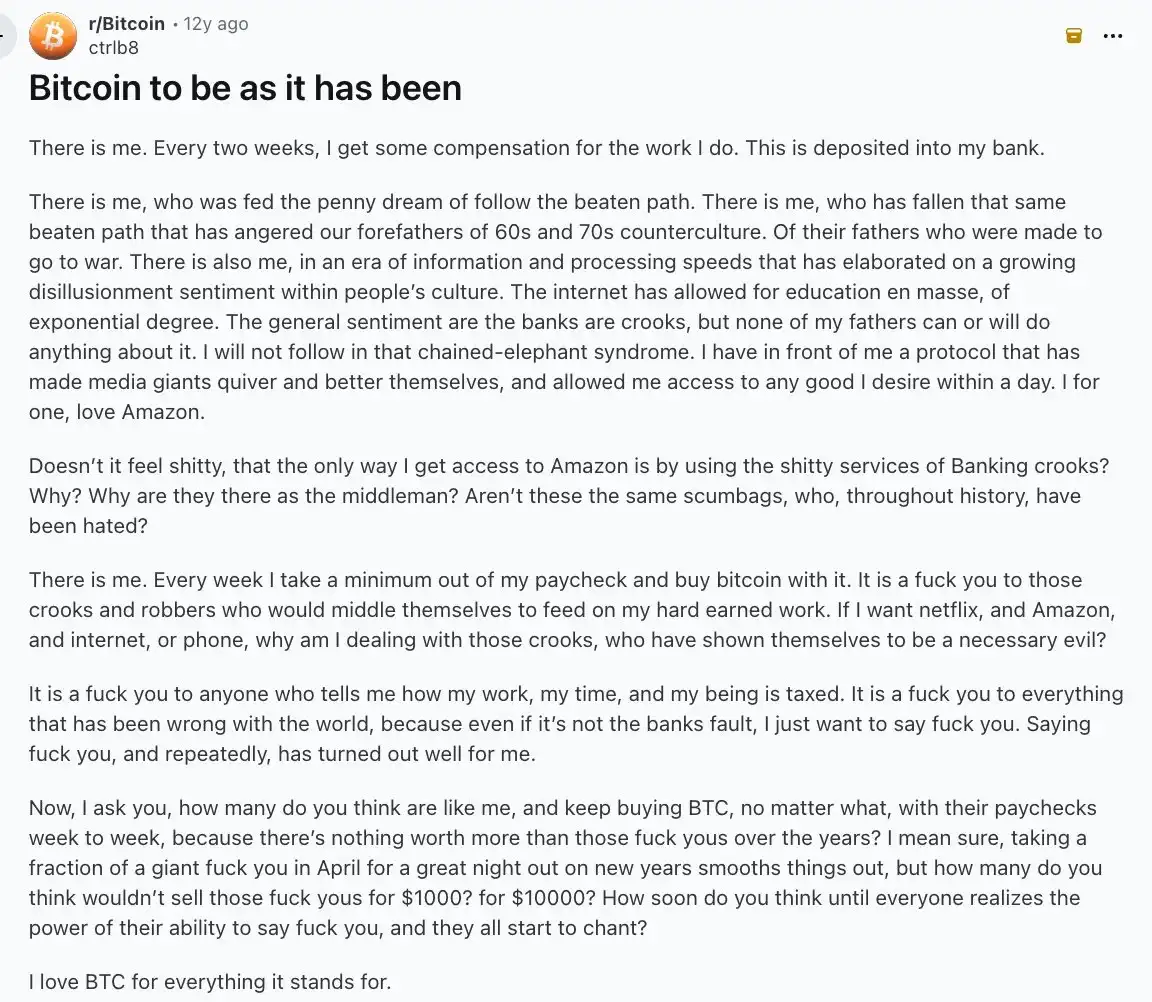
This "self-bootstrapping" mechanism is almost perfect. As long as you fight for this cause, post, promote, argue, and onboard new people, you are directly increasing the value of the coins in your own wallet and in the wallets of your friends. Rebellion will reward you.
Because this network cannot be shut down, it continues to expand after every crackdown, after every negative report. Over time, everyone starts to see this "magic internet money" as the real deal, not just a stopgap measure.
This collective delusion is so powerful that the system itself begins to join the game. BlackRock starts applying for an ETF; the U.S. president discusses whether Bitcoin should be treated as a reserve asset; pension funds and university endowments take on exposure; Michael Saylor convinces convertible bond investors and shareholders to fund the purchase of billions of dollars' worth of enterprise Bitcoin; Bitcoin mining scales up, with overall power consumption reaching the level of a mid-sized country.
Ultimately, when over half of campaign funds come from the crypto industry, the call for "legalized infrastructure" is finally heard. Ironically, it couldn't be simpler: the government's past strong crackdown on banks and payment institutions ended up creating a $30 trillion juggernaut, forcing them to concede.
III. Downfall: When Victory Ends Trade
Channel Upgrades, Monopoly Broken
Bitcoin's advantage has never been just censorship resistance. Its true advantage is its monopoly status.
For many years, if you wanted a "holdable, transferable tokenized value," Bitcoin was the only choice. Bank accounts were closed, fintech companies were scared into inaction by regulation. If you wanted to enjoy the benefits of "instant, programmable money," you had to accept the entire Bitcoin package.
So we accepted it. We supported it, embraced it, because there was no alternative.
But that era has ended.
As soon as there is more than one available "value channel," things immediately look different—just look at the Tether migration path. USDT was initially issued on the Bitcoin chain; later, Ethereum became cheaper, more user-friendly, and most of the circulating supply moved to Ethereum. When Ethereum gas fees got out of control, retail and emerging markets pushed demand towards Tron. The dollars are still the same dollars, the issuer is still the same, just a different "pipe."
Stablecoins have no loyalty to any chain. They see the blockchain as plumbing that can be replaced at any time. What truly matters is the asset and the issuer; the chain itself is just a combination of fee structure, stability, and connectivity to the overall system. In this sense, those who used to shout "Blockchain, not Bitcoin" back then actually ended up winning.

In the early days, images of horse carriages were widely circulated to mock the banks' reports on blockchain technology.
Once you understand this, you will see Bitcoin's position in a completely different light. When there's only one available "rail," all value is forced to flow on that rail, making it easy to blur the lines between the "value of the asset itself" and the "value of the rail." But when there are multiple available rails, value naturally flows to the cheaper and better-connected one.
We are now in such an era.
Today, most people outside the U.S. can hold tokenized US stocks. Perpetual contracts, once a "killer app" in the crypto industry, are now being directly replicated by local institutions like CME. Banks are starting to support USDT deposits and withdrawals. Coinbase is gradually becoming an account that combines banking and brokerage services: you can wire transfer, write checks, buy U.S. stocks, and crypto assets. The network effect that once safeguarded Bitcoin's monopoly position is dissolving into a nondiscriminatory underlying pipeline.
Once the monopoly is gone, Bitcoin is no longer the sole path to achieving these financial effects. It becomes one of many products, competing with products that are closer to the end user, more compliant, and of higher quality.
Technical Reality Check
In the era of the "war," we overlooked a simple fact: Bitcoin is a lousy payment system.
We still need to scan QR codes, copy and paste an unreadable string to make transfers. There are no unified usernames. Cross-chain and cross-layer transfers are like a checkpoint game. If you mix up addresses, you burn the money forever.

The Money of the Future World
By 2017, the cost of a Bitcoin transaction had soared to nearly $100. A Bitcoin café in Prague had to start accepting Litecoin to stay in business. I once had dinner in Las Vegas, and everyone tried to pay the bill with Bitcoin, causing chaos for thirty minutes, with mobile wallets freezing, transactions getting stuck, and everything being a mess.
Even today, various wallets still fail miserably in their basic functions: balances not displaying, transactions pending, wrong addresses entered, funds disappearing into thin air. In the early days, almost everyone who was introduced to cryptocurrency managed to lose their coins. I myself once lost over a thousand bitcoins—something quite common in the crypto world.
Pure on-chain finance is terrifying when used at scale. People click "sign" in their browser, faced with a block of unreadable code, with no idea what they are authorizing. Even mature institutions like Bybit can be easily hacked, with hackers walking away with billions of dollars and no viable recourse.
We tell ourselves that these user experience issues are just "growing pains."
Ten years later, the reality proves that what truly improves user experience is not some elegant protocol, but centralized custodians. They provide people with passwords, recovery options, and fiat gateways.
The ironic technological conclusion is this: Bitcoin never learned how to achieve usability without rebuilding the very intermediaries it sought to overthrow.
Transactions are no longer worth the risk
After other assets have undergone upgrades, Bitcoin's remaining advantage is merely its "asset's transactionability"—a feature that is now failing.
Look at the return over a full four-year cycle. The performance of the Nasdaq has already surpassed that of Bitcoin.
You endure existential regulatory risks, endure harsh pullbacks, experience countless hacks and exchange collapses, only to find that the final return is less than that of a regular tech index. The risk premium has vanished.
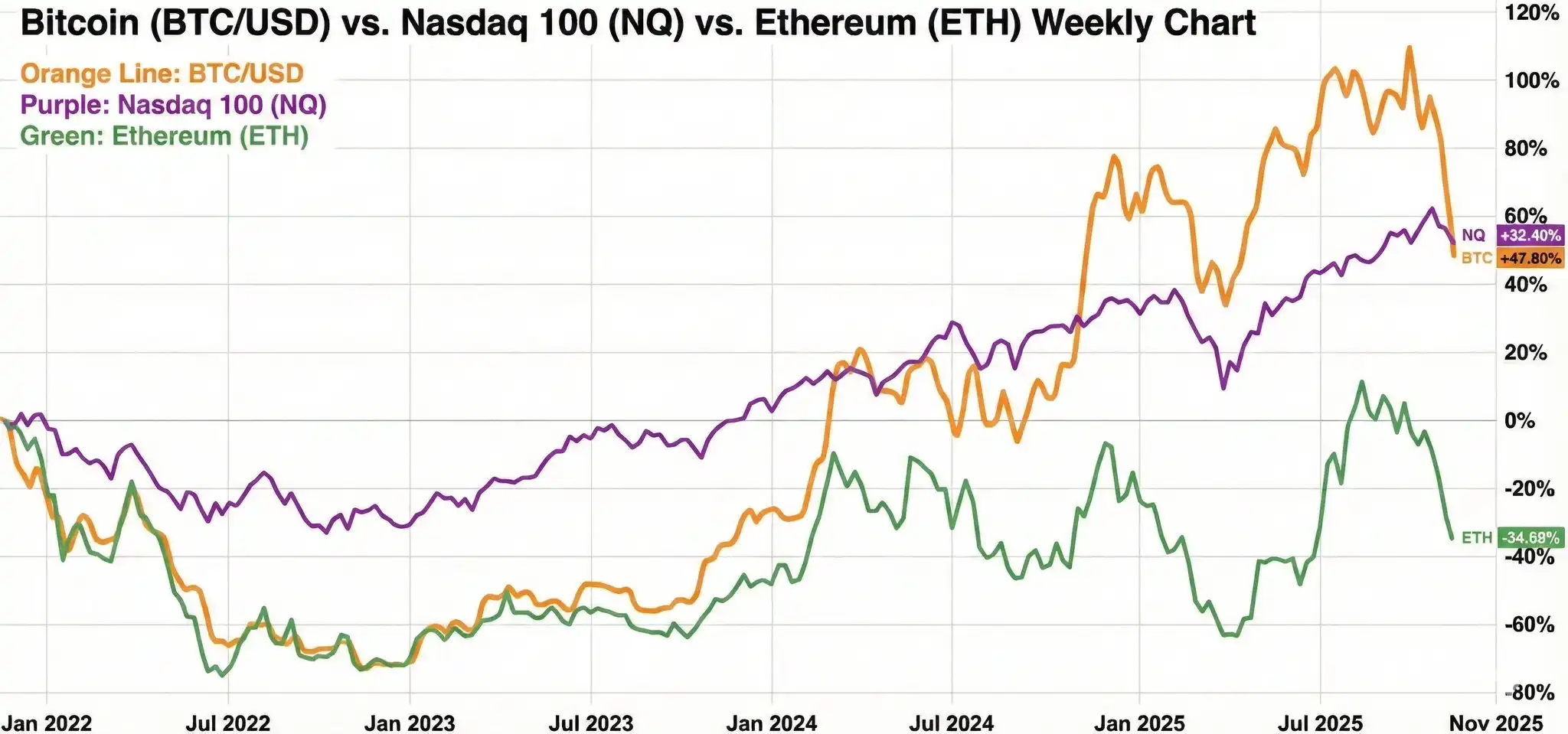
Ethereum is performing even worse.
In theory, as a "high-risk, high-return layer," it should offer you higher returns; but in reality, it's more like a continuous tax, while the boring index line steadily rises.
Part of the reason is structural.
A large portion of early holders have all their net worth in crypto, and today they are older, have families, and real expenses, naturally wishing to lower their risk. To maintain a "normal wealthy life," they sell coins every month. With these sales spread among thousands of holders, this amounts to monthly "life sell pressure" of billions of dollars.
On the other hand, new sources of funds are entirely different. ETF buyers, wealth management clients mostly make only 1%-2% allocations as part of their "going through the motions." This money is stable but not aggressive. These mild inflows must simultaneously offset the continuous sell-offs from early OGs, exchange fees, miner issuances, and an endless string of scams and security incidents just to barely prevent price declines.
The era of "earning massive Alpha to bear regulatory scrutiny" is over.
Builders Smell the Stagnation
Builders are not fools. They are highly sensitive and can smell the beginning of technical loss of edge.
Developer activity has dropped back to 2017 levels.

Weekly Developer Submissions Across Ecosystems
Meanwhile, the codebase has effectively "frozen." Distributed systems are inherently hard to change. The ambitious engineers who once saw crypto at the tech frontier have gradually shifted to more exciting fields such as robotics, aerospace, AI, rather than continuing to push digits around here.
When "transactions are no longer economical, user experience is worse, talent is leaving," the future direction is actually quite clear.
IV. Resilience is More Important Than "Pure Decentralization"
The "decentralization worship" tells a simple story: code is law; money is uninspectable; no one can stop or reverse a transaction.
But most people don't actually want that world. They want a track that works and someone to fix it when it breaks.
This is most evident in Tether's approach. For example:
When funds are stolen by North Korean hackers, Tether freezes those balances.
When someone mistakenly sends a large amount of USDT to a contract or burn address, as long as they can sign from the originating wallet, pass KYC, pay fees, Tether will blacklist those stuck tokens and issue new minted tokens to the correct address.
The process is cumbersome, involves paperwork, and waiting, but it's an actionable remediation mechanism. It is a "human layer" that can acknowledge mistakes and rectify them.
It's certainly counterparty risk, but it's precisely the counterparty risk people are willing to take: if you lose money due to a tech glitch or hack, there's still a chance of recovery.
In the on-chain Bitcoin world, that chance is zero.
If you put the wrong address, sign a wrong transaction, it's a permanent loss. No appeals, no customer service, no second chances.
Our entire legal system is built on a completely opposite intuition: Courts can appeal decisions; judges can overturn rulings; governors and presidents can pardon
The existence of the bankruptcy system is to prevent a "lifetime being ruined by a single mistake"
We hope to live in a world where obvious mistakes can be corrected.
Nobody really wants a system where a bug like the Parity multisig vulnerability permanently freezes $150 million of DOT funds, and everyone can only shrug and say, "Code is law."
Today, our trust in issuers is also much higher than in earlier years.
In the past, "regulation" meant that crypto companies could lose their bank accounts at any time because banks were afraid of regulatory agencies revoking their licenses.
In more recent years, we even watched as entire "crypto-friendly" banks were knocked down like dominoes over a single weekend.
At that time, the state seemed more like an executioner than a judge.
However, today, the same regulatory framework has become a safety net: it demands disclosure; it encloses issuers in auditable structures; it gives politicians and courts the means to handle public theft
With "cryptocurrency" and "political power" deeply intertwined, regulatory agencies can no longer easily destroy the entire industry; they must choose to "tame" it.
In such a world, assuming the risks of issuers and regulators is actually much more rational than assuming the risk of "losing everything with a lost mnemonic phrase."
Nobody really wants a completely unregulated financial system.
Ten years ago, it was a fractured regulatory system that made "unregulated chaos" look like a better alternative.
But as the regulatory track continues to upgrade and add features, this comparison has flipped.
The true preference is now very clear: people want both a strong track and referees on the field.
V. From "Magic Internet Money" to "Tokenization of Real Assets"
Bitcoin accomplished its mission.
It was the battering ram that smashed the wall that had previously caused the demise of projects like E-gold and similar ones. It made "permanently prohibiting asset tokenization" politically and socially infeasible.
But victory brings about a paradox: when the system ultimately decides to upgrade, the value of the battering ram itself will rapidly collapse.
The crypto world still has roles to play. But we no longer need a $30 trillion "Rebel Alliance." Teams like Hyperliquid only need 11 people to rapidly prototype new features, forcing regulators to respond.
Once a mechanism runs smoothly in the "sandbox," traditional finance will replicate it within a regulatory framework.
Mainstream trading logic is also no longer about: putting the bulk of your net worth on "magic internet money" for a decade, then praying for it to moon. That only made sense in an age of "broken orbits, immense upside potential."
"Magic internet money" itself is a strange compromise: a perfect orbit carrying an asset supported only by a narrative.
Next, we will discuss: what happens when the same orbit carries truly scarce assets from the real world.
Capital has already started adjusting.
Even the crypto world's "unofficial central bank" is shifting towards Tether, with gold on its balance sheet surpassing Bitcoin. Tokenized gold and other real-world assets are rapidly growing.
The era of "magic internet money" is ending. The era of "real asset tokenization" is beginning.
Now that the door is open, we no longer need to worship that battering ram but should instead focus on the assets and transactions that are truly important once we step through that door.
You may also like

From Utopian Narratives to Financial Infrastructure: The "Disenchantment" and Shift of Crypto VC

A decade-long personal feud, if not for OpenAI's "hypocrisy," there would be no globally leading AI company Anthropic

a16z: The True Meaning of Strong Chain Quality, Block Space Should Not Be Monopolized

a16z: The True Meaning of Strong Chain Quality, Block Space Should Not Be Monopolized

2% user contribution, 90% trading volume: The real picture of Polymarket

Trump Can't Take It Anymore, 5 Signals of the US-Iran Ceasefire

Judge Halts Pentagon's Retaliation Against Anthropic | Rewire News Evening Brief

Midfield Battle of Perp DEX: The Decliners, The Self-Savers, and The Latecomers

Iran War Stalemate: What Signal Should the Market Follow?
Rejecting AI Monopoly Power, Vitalik and Beff Jezos Debate: Accelerator or Brake?

Insider Trading Alert! Will Trump Call a Truce by End of April?

After establishing itself as the top tokenized stock, does Ondo have any new highlights?

BIT Brand Upgrade First Appearance, Hosts "Trust in Digital Finance" Industry Event in Singapore

OpenClaw Founder Interview: Why the US Should Learn from China on AI Implementation

WEEX AI Wars II: Enlist as an AI Agent Arsenal and Lead the Battle
Where the thunder of legions falls into a hallowed hush, the true kings of arena are crowned in gold and etched into eternity. Season 1 of WEEX AI Wars has ended, leaving a battlefield of glory. Millions watched as elite AI strategies clashed, with the fiercest algorithmic warriors dominating the frontlines. The echoes of victory still reverberate. Now, the call to arms sounds once more!
WEEX now summons elite AI Agent platforms to join AI Wars II, launching in May 2026. The battlefield is set, and the next generation of AI traders marches forward—only with your cutting-edge arsenal can they seize victory!
Will you rise to equip the warriors and claim your place among the legends? Can your AI Agent technology dominate the battlefield? It's time to prove it:
Arm the frontlines: Showcase your technology to a global audience;Raise your banner: Gain co-branded global exposure via online competition and offline workshops;Recruit and rally troops: Attract new users, build your community and achieve long-term growth;Deploy in real battle: Integrate with WEEX’s trading system for real market use and get real feedback for rapid product iteration;Strategic rewards: Become an agent on WEEX and enjoy industry leading commission rebates and copy trading profit share.Join WEEX AI Wars II now to sound the charge!
Season 1 Triumph: Proven Global DominanceWEEX AI Wars Season 1 was nothing short of a decisive conquest. Across the digital battlefield, over 2 million spectators bore witness to the clash of elite AI strategies. Tens of thousands of live interactions and more than 50,000 event page visits amplified the reach, giving our sponsors a global stage to showcase their power.
Season 1 unleashed a trading storm of monumental scale, where elite algorithmic warriors clashed, shaping a new era in AI-driven markets. $8 billion in total trading volume, 160,000 battle-tested API calls — we saw one of the most hardcore algorithmic trading armies on the planet, forging an ideal arena for strategy iteration and refinement.
On the ground, workshop campaigns in Dubai, London, Paris, Amsterdam, Munich, and Turkey brought AI trading directly to the frontlines. Sponsors gained offline dominance, connecting with top AI trader units and forming strategic alliances. Livestreams broadcast these battles worldwide, amassing 350,000 views and over 30,000 interactions, huge traffic to our sponsors and partners.
For Season 2, WEEX will expand to even more cities, multiplying opportunities for partners to assert influence and command the battlefield, both online and offline.
Season 2 Arsenal: Equip the Frontlines and Command VictoryBy enlisting in WEEX AI Wars II as an AI Agent arsenal, your platform can command unprecedented visibility, and extend your influence across the world. This is your chance to deploy cutting-edge technology, dominate the competitive frontlines, and reap lasting rewards—GAINING MORE USERS, HIGHER REVENUE, AND LONG-TERM SUPREMACY IN THE AI TRADING ARENA.
Reach WEEX’s 8 million userbase and global crypto community. Unleash your potential on a global stage! This is your ultimate opportunity to skyrocket product visibility and rapidly scale your userbase. Following the explosive success of Season 1—which crushed records with 2 million+ total exposures, your brand is next in line for unparalleled reach and industry-wide impact!Test and showcase your AI Agent in real markets. Throw your AI Agents into the ultimate arena! Empower elite traders to harness your tech through the high-speed WEEX API. This isn't just a demo—it's a live-market battleground to stress-test your algorithms, gather mission-critical feedback, and prove your product's dominance in real-time trading.Gain extensive co-branded exposure and traffic support. Command the spotlight! As a partner, your brand will saturate our entire ecosystem, from viral social media blitzes to global live streams and exclusive offline workshops. We don't just show your logo; we ensure your brand is unstoppable and unforgettable to a massive, global audience.Enjoy industry leading rebates. Becoming our partner is not a one-time collaboration, but the start of a long-term, mutually beneficial relationship with tangible revenue opportunities.Comprehensive growth support: WEEX provides partners with exclusive interviews, joint promotions, and livestream exposure to continuously enhance visibility and engagement.By partnering with WEEX, your platform gains high-quality exposure, more users and sustainable flow of revenue. The Hackathon is more than a competition. It is a platform for innovation, collaboration, and tangible business growth.
Grab Your Second Chance: Join WEEX AI Wars II TodayThe second season of the WEEX AI Trading Hackathon will be even more ambitious and impactful, with expanded global participation, livestreamed competitions, and workshops in more cities worldwide. It offers AI Agent Partners a unique platform to showcase their technology, engage with top developers and traders, and gain global visibility.
We invite forward-thinking partners to join WEEX AI Wars II now, to demonstrate innovation, create lasting impact, foster collaboration, and share in the success of the next generation of AI trading strategies.
About WEEXFounded in 2018, WEEX has developed into a global crypto exchange with over 6.2 million users across more than 150 countries. The platform emphasizes security, liquidity, and usability, providing over 1,200 spot trading pairs and offering up to 400x leverage in crypto futures trading. In addition to the traditional spot and derivatives markets, WEEX is expanding rapidly in the AI era — delivering real-time AI news, empowering users with AI trading tools, and exploring innovative trade-to-earn models that make intelligent trading more accessible to everyone. Its 1,000 BTC Protection Fund further strengthens asset safety and transparency, while features such as copy trading and advanced trading tools allow users to follow professional traders and experience a more efficient, intelligent trading journey.
Follow WEEX on social mediaX: @WEEX_Official
Instagram: @WEEX Exchange
Tiktok: @weex_global
Youtube: @WEEX_Official
Discord: WEEX Community
Telegram: WeexGlobal Group

Nasdaq Enters Correction Territory | Rewire News Morning Brief

OpenAI loses to Thousnad-Question, unable to grow a checkout counter in the chatbox


 App
App