
- Buy Crypto
- Markets
 Futures
- Spot
- Copy Trade
- Earn
- More
Wintermute: The four-year cycle is dead, Crypto Breakthrough 2026, where to next?

Original Title: The four-year cycle is dead. What will drive crypto in 2026?
Original Source: Wintermute
Original Translation: DeepTech TechFlow
Abstract:
What was once considered the "iron rule" of the crypto market, the four-year halving cycle, is facing an unprecedented challenge. Top market maker Wintermute pointed out in its latest 2025 annual report that the traditional cycle narrative has collapsed, and the market logic has shifted from "seasonal rotation" to "liquidity locking."
2025 did not see the expected widespread frenzy; instead, it showed extreme emotional polarization: on one hand, BTC and ETH entered the institutional hall under the blessing of ETFs, while on the other hand, altcoins experienced a sudden loss of momentum and shortened lifecycle.
Looking into 2026, can the crypto market break free from the current stockpile deadlock? Wintermute has outlined three core variables that could disrupt the status quo.
Body:
2025 did not bring the anticipated bull market, but this may be seen by future generations as the beginning of the cryptocurrency's transition from a speculative tool to a mature asset class.
The traditional four-year cycle is becoming obsolete. Market performance is no longer dominated by self-fulfilling timed narratives but rather depends on the flow of liquidity and the concentration of investor attention.
What changed in 2025?
Historically, native crypto wealth has acted as a fungible fund. Bitcoin's gains would spill over to Ethereum (ETH), then to blue-chip stocks, and finally reach altcoins.
Wintermute's over-the-counter (OTC) trading flow data indicates that this transmission mechanism significantly weakened in 2025.
Spot exchange traded funds (ETFs) and digital asset trust companies (DATs) have evolved into a "walled garden." They provide sustained demand for large-cap assets but do not naturally rotate funds into the broader market.
As retail interest shifted to the stock market, 2025 became a year of extreme polarization.
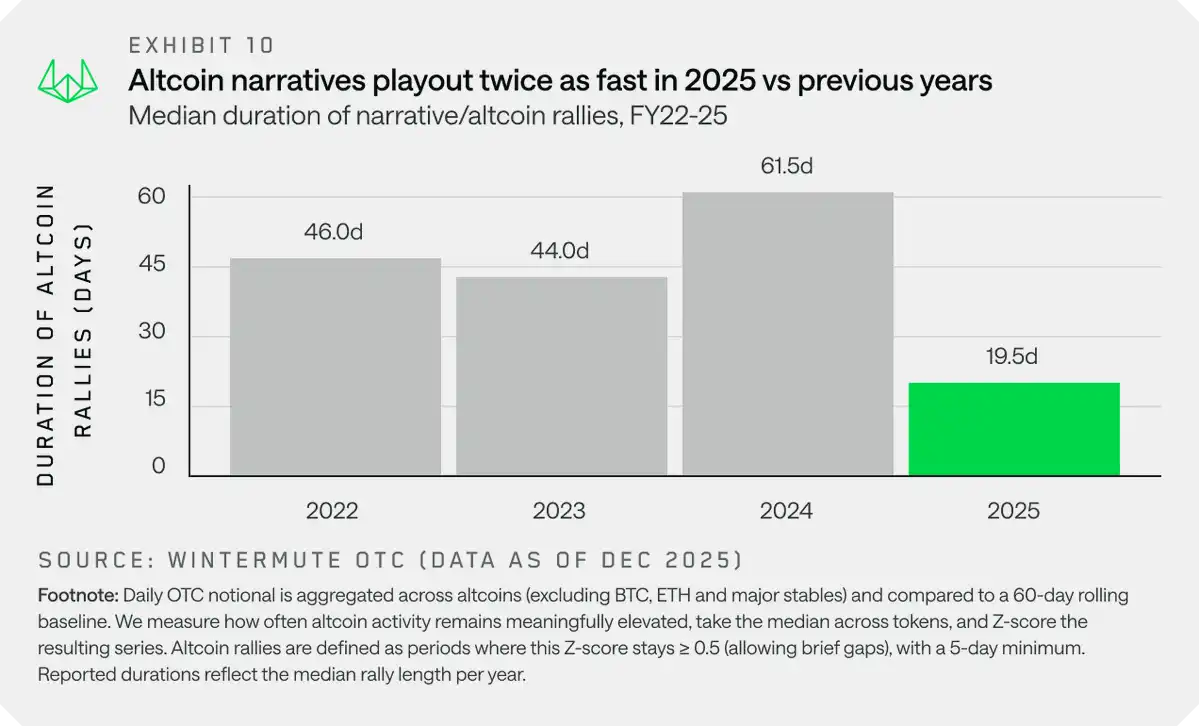
In 2025, the average rebound duration of altcoins was 20 days, much lower than 60 days in 2024.
A few mainstream assets absorbed the majority of the new inflows, while the broader market struggled.
Three Paths for 2026
If market participation beyond mainstream assets is to grow further, at least one of the following three things needs to happen:
1. Expanding Institutional Mandates
Currently, most of the new liquidity remains within institutional channels. A full market recovery requires institutional investors to expand the range of assets they can invest in.
Early signs are evident through Solana (SOL) and XRP's ETF applications.
2. The Wealth Effect from Mainstream Assets
A strong rebound in Bitcoin or Ethereum could trigger the wealth effect, spilling over to the broader market, similar to what happened in 2024.
The level of funds eventually flowing back into digital assets remains uncertain.
3. Rotation from Equities
Retail investors' focus may rotate back from the stock market (into areas like artificial intelligence AI, rare earths, quantum computing, etc.) to cryptocurrency, bringing in new inflows and stablecoin minting.
While this is the least probable scenario, it would significantly increase market participation.
The future outcome will depend on whether the above catalysts can effectively diffuse liquidity beyond a few large-cap assets, or if the trend of centralization will persist.
Understanding fund flows and the necessary structural changes will determine which strategies will succeed in 2026.
You may also like

Particle Founder: The entrepreneurial insights I have gained the most from in the past year

Huang Renxun's latest podcast transcript: The future of Nvidia, the development of embodied intelligence and agents, the explosion of inference demand, and the public relations crisis of artificial intelligence

OKX Ventures Research Report: AI Agent Economic Infrastructure Research Report (Part 1)

The migration of settlement rights: B18 and the institutional starting point of on-chain banks

From Tencent and Circle: Looking at the Simple and Difficult Questions of Investment

The second half of stablecoins no longer belongs to the crypto circle

Cursor "Shell" Kimi Controversy Reversed: From Copyright Infringement Allegations to Authorized Collaboration, China's Open Source Model Once Again Becomes a Global AI Foundation

The Real Reason Tokens Don't Sell: 90% of Crypto Projects Overlook Investor Relations

Is the income of pump.fun real, earning a million dollars a day despite the market downturn?

The real reason why tokens are not selling: 90% of crypto projects neglect investor relations

Who is the true winner of the "Tokenization" narrative?

Moss: The Era of AI-Traded by Anyone | Project Introduction

Chip Smuggling Case Exposes Regulatory Loophole | Rewire News Evening Update

How a Structured AI Crypto Trading Bot Won at the WEEX Hackathon
Ritmex demonstrates how disciplined risk control and structured signals can make an AI crypto trading bot more stable and reliable on WEEX, highlighting the importance of combining execution discipline with scalable AI trading systems.

Old Indicator Fails, Three Major New Signals Emerge: BTC True Bottom May Still Be Below $60K

Meeting OpenClaw Founder at a Hackathon: What Else Can Lobsters Do?
Huang Renxun's Latest Podcast Transcript: NVIDIA's Future, Embodied Intelligence and Agent Development, Soaring Demand for Inferencing, and AI's PR Crisis

How a Structured AI Crypto Trading Bot Won at the WEEX Hackathon
Crypto_Trade shows how structured inputs and controlled adaptability can build a more stable and reliable AI crypto trading bot within the WEEX AI Trading Hackathon, highlighting a practical path toward scalable AI trading systems.


 App
App