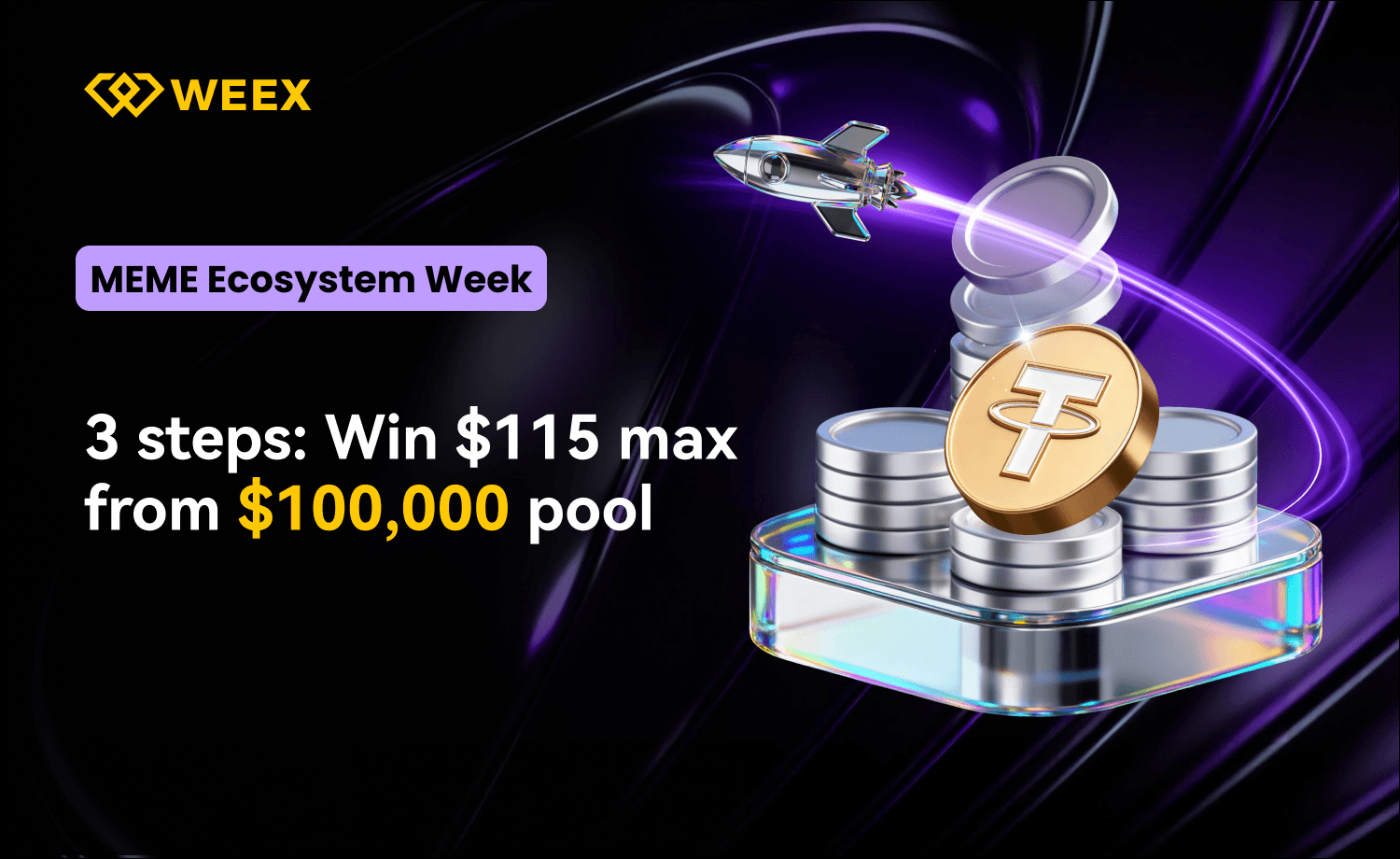
MEME Ecosystem Week on WEEX: Guide to Claiming $115 in New User Rewards

The cryptocurrency market has witnessed a significant shift in asset valuation paradigms over the last few years, particularly within the meme coin sector. Data from platforms like CoinMarketCap indicates that meme tokens often drive substantial trading volume during market rallies, serving as a high-beta proxy for broader blockchain adoption. For astute investors, volatility is not a deterrent but a mechanism for profit generation. In this context, the WEEX exchange has launched a targeted initiative designed to reward traders who are ready to capitalize on these movements. The current MEME Ecosystem Week offers a structured opportunity for new market participants to secure up to 115 USDT in bonuses while engaging with high-velocity assets like SHIB, WIF, and PEPE.
Understanding the MEME Ecosystem and Token Dynamics
Before diving into the mechanics of the event, it is crucial to understand the asset class driving this campaign. The "Meme Ecosystem" refers to a category of cryptocurrencies that derive their value primarily from community consensus, internet culture, and viral marketing, rather than traditional utility or cash flow models. Historically dismissed by institutional investors, tokens such as Shiba Inu (SHIB), Pepe (PEPE), and Dogwifhat (WIF) have matured into multi-billion dollar assets. Recent analysis from CoinGecko highlights that during specific liquidity cycles, meme coins frequently outperform major altcoins in percentage gains.
The tokens featured in this WEEX event—including FLOKI, FISH, YEE, RUSSELL, and the newly highlighted RNGR—represent various niches within this sector. RNGR (Ranger), for instance, is gaining traction as traders look for the next rotation in liquidity. Understanding the support and resistance levels of these tokens is vital. For a beginner, participating in the MEME Ecosystem Week is not just about claiming a bonus; it is a practical exercise in navigating high-volatility markets with the safety net of exchange incentives.
Event Overview: Timeline and Eligibility
The MEME Ecosystem Week is specifically tailored for new users entering the WEEX platform. The campaign is currently active, running from January 7, 2026, to January 17, 2026 (UTC+8). Since today is January 12, 2026, prospective participants have a limited window of approximately five days to register and complete the requisite tasks. This event is strictly for new registrations during this period; institutional users and market makers are excluded to ensure the rewards pool directly benefits individual retail traders.
To maintain fairness and preventing manipulation, WEEX has implemented strict verification protocols. The platform defines a new user as someone who signs up within the event duration. It is important to note that any attempt at bulk registration or wash trading will result in immediate disqualification. The structure of the event allows users to earn rewards cumulatively, meaning you can maximize your returns by completing all three designated events in sequence.
Step-by-Step Guide to Maximizing Rewards
The reward structure is divided into three distinct stages, allowing users to scale their participation based on their comfort level with capital allocation.
Event 1: Securing the Deposit Reward
The first step involves capital injection. Participants are required to make a net deposit of at least 100 USDT or an equivalent amount in eligible tokens such as SHIB, WIF, FLOKI, FISH, PEPE, YEE, or RUSSELL. The concept of "net deposit" is critical here; it is calculated as your total deposits minus your total withdrawals during the event period. Internal transfers do not count toward this metric. Successful completion of this step grants a reward of 8 USDT. This initial capital serves as the foundation for subsequent trading activities.
Event 2: Executing the First Spot Trade
Once the deposit is confirmed, the next phase focuses on spot trading execution. Users must complete a first spot trade with a volume of at least 100 USDT in any of the eligible event tokens mentioned previously. Spot trading volume is calculated by adding the buy volume and the sell volume. Completing this task yields a reward of 7 USDT. Unlike complex derivative strategies, spot trading is the most direct way to gain exposure to the underlying asset. For beginners, this is an excellent opportunity to practice order execution—limit orders or market orders—while knowing that a portion of the transaction cost is effectively subsidized by the reward.
Event 3: Daily Futures Trading Check-in
The most lucrative component of the campaign is the daily trading check-in. This stage requires a higher level of engagement and risk management. Participants must trade at least 1,000 USDT in futures volume on any pair daily. It is important to distinguish that futures volume includes both opening and closing positions. Meeting this daily threshold unlocks a Mystery Box containing a futures bonus ranging from 5 to 10 USDT. By checking in consistently every day throughout the event, a user can accumulate up to 100 USDT in futures bonuses. This rewards consistency and active market participation rather than passive holding.
Strategic Advice for New Crypto Traders
Entering the market through an incentivized event like the MEME Ecosystem Week requires a strategic mindset. A common mistake beginners make is over-leveraging their futures positions to meet volume requirements. To achieve the 1,000 USDT futures volume safely, consider using lower leverage with a higher margin, or executing multiple smaller trades rather than a single large, high-risk trade.
Furthermore, regarding the spot trading requirement, liquidity is key. Tokens like SHIB and PEPE generally have deeper order books compared to newer tokens like RUSSELL or RNGR. Trading pairs with higher liquidity results in lower slippage, ensuring that your trade execution price is closer to the market mark. Always keep in mind that the calculation excludes zero-fee trades and stablecoin pairs like USDC/USDT, so ensure your volume is generated on valid USDT-margined pairs.
Reward Distribution and Terms
Transparency in reward distribution is a hallmark of a reliable exchange. WEEX stipulates that rewards will be distributed within seven working days after the event concludes on January 17, 2026. The rewards for the deposit and daily check-in tasks are issued in USDT tokens, while the additional reward for the spot trade event is a futures bonus. This distinction is important for your post-event strategy; USDT can be withdrawn or traded, while futures bonuses are typically used to cover trading fees or as margin for contract trading. Users should also be aware that they can only claim one reward from the new user event series if multiple events overlap, based on the earliest distribution date.
Conclusion
The current market environment offers a unique convergence of volatility and opportunity. The MEME Ecosystem Week on WEEX provides a structured, incentivized pathway for new traders to engage with this dynamic sector. By adhering to the rules—maintaining net deposits, executing precise spot trades, and managing futures volume consistently—users can effectively reduce their cost of entry and maximize their potential upside. As we move further into 2026, understanding how to leverage exchange incentives while managing risk will continue to be a defining trait of the successful crypto investor.
DISCLAIMER: WEEX and affiliates provide digital asset exchange services, including derivatives and margin trading, only where legal and for eligible users. All content is general information, not financial advice-seek independent advice before trading. Cryptocurrency trading is high risk and may result in total loss. By using WEEX services you accept all related risks and terms. Never invest more than you can afford to lose. See our Terms of Use and Risk Disclosure for details.
You may also like

World Collective Oil Reserve (WCOR) Price Prediction 2026-2045: Expert Insights
WCOR (World Collective Oil Reserve) is a Solana-based cryptocurrency token that promotes an “oil reserve + real-world asset (RWA) narrative.” However, there is no public evidence that it is actually backed by physical oil assets. It is essentially a highly speculative, narrative-driven token. Its current market cap is around $14 million, with relatively low liquidity and high volatility, and its price is mainly driven by market sentiment and hype. Most analyses suggest limited short-term upside, with a possible gradual increase to around $0.02 by 2030. Overall, it is considered a high-risk crypto asset driven more by narrative speculation than fundamentals.

WEEX Gold & Silver 0% Fees Event: Trade Metals, Crude Oil and Stock Futures With Zero Fees
Join the WEEX 0-fee futures event from April 16 to May 31, 2026. Trade eligible gold, silver, crude oil, and stock futures with 0% fees.

Can PAC Coin Reach $1 Soon? Analyzing Public Asset Control
PAC is a Solana-based meme token with a government-themed narrative, but it is highly speculative.
At its current price (~$0.0009) and 1B supply, reaching $1 would require a $1B market cap, which is very unlikely.
Short-term moves to $0.001 or $0.01 are more realistic, but the token is highly volatile due to low liquidity and hype-driven trading.
Overall, $1 is not a realistic target, and PAC is better suited for short-term speculation than long-term investment.

What Is SAOS? Strategic American Oil Supply Token Explained
SAOS is a meme token on Solana with a 75,000 USD market cap and 22,000 USD locked liquidity, positioned around oil supply themes but lacking real asset backing
It thrives on pure narrative speculation, with no utility, website, or doxxed team, making it highly volatile and attention-dependent
Traders should distinguish SAOS from legitimate real-world asset projects, as its branding is speculative rather than substantive
Positive aspects include locked liquidity reducing rug pull risks, but low trading activity signals high uncertainty
NBIS Stock: What Nebius’ AI Cloud Surge Means Now
NBIS stock jumped as Nebius reported rapid AI cloud growth. See the key Q1 2026 numbers, catalysts, valuation risks, and what to watch next.

What Is Public Asset Control (PAC) Coin? Explained for Beginners
Public Asset Control (PAC) is a Solana-based token that uses a “government asset control” narrative involving oil and gold themes, but it has no verified ties to any real institutions or governments. It is mainly an entertainment-focused, speculative meme coin.
The project’s claims about links to entities like BlackRock or Palantir are unverified, and its own disclaimer states it is not a real financial or institutional asset. Like many new Solana tokens, PAC is highly volatile, with low liquidity and limited transparency, including no fully verified audit.
Overall, PAC is a high-risk speculative token driven by hype and storytelling rather than real utility. Beginners are advised to be cautious, verify contract details, and prioritize risk control before considering any trading.

Public Asset Control: What PAC Token Really Is
Public Asset Control PAC is a Solana token with bold asset-control branding. Learn what it is, what is verified, and the key trading risks.

Why Is Chinese Oil Asset Reserve (COAR Crypto) Trending Now?
Why is Chinese Oil Asset Reserve trending now? Learn the latest COAR crypto price action, trading volume, oil narrative, Solana pair data, and what is driving attention today.

How to Buy Chinese Oil Asset Reserve (COAR) Token in 2026: Latest Step-by-Step Guide, Contract Address, and Safe Buying Tips
How to buy Chinese Oil Asset Reserve (COAR) token step by step, including the official COAR contract address, Solana wallet setup, SOL funding, and latest market data.

COAR Coin: What Chinese Oil Asset Reserve Really Is
COAR coin is a new Solana oil-narrative token. Learn what Chinese Oil Asset Reserve claims, how to verify the contract, and key trading risks.

Did the CLARITY Act Pass Today? Latest Status and the History of the Crypto Bill
SEO meta description: Did the CLARITY Act pass today? Read the latest crypto bill update, the history of the CLARITY Act, House and Senate votes, and what happens next for U.S. crypto regulation.

What Is Chinese Oil Asset Reserve (COAR) Token? $COAR and Coar Stock Relationship Explained
Chinese Oil Asset Reserve (COAR) token explained, $COAR price, Solana details, and the relationship between COAR and Coar stock. Learn the latest facts.

Trade to Earn on WEEX: Join the Futures Trading Event and Earn Real-Time WXT Rewards Throughout May 2026
Join the WEEX Trade to Earn Series Five event from May 1–31, 2026 and earn real-time WXT rewards through futures trading. Boost your rebate level, complete missions, invite friends, and maximize your trade to earn rewards with USDT-M futures trading.

Trade to Earn With Futures Trading on WEEX: How Smart Traders Are Turning Every Position Into WXT Rewards
Join the WEEX Trade to Earn Series Five campaign and earn real-time WXT rewards through futures trading from May 1–31, 2026. Upgrade mining levels, unlock higher rebate ratios, complete missions, and maximize your trade to earn rewards with USDT-M futures trading.

CBRS Stock: What to Know About Cerebras After Its IPO
CBRS stock surged after Cerebras priced its IPO at $185. Learn what the AI chipmaker does, why valuation matters, and what risks to watch.
SpaceX IPO Stock Market Impact: What Investors Should Watch
SpaceX’s IPO could reshape indexes, liquidity, space stocks, and crypto risk appetite. Here is what matters before the listing.

HMSTR Token Price: What Moves Hamster Kombat Now
Track HMSTR token price, supply, catalysts, and risks. Learn what drives Hamster Kombat price action and what traders should watch.

How to Buy Public Asset Control (PAC) Token in 2026: Latest Solana Buying Guide
How to buy Public Asset Control (PAC) token in 2026, PAC contract address, Solana wallet setup, Jupiter swap guide, latest price, liquidity, and risks.
World Collective Oil Reserve (WCOR) Price Prediction 2026-2045: Expert Insights
WCOR (World Collective Oil Reserve) is a Solana-based cryptocurrency token that promotes an “oil reserve + real-world asset (RWA) narrative.” However, there is no public evidence that it is actually backed by physical oil assets. It is essentially a highly speculative, narrative-driven token. Its current market cap is around $14 million, with relatively low liquidity and high volatility, and its price is mainly driven by market sentiment and hype. Most analyses suggest limited short-term upside, with a possible gradual increase to around $0.02 by 2030. Overall, it is considered a high-risk crypto asset driven more by narrative speculation than fundamentals.
WEEX Gold & Silver 0% Fees Event: Trade Metals, Crude Oil and Stock Futures With Zero Fees
Join the WEEX 0-fee futures event from April 16 to May 31, 2026. Trade eligible gold, silver, crude oil, and stock futures with 0% fees.
Can PAC Coin Reach $1 Soon? Analyzing Public Asset Control
PAC is a Solana-based meme token with a government-themed narrative, but it is highly speculative.
At its current price (~$0.0009) and 1B supply, reaching $1 would require a $1B market cap, which is very unlikely.
Short-term moves to $0.001 or $0.01 are more realistic, but the token is highly volatile due to low liquidity and hype-driven trading.
Overall, $1 is not a realistic target, and PAC is better suited for short-term speculation than long-term investment.
What Is SAOS? Strategic American Oil Supply Token Explained
SAOS is a meme token on Solana with a 75,000 USD market cap and 22,000 USD locked liquidity, positioned around oil supply themes but lacking real asset backing
It thrives on pure narrative speculation, with no utility, website, or doxxed team, making it highly volatile and attention-dependent
Traders should distinguish SAOS from legitimate real-world asset projects, as its branding is speculative rather than substantive
Positive aspects include locked liquidity reducing rug pull risks, but low trading activity signals high uncertainty
NBIS Stock: What Nebius’ AI Cloud Surge Means Now
NBIS stock jumped as Nebius reported rapid AI cloud growth. See the key Q1 2026 numbers, catalysts, valuation risks, and what to watch next.
What Is Public Asset Control (PAC) Coin? Explained for Beginners
Public Asset Control (PAC) is a Solana-based token that uses a “government asset control” narrative involving oil and gold themes, but it has no verified ties to any real institutions or governments. It is mainly an entertainment-focused, speculative meme coin.
The project’s claims about links to entities like BlackRock or Palantir are unverified, and its own disclaimer states it is not a real financial or institutional asset. Like many new Solana tokens, PAC is highly volatile, with low liquidity and limited transparency, including no fully verified audit.
Overall, PAC is a high-risk speculative token driven by hype and storytelling rather than real utility. Beginners are advised to be cautious, verify contract details, and prioritize risk control before considering any trading.