
What Is Public Asset Control (PAC) Coin? Explained for Beginners


Public Asset Control (PAC) coin has sparked curiosity in the crypto space with its bold, government-themed branding and claims tied to assets like oil and gold. This article dives into what PAC really is—a Solana-based token positioned as a speculative asset with an entertaining narrative—while examining its market context, risks, and whether it suits beginner investors. We'll break down its contract details, debunk unverified claims, and offer practical insights for safe exploration. If you're new to trading such tokens, platforms like WEEX can help you explore trending coins via WEEX as you learn the ropes.
KEY TAKEAWAYS
Public Asset Control (PAC) is a speculative Solana token with a themed narrative around asset control, but it's primarily for entertainment, not backed by real institutions or governments.
Always verify the token's contract address (B5xwCQUKfx8BJZsgvuBvW6XgrxtkqLTrDEAYjpLJpump) before any trades to avoid scams or copycat tokens.
Claims of links to BlackRock, Palantir, or sovereign reserves lack public verification; treat them as fictional per the project's own disclaimer.
PAC suits high-risk traders monitoring liquidity and social momentum, but beginners should prioritize education and risk assessment over hype.
Market activity shows volatility typical of new Solana tokens, emphasizing the need for independent research and caution.
Understanding Public Asset Control (PAC) Coin Basics
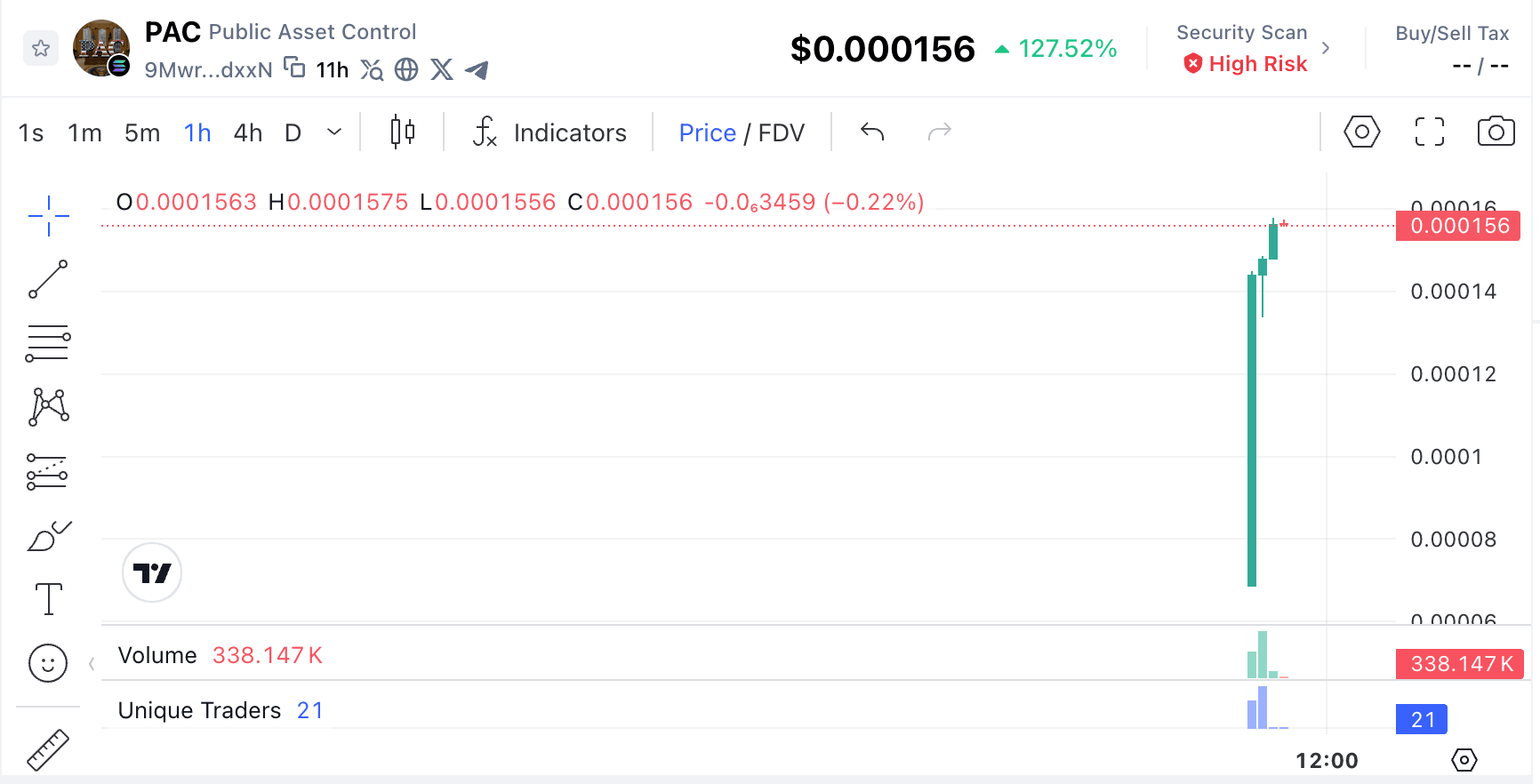
Public Asset Control (PAC) coin, ticker $PAC, operates on the Solana blockchain, known for its fast transactions and low fees. Launched as a decentralized token, it draws attention through a website styled like a classified government document, referencing public assets, strategic reserves, and even commodities like oil and gold. According to the project's disclaimer, accessed on May 13, 2026, PAC is explicitly for "entertainment and speculative purposes only," distancing itself from any real affiliations.
This setup positions PAC as more of a narrative-driven meme token than a functional asset management tool. For beginners, think of it like a storybook cryptocurrency—engaging but not necessarily grounded in verifiable utility. Public data from Solana explorers, as of the extraction time on May 13, 2026, shows its contract address as B5xwCQUKfx8BJZsgvuBvW6XgrxtkqLTrDEAYjpLJpump. Confirming this address via official sources is crucial, as similar-named tokens can confuse traders and lead to losses.
Crypto analyst Alex Becker noted in a recent YouTube breakdown that tokens like PAC thrive on viral themes but often lack depth, stating, "Bold claims without audits are red flags in crypto—always dig deeper." This aligns with broader industry trends where Solana hosts many such projects, blending hype with high-risk trading.
Public Asset Control (PAC) Claims and Reality Check
The PAC website uses intriguing phrases like "protocol active," "capital commitment," and "asset intelligence," suggesting ties to real-world assets. It mentions backing by oil, gold, and strategic reserves, even nodding to entities like BlackRock and Palantir. However, the same site includes a clear disclaimer: the token isn't affiliated with any government, corporation, or individual referenced.
Independent verification is key here. As of May 13, 2026, no official statements from BlackRock or Palantir confirm any connection, per public records and news outlets like CoinDesk. This echoes warnings from the SEC about unverified crypto claims, where thematic branding can mislead without legal backing.
For context, similar tokens in the past, like those themed around politics or finance, have seen short-lived pumps followed by dumps. A balanced view? PAC's narrative might drive short-term interest, but without transparent tokenomics or a whitepaper, it's speculative at best. Traders should cross-check claims through reliable channels, avoiding assumptions that could turn entertaining fiction into financial regret.
Risk Assessment for PAC Coin Investors
Investing in PAC coin comes with inherent risks typical of early-stage Solana tokens. Liquidity is often thin, meaning prices can swing wildly from small trades—as seen in market data from DEX trackers on May 13, 2026, where PAC showed volatile activity. Holder distribution is another factor; if concentrated in few wallets, it raises manipulation concerns.
No full third-party audit report is publicly available, though some automated DEX tools flag basic issues. Crypto security firm PeckShield emphasizes that without comprehensive audits, smart contract vulnerabilities persist, potentially leading to exploits. Beginners should start by reviewing transaction history on platforms like Solana's block explorer.
A practical tip: Use only disposable funds and set stop-losses if trading. Recent news from Blockchain.com highlights how unverified tokens like PAC can attract scams, so enabling two-factor authentication on wallets is non-negotiable. Ultimately, risk checks aren't just boxes to tick—they're your shield in a market where hype often outpaces substance.
| Risk Factor | Description | Mitigation Strategy |
|---|---|---|
| Liquidity | Low volume leads to price volatility | Monitor trading pairs on DEXs; avoid illiquid times |
| Audit Status | No public full audit | Seek tokens with reports from firms like Certik |
| Claim Verification | Unsubstantiated institutional links | Cross-reference with official entity statements |
| Holder Concentration | Potential for dumps by large holders | Check distribution on explorers like Solscan |
| Market Volatility | Sharp moves in new tokens | Use small positions and track social sentiment |
Market Context and Trading PAC on Solana
PAC coin fits into Solana's ecosystem, where tokens often gain traction via decentralized exchanges like Raydium or Jupiter. As of May 13, 2026, market trackers show live trading, but with thin volume, it's prone to rapid shifts—much like a small boat in choppy waters. Traders watch it for its meme-like political and institutional vibe, blending entertainment with speculation.
Why the buzz? Solana's speed enables quick swaps, attracting narrative-driven plays. Data from DefiLlama indicates Solana's TVL grew 15% in early 2026, boosting visibility for tokens like PAC. Yet, as analyst Lark Davis pointed out in a podcast, "Visibility doesn't equal viability—check fundamentals first."
For those considering trades, focus on chart patterns and social momentum. Tools like DexScreener provide real-time data, helping spot entry points. Remember, while Solana offers opportunities, PAC's context screams caution: it's not a stable asset but a high-stakes bet on community hype.
Is Public Asset Control (PAC) Suitable for You?
PAC might appeal to seasoned traders who thrive on high-risk, short-term plays, tracking metrics like liquidity pools and holder behavior. If you're researching Solana innovations, it offers a case study in verifying claims—start by confirming the contract and reading disclaimers thoroughly.
Beginners, however, face steeper hurdles. With limited team info, no clear roadmap, and bold but unproven claims, it's easy to get burned. Prioritize education: learn about tokenomics through resources like CoinGecko academy. Ask yourself: Do I need regulated stability, or am I okay with speculation?
A framework for decisions: Assess your risk tolerance, research independently, and diversify. PAC isn't for everyone—it's a reminder that in crypto, entertaining themes can mask uncertainties. As expert Andreas Antonopoulos advises, "Invest in understanding before investing money."
Navigating PAC Coin in the Broader Crypto Landscape
Looking ahead, PAC's fate hinges on community adoption and market sentiment. Solana tokens often evolve quickly, but without verifiable backing, sustainability is questionable. Compare it to established assets like SOL, which boasts real utility—PAC, by contrast, leans on narrative alone.
Unique insight: In a post-2025 bull run, as reported by Chainalysis, thematic tokens surged 20% faster but crashed harder. For PAC, this means potential for quick gains if hype builds, but equal risk of fading. Traders could monitor social channels for momentum shifts, using it as a learning tool rather than a core holding.
Ultimately, PAC exemplifies crypto's wild side—innovative yet perilous. Approach with eyes wide open, blending curiosity with caution to make informed choices.
Before wrapping up, it's worth noting that platforms like WEEX offer their own ecosystem tokens, such as WEEX Token (WXT), which can provide utility within the exchange. New users might also find value in WEEX welcome bonus programs, offering rewards for tasks like deposits or initial trades.
DISCLAIMER: WEEX and affiliates provide digital asset exchange services, including derivatives and margin trading, only where legal and for eligible users. All content is general information, not financial advice-seek independent advice before trading. Cryptocurrency trading is high risk and may result in total loss. By using WEEX services you accept all related risks and terms. Never invest more than you can afford to lose. See our Terms of Use and Risk Disclosure for details.
You may also like
What Is SAOS? Strategic American Oil Supply Token Explained
SAOS is a meme token on Solana with a 75,000 USD market cap and 22,000 USD locked liquidity, positioned around oil supply themes but lacking real asset backing
It thrives on pure narrative speculation, with no utility, website, or doxxed team, making it highly volatile and attention-dependent
Traders should distinguish SAOS from legitimate real-world asset projects, as its branding is speculative rather than substantive
Positive aspects include locked liquidity reducing rug pull risks, but low trading activity signals high uncertainty
How to Buy Public Asset Control (PAC) Token in 2026: Latest Solana Buying Guide
How to buy Public Asset Control (PAC) token in 2026, PAC contract address, Solana wallet setup, Jupiter swap guide, latest price, liquidity, and risks.

What Is Public Asset Control (PAC) Token and How Does It Work? Latest Solana PAC Token Guide
Public Asset Control (PAC) token explained. Learn what PAC is, how it works on Solana, current price snapshot, risks, and buying basics.

Can PAC Coin Reach $1 Soon? Analyzing Public Asset Control
PAC is a Solana-based meme token with a government-themed narrative, but it is highly speculative.
At its current price (~$0.0009) and 1B supply, reaching $1 would require a $1B market cap, which is very unlikely.
Short-term moves to $0.001 or $0.01 are more realistic, but the token is highly volatile due to low liquidity and hype-driven trading.
Overall, $1 is not a realistic target, and PAC is better suited for short-term speculation than long-term investment.

United Nations Oil Reserve (UNOS) Crypto: Solana Token, UN Links, and Risks
United Nations Oil Reserve (UNOS) Crypto explained: Solana token basics, UN links, oil-backing claims, market risks, contract checks, and buying cautions.
What Is Official Saudi Oil Reserve (OSOR) Coin?
Learn what OSOR coin is, why its Saudi oil narrative matters, how to verify the contract, and what risks to check before trading.

Global Digital Oil Reserve (GDOR): What It Is, Risks, and How to Check It
Global Digital Oil Reserve (GDOR) is an oil-themed Solana token with unclear backing. Learn its risks, market data, and verification checklist.
Is OBC Crypto a Good Investment?
Is OBC crypto a good investment? We analyze the latest market data, holder concentration, liquidity risks, and short-term momentum. Read this before you invest in OBC token.
Can OSOR Reach $1? Full Price Analysis 2026
OSOR crypto price prediction 2026: Can Saudi Oil Reserve token reach 1? Read before buying.

What is International Oil Supply (IOS) Coin?
Wondering what is IOS crypto? Here’s a straight look at International Oil Supply (IOS) coin—the Solana token tied to oil reserve data. Contract address, risks, and what’s still unverified.

What Is the Unified International Token (UNIT)? Is UNIT Crypto Legit or Scam?
what is UNIT crypto? Here’s a breakdown of the Unified International Token ($UNIT), how it ties to BRICS+ data, where to buy it, and why it’s a conceptual project—not an official currency.
What Is Stablecoin Business OS (SBOS) Coin?
What is SBOS crypto? We break down Stablecoin Business OS, its USDC invoicing tools, AI finance assistant, token contract address, and real utility for online businesses.

What Is $PAC Token? Legitimate Crypto or Just A High-Risk Meme Coin?
Is Public Asset Control ($PAC) a real asset-backed token or just another meme coin narrative? We analyze its official website, market data, and risks.
NEAR Airdrop: Join WEEX to Share 50,000 USDT in Crypto Rewards
Join the NEAR airdrop on WEEX from May 7 to May 14 to share a 50,000 USDT prize pool. New users can earn rewards through deposits and spot trades with zero-fee trading advantages.
Is OSOR Token Next 10X Like WCOR or Just Market Hype?
Is OSOR the next 10X crypto like WCOR or just market hype? Compare OSOR vs WCOR on-chain data, price discrepancies, and holder risks in this deep dive into Saudi oil-backed tokens.
OPG Airdrop: Share 50,000 USDT and Enjoy 0-Fee Trading on WEEX
Join the OPG airdrop on WEEX to share a 50,000 USDT prize pool. New users earn rewards through spot trade and deposits. Trade OPG with zero fees now.

Is $PAC Token a Good Investment in 2026? Price, Risks, and Market Analysis
A data-driven analysis of Public Asset Control (PAC) token: current price, market cap, liquidity, $1 target feasibility, and risk factors. Is it a legitimate investment or a high-risk meme coin?

How to Buy $WCOR Coin: Should I Invest or Is It Just Hype?
Learn how to buy $WCOR coin on Solana and explore its latest 57% price surge. This expert guide analyzes whether WCOR is a solid investment or speculative hype.
What Is SAOS? Strategic American Oil Supply Token Explained
SAOS is a meme token on Solana with a 75,000 USD market cap and 22,000 USD locked liquidity, positioned around oil supply themes but lacking real asset backing
It thrives on pure narrative speculation, with no utility, website, or doxxed team, making it highly volatile and attention-dependent
Traders should distinguish SAOS from legitimate real-world asset projects, as its branding is speculative rather than substantive
Positive aspects include locked liquidity reducing rug pull risks, but low trading activity signals high uncertainty
How to Buy Public Asset Control (PAC) Token in 2026: Latest Solana Buying Guide
How to buy Public Asset Control (PAC) token in 2026, PAC contract address, Solana wallet setup, Jupiter swap guide, latest price, liquidity, and risks.
What Is Public Asset Control (PAC) Token and How Does It Work? Latest Solana PAC Token Guide
Public Asset Control (PAC) token explained. Learn what PAC is, how it works on Solana, current price snapshot, risks, and buying basics.
Can PAC Coin Reach $1 Soon? Analyzing Public Asset Control
PAC is a Solana-based meme token with a government-themed narrative, but it is highly speculative.
At its current price (~$0.0009) and 1B supply, reaching $1 would require a $1B market cap, which is very unlikely.
Short-term moves to $0.001 or $0.01 are more realistic, but the token is highly volatile due to low liquidity and hype-driven trading.
Overall, $1 is not a realistic target, and PAC is better suited for short-term speculation than long-term investment.
United Nations Oil Reserve (UNOS) Crypto: Solana Token, UN Links, and Risks
United Nations Oil Reserve (UNOS) Crypto explained: Solana token basics, UN links, oil-backing claims, market risks, contract checks, and buying cautions.
What Is Official Saudi Oil Reserve (OSOR) Coin?
Learn what OSOR coin is, why its Saudi oil narrative matters, how to verify the contract, and what risks to check before trading.


