
 Buy Crypto
- Markets
 Futures
- Spot
- Copy Trade
- Earn
- More
Between Risk and Hope: ETH Cali and the Colombian Ethereum Community

Original Title: "Between Risk and Hope: ETH Cali and the Colombian Ethereum Community"
Original Source: ShanhaiWoo Mountain & Sea Pavilion
Cali City, the salsa dance capital of Colombia, is also the birthplace and hometown of ETH Cali. Here lies a comprehensive offshore industrial and service park called Zonamerica, where an innovative ecosystem, an active community of entrepreneurs, and tax benefits for resident companies have attracted ETH Cali to establish its presence. In addition to the office area, the Universidad del Valle (Valle University) and Universidad ICESI (ICESI University), located within five kilometers of Zonamerica, have also become important hubs for ETH Cali to hold events and connect with student communities.

Growth Trajectory of the Colombian Ethereum Community
William Martinez, who prefers to call himself a core member rather than a founder, tells us about the current development status of the Ethereum community in Colombia. The Ethereum Colombian community has adopted a geographically and locally based organizational structure, forming an Ethereum local community network consisting of multiple nodes such as ETH Medellin, ETH Bogota, ETH Caribe, ETH Eje Cafetero, ETH Arauca, and ETH Cali.
Among them, both ETH Arauca and ETH Cali were established after Devcon VI in Bogota in October 2022. Unfortunately, Emerson David Silva, the community leader of ETH Arauca, was tragically killed last year while promoting Ethereum in a high-risk area. Currently, the active Colombian Ethereum community mainly includes ETH Bogotá, ETH Medellín, and ETH Cali.

ETH Arauca Community Leader Emerson David Silva
Like other Ethereum communities in Colombia, ETH Cali aims to promote Ethereum adoption in the local community. William stated that Cali City has a strong pool of technical talent, but they know very little about Web3. Therefore, ETH Cali focuses on education, developer meetups, and practical activities such as integrating Web3 frameworks and tools into cutting-edge fields like artificial intelligence, attempting to open a window to a new technological paradigm for local tech talent.
"The story of Emerson and ETH Arauca is heartbreaking," William said, "but it has also strengthened our resolve to continue building the developer community."
ETH Cali Wallet: An Open-Source Wallet for Real-World Use Cases
A tech-driven approach has always been the hallmark of the ETH Cali community development, reflected not only in numerous tech-related activities but also in the team members who have collectively participated in building the community. Today, the community consists of 9 core members and 6 contributors, almost all of whom have a deep developer background.
At Devconnect's ETH Latam Hub, we met Cristobal Valencia, a core community developer. He is working on a new ReFi project: ReFiUP. According to Cristobal, ReFiUP aims to create an on-chain protocol, ReFi Universe Protocol, that coordinates global efforts to clean the Earth. Users can earn tokens and verifiable certificates by collecting various types of waste, while companies can reduce their carbon footprint by purchasing these certificates. The entire process involves AI agents to verify user work and uses zero-knowledge proof technology to protect user privacy data.
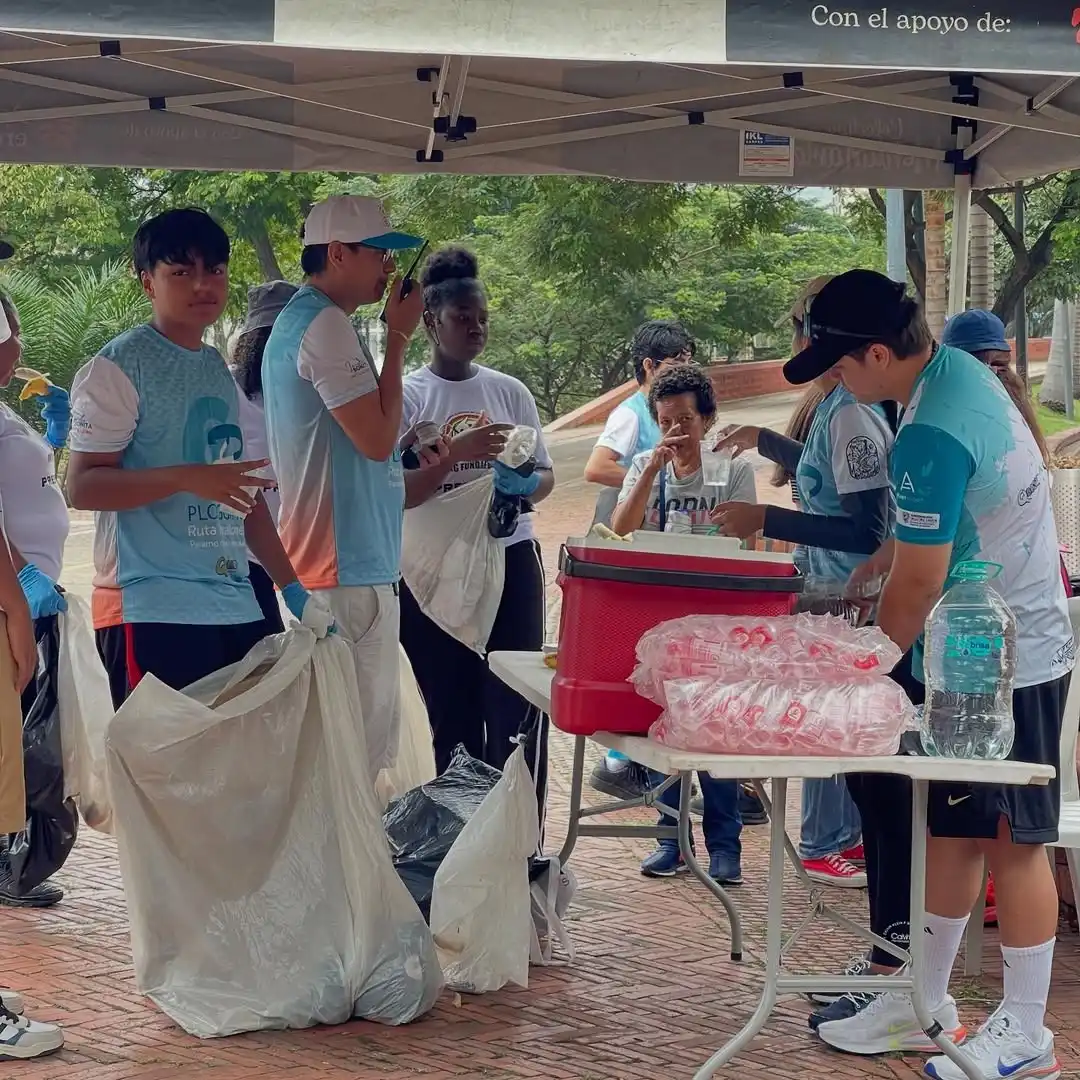
The inspiration for ReFiUP came from an offline event supported by ETH Cali. In June of this year, ETH Cali partnered with the local environmental organization Lapapaya to provide technical and logistical support for a small marathon event held in Cali. During the race, participants could earn tokens and NFT certificates as rewards based on the amount of garbage they collected. The event collected over 150 kilograms of recyclable waste, and more than 60 participants successfully claimed their on-chain rewards through the ETH Cali Wallet.
"Our goal is to engage community members and new users, allowing them to explore the possibilities of cryptocurrency through this open-source wallet designed for real-world use cases," William explained. The ETH Cali Wallet is built on the Privy account system, supports email registration, introduces zkPassport.id as an anti-whale mechanism, and implements gas sponsorship transactions through account abstraction. ETH Cali has open-sourced the codebase of this wallet, enabling other developers to focus on building application logic without having to redevelop user authentication or anti-whale mechanisms.
From Events to Impact: ETH Cali's 2026 Roadmap
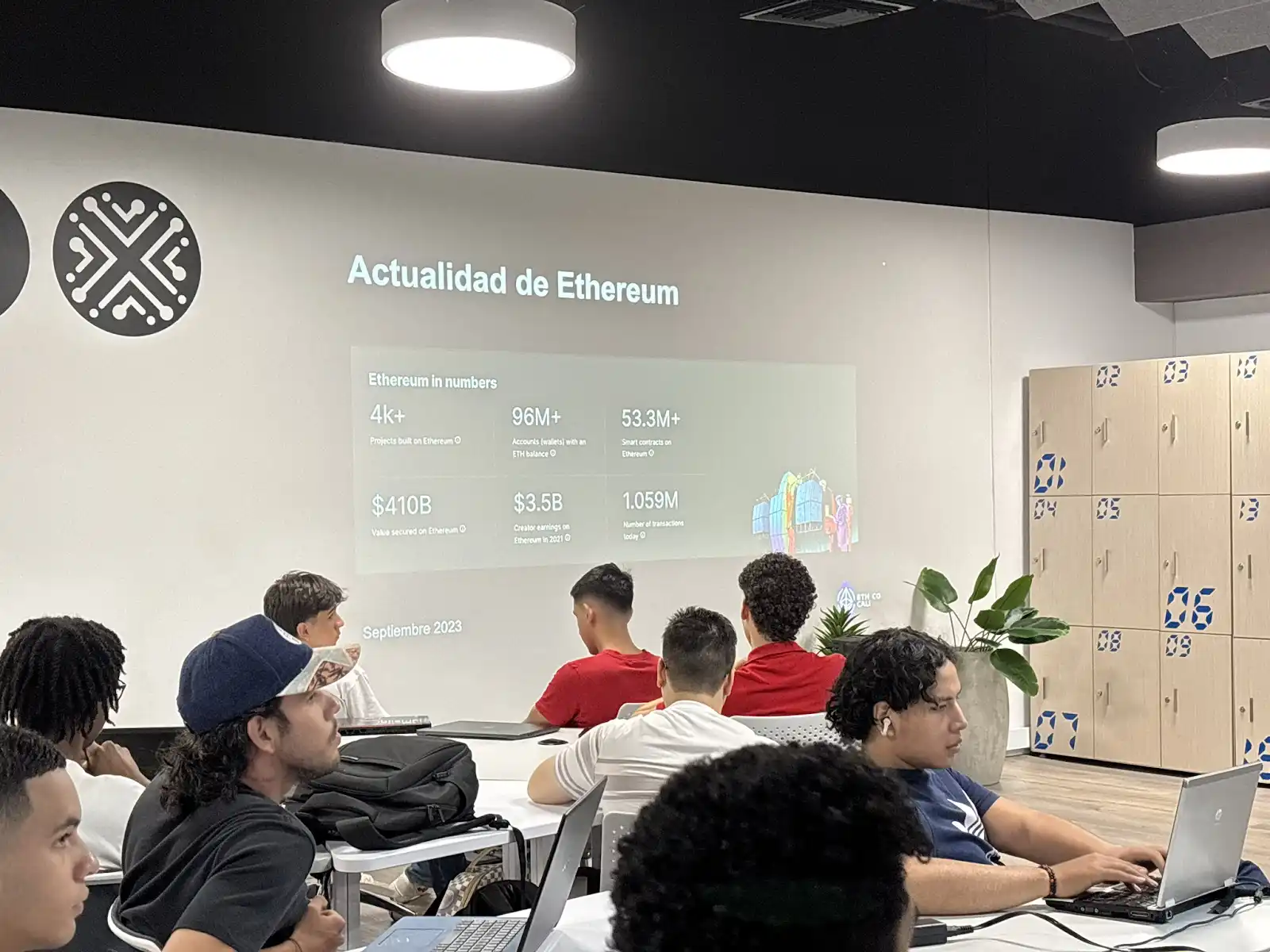
Looking back at the past three years, ETH Cali has held over 40 offline meetups, attracting over 100 Web2 developers to join, and growing its Web3 membership from 5 people to over 250. At the same time, the community has supported over 10 local Web3 projects, established partnerships with 5 universities, and gradually engaged in dialogues with senior leadership, government agencies, and key institutions to help them understand this technology through practice.
"We focus on real builders, not hype." Looking to the future, William listed specific goals for ETH Cali by 2026:
• Establish an ETH Cali center or hacker space for the local tech community as a long-term space for developer interaction and collaboration.
• Partner with universities such as ICESI, USB Cali, Universidad Santiago de Cali to drive research focused on cryptography, blockchain, and artificial intelligence.
• Cultivate over 100 Web2 developers to transition to Web3 through structured projects like Speed Run Ethereum, Cyfrin Updraft.
• Collaborate with the Ethereum Foundation Secretariat to transform a university DeFi course into a free, open Web3 learning project for local developers and the community.
• Build and operate their own RPC infrastructure to provide stable and reliable technical support for the local ecosystem.
• Explore new technologies including robotics to create a more practical learning and experimental environment.
• Strengthen cooperation with Ethereum communities in Cluj, Prague, Naples, Rome, India, and China to make Cali an active node in the global Ethereum network.
These goals are not merely about numbers or scale expansion but revolve around the question of "how to make technology truly effective." For ETH Cali, the culmination of community development is not the events themselves but whether the technology can address broader real-world needs.
The Next Inflection Point for Ethereum: Real Products and Services
In William's view, the Latin American region faces some structural challenges such as cross-border payments, global currency access, currency devaluation risks, and limited participation in the global tech community, where Ethereum technology can provide real value.
He believes that the next stage of breakthrough will come from shifting the focus from speculation to truly global products and services. With improving Internet access, mature data infrastructure, and widespread use of artificial intelligence tools, Latin America is poised to accelerate its pace of innovation and play a more important role in open-source technologies and global collaboration.
“The end of 2026 or the beginning of 2027 might be an appropriate time window,” William suggested. “We may hold a flash city event, bringing together local builders, institutions, governments, entrepreneurs, developers, and researchers to collectively envision the next phase of Cali's development through open collaboration.”
Conclusion
Technological advancement has never been a straight upward line but more like a spiral ascent. The Colombian Ethereum community, represented by ETH Cali, is no different: despite setbacks and ups and downs, it has continued to build strength, continuously spreading core Web3 values such as collaboration, permissionless innovation, and open-source culture to more people.
You may also like

From x402 to MPP: Cloudflare's crucial vote, will it go to Coinbase or Stripe?

BlackRock CEO issues annual open letter: The wave of tokenization has arrived, and we will lead this trend

When Backpack backstabs the community

When gold is no longer a safe haven, and Bitcoin continues to panic

Trump, the World's Largest Oil Trader

If the US and Iran have not reached an agreement in 5 days, what other cards does Trump have?

Tether Whale Dumps £12 Million, Backing Crypto’s ‘British Trump’
Ethereum Foundation Post: Rethinking the Division of Work Between L1 and L2 to Build the Ultimate Ethereum Ecosystem

Two Major Prediction Market Platforms Unite Rarely, What Is the Story Behind This New Fund?
Dragonfly Partners: Most agents will not engage in autonomous trading, how can crypto payments prevail?

US AI Startup Goes All In on Chinese Mega-Model | Rewire News Morning Brief

Trump Lies Again: A "Five-Day Pause" Psyop, How Wall Street, Bitcoin, and Polymarket Insiders Synced Uposciogen

When a Token Becomes Labor, People Become the Interface

Ceasefire News Leaked Ahead of Time? Large Polymarket Bets on Outcome Before Trump's Tweet
BlackRock CEO's Annual Shareholder Letter: How is Wall Street Using AI to Keep Profiting from National Pension Funds?

Sun Valley Releases 2025 Financial Report: Bitcoin Mining Revenue Reaches $670 Million, Accelerating Transformation to AI Infrastructure Platform
On March 16, 2026, in Dallas, Texas, USA, CanGu Company (New York Stock Exchange code: CANG, hereinafter referred to as "CanGu" or the "Company") today announced its unaudited financial performance for the fourth quarter and full year ended December 31, 2025. As a btc-42">bitcoin mining enterprise relying on a globally operated layout and dedicated to building an integrated energy and AI computing power platform, CanGu is actively advancing its business transformation and infrastructure development.
• Financial Performance:
Total revenue for the full year 2025 was $688.1 million, with $179.5 million in the fourth quarter.
Bitcoin mining business revenue for the full year was $675.5 million, with $172.4 million in the fourth quarter.
Full-year adjusted EBITDA was $24.5 million, while the fourth quarter was -$156.3 million.
• Mining Operations and Costs:
A total of 6,594.6 bitcoins were mined throughout the year, averaging 18.07 bitcoins per day; of which 1,718.3 bitcoins were mined in the fourth quarter, averaging 18.68 bitcoins per day.
The average mining cost for the full year (excluding miner depreciation) was $79,707 per bitcoin, and for the fourth quarter, it was $84,552;
The all-in sustaining costs were $97,272 and $106,251 per bitcoin, respectively.
As of the end of December 2025, the company has cumulatively produced 7,528.4 bitcoins since entering the bitcoin mining business.
• Strategic Progress:
The company has completed the termination of the American Depositary Receipt (ADR) program and transitioned to a direct listing on the NYSE to enhance information transparency and align with its strategic direction, with a long-term goal of expanding its investor base.
CEO Paul Yu stated: "2025 marked the company's first full year as a bitcoin mining enterprise, characterized by rapid execution and structural reshaping. We completed a comprehensive adjustment of our asset system and established a globally distributed mining network. Additionally, the company introduced a new management team, further strengthening our capabilities and competitive advantage in the digital asset and energy infrastructure space. The completion of the NYSE direct listing and USD pricing also signifies our transformation into a global AI infrastructure company."
"As we enter 2026, the company will continue to optimize its balance sheet structure and enhance operational efficiency and cost resilience through adjustments to the miner portfolio. At the same time, we are advancing our strategic transformation into an AI infrastructure provider. Leveraging EcoHash, we will utilize our capabilities in scalable computing power and energy networks to provide cost-effective AI inference solutions. The relevant site transformations and product development are progressing simultaneously, and the company is well-positioned to sustain its execution in the new phase."
The company's Chief Financial Officer, Michael Zhang, stated: "By 2025, the company is expected to achieve significant revenue growth through its scaled mining operations. Despite recording a net loss of $452.8 million from ongoing operations, mainly due to one-time transformation costs and market-driven fair value adjustments, the company, from a financial perspective, will reduce its leverage, optimize its Bitcoin reserve strategy and liquidity management, introduce new capital to strengthen its financial position, and seize investment opportunities in high-potential areas such as AI infrastructure while navigating market volatility."
The total revenue for the fourth quarter was $1.795 billion. Of this, the Bitcoin mining business contributed $1.724 billion in revenue, generating 1,718.3 Bitcoins during the quarter. Revenue from the international automobile trading business was $4.8 million.
The total operating costs and expenses for the fourth quarter amounted to $4.56 billion, primarily attributed to expenses related to the Bitcoin mining business, as well as impairment of mining machines and fair value losses on Bitcoin collateral receivables.
This includes:
· Cost of Revenue (excluding depreciation): $1.553 billion
· Cost of Revenue (depreciation): $38.1 million
· Operating Expenses: $9.9 million (including related-party expenses of $1.1 million)
· Mining Machine Impairment Loss: $81.4 million
· Fair Value Loss on Bitcoin Collateral Receivables: $171.4 million
The operating loss for the fourth quarter was $276.6 million, a significant increase from a loss of $0.7 million in the same period of 2024, primarily due to the downward trend in Bitcoin prices.
The net loss from ongoing operations was $285 million, compared to a net profit of $2.4 million in the same period last year.
The adjusted EBITDA was -$156.3 million, compared to $2.4 million in the same period last year.
The total revenue for the full year was $6.881 billion. Of this, the revenue from the Bitcoin mining business was $6.755 billion, with a total output of 6,594.6 Bitcoins for the year. Revenue from the international automobile trading business was $9.8 million.
The total annual operating costs and expenses amount to $1.1 billion.
Specifically, they include:
· Revenue Cost (excluding depreciation): $543.3 million
· Revenue Cost (depreciation): $116.6 million
· Operating Expenses: $28.9 million (including related-party expenses of $1.1 million)
· Miner Impairment Loss: $338.3 million
· Bitcoin Collateral Receivable Fair Value Change Loss: $96.5 million
The full-year operating loss is $437.1 million. The continuing operations net loss is $452.8 million, while in 2024, there was a net profit of $4.8 million.
The 2025 non-GAAP adjusted net profit is $24.5 million (compared to $5.7 million in 2024). This measure does not include share-based compensation expenses; refer to "Use of Non-GAAP Financial Measures" for details.
As of December 31, 2025, the company's key assets and liabilities are as follows:
· Cash and Cash Equivalents: $41.2 million
· Bitcoin Collateral Receivable (Non-current, related party): $663.0 million
· Miner Net Value: $248.7 million
· Long-Term Debt (related party): $557.6 million
In February 2026, the company sold 4,451 bitcoins and repaid a portion of related-party long-term debt to reduce financial leverage and optimize the asset-liability structure.
As per the stock repurchase plan disclosed on March 13, 2025, as of December 31, 2025, the company had repurchased a total of 890,155 shares of Class A common stock for approximately $1.2 million.

The US AI Startup Is Loving China's Open Source Model



 App
App