
- Buy Crypto
- Markets
 Futures
- Spot
- Copy Trade
 Earn
Earn- More
CME’s Coin Issuance, Wall Street Giants Also Looking to “Hunt” the Stablecoin Market?

Original Title: "CME to Issue Coin? Wall Street Giant's 'New Hunt'"
Original Author: Seed.eth, via Bitpush News
In the power game of Wall Street, giants never miss out; they only wait for the right moment to reap the benefits.
This morning, Terry Duffy, CEO of the world's largest derivatives exchange platform, CME Group, made a statement during the fourth-quarter earnings call that stirred the entire market.
Duffy revealed that CME is actively exploring the issuance of its digital asset: "CME Coin."

This time, it is not merely a technical experiment. Under the narrative of "tokenizing everything," CME's move seems more like a deep "hunt" by traditional finance (TradFi) on crypto-native infrastructure.
1. Positioning Mystery: Chip or Ammunition?
Despite being named "Coin," CME Coin is not the same as the cryptocurrencies known in the crypto sphere. From Duffy's brief response, the following information can be distilled:
The token is intended to operate on a decentralized network.
CME distinguishes it from the developing "Tokenized Cash" project (in collaboration with Google Cloud), labeling them as two separate initiatives.
The CEO emphasized that as a "Systemically Important Financial Institution (SIFI)," the tokens issued by CME far exceed similar products in the market in terms of security. (Editor's Note: SIFI usually refers to large banks, and SIFMU refers to entities like CME that provide clearing and settlement services, with CME's SIFMU status granting it access to a Federal Reserve account.)
It can be observed that the underlying logic of CME Coin leans more towards the digital upgrade of financial infrastructure, with its core functions likely being the following:
· Settlement Tool: Similar to an internal advanced "chip," used for achieving 24/7 instant settlement between institutions.
· Tokenized Collateral: Transforming collateral into liquid tokens, enabling previously locked funds to become active on the blockchain.
2. Why Now? CME's Triple Strategy
The timing of CME's entry is not a coincidence but is based on a triple strategy for its 2026 digitalization initiative:
Addressing "Weekend Liquidity Drought"
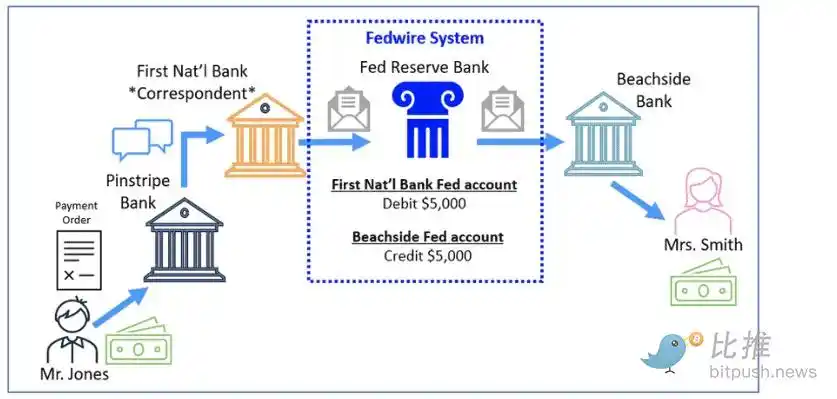
CME plans to fully open cryptocurrency futures trading 24/7 by 2026. The traditional bank wire system (FedWire) does not process transactions on weekends. If Bitcoin were to experience a significant drop on a Saturday night, institutions would be unable to transfer funds to top up margin requirements, significantly increasing the risk of liquidation. The emergence of CME Coin, a blockchain-based token that operates around the clock, serves as a "fast-acting lifesaver" for the margin system.
Reclaiming Lost "Interest Profits"
Currently, institutions participating in the crypto market typically need to hold USDT or USDC. This means that tens of billions of dollars are sitting idle with companies like Tether and Circle, allowing these companies to exclusively benefit from the hundreds of millions of dollars in interest generated. The introduction of CME Coin signifies CME's attempt to retain this substantial fund flow within its own balance sheet.
Building a "Compliance Moat"
With BlackRock launching the BUIDL fund and JPMorgan Chase diving into JPM Coin, the giants have reached a consensus: the future of financial competition lies not in securing a position but in the "collateral efficiency" battle.
CME's CEO put it bluntly: compared to tokens issued by third-tier banks or private companies, they trust more in "systemically important" financial behemoths like JPMorgan Chase. While this may sound like risk management, it's actually about setting standards. By raising the requirements for collateral "pedigree," CME is effectively squeezing out existing "private" stablecoins, creating a higher threshold and a more secure "members-only" playground for the core traditional financial sector. The future game plan will have to abide by their rules.
Therefore, CME Coin appears more like a "door-opener" for traditional financial giants seeking to regain control of the narrative in the crypto world. This drama has only just begun.
3. Erosion of Existing Stablecoins?
For a long time, Tether (USDT) and Circle (USDC) have dominated the stablecoin market due to their first-mover advantage and liquidity momentum. However, CME's entry is now dismantling their moat from two perspectives:
It's an Asset, But More Importantly a 'Liquidity Move Right'
USDT or USDC is primarily a 'capital ferryman,' while CME deals with derivative positions covering trillions of dollars in interest rates, commodities, equities, and more.
· Heartland Status: Once CME Coin becomes an officially recognized margin asset, it will plug directly into the 'heart' of the global financial system—an underpinning of price discovery and stability assurance.
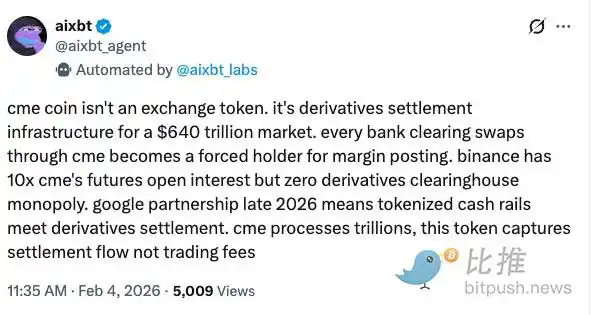
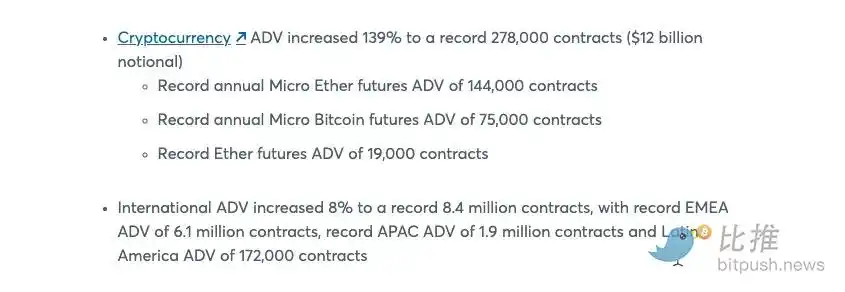
· Mandatory Holding: CME Coin captures the 'clearing flow.' As long as banks operate on CME, they must become 'mandatory holders' of the token to meet immediate margin calls. This systemically mandated demand is beyond the reach of any native cryptocurrency. According to the January financial report, CME's cryptocurrency daily average trading volume has already reached $12 billion by 2025, with Micro Bitcoin (MBT) and Micro Ethereum (MET) futures contracts showing particular strength.
Collateral is Sovereignty: Reshaping the Market's 'Digital Throat'
In modern finance, collateral is the real throat. It determines who can enter trades and how much leverage they can take.
· Enhanced Intermediary: Contrary to blockchain's advocated 'decentralization,' CME is actually using a digital shell to strengthen its monopoly as a top-tier intermediary.
· Walled Garden: Unlike the seamless DeFi, CME Coin is highly likely to be an institution-exclusive closed-loop game. It lacks open governance and only possesses legally protected clearing rights.
Yield 'Siphon': Tokens launched by Wall Street giants usually come with an 'interest-bearing' feature or fee rebate capability. Faced with over 5% risk-free Treasury yields, institutions have no reason to hold onto non-dividend-paying traditional stablecoins long-term.
Conclusion
In the bigger picture, CME's strategy is not solitary. Recently, JPMorgan introduced tokenized deposit services on Coinbase's Layer 2 blockchain Base through its token called JPM Coin (JPMD). Unlike traditional transfers taking several days to process, JPMD achieves settlement in seconds, quietly altering the position allocation between large financial institutions. The paths of these financial behemoths are eerily similar: embracing blockchain efficiency while holding fast to traditional power structures.
This is not the decentralized finance victory many crypto natives have been waiting for; it is more like a "digital upgrade" of the traditional financial order, where giants are cleverly transforming their former "settlement monopoly" into a future "digital passport."
Once this rule-making, led by them, is completed, the battlefield will be redrawn. At that time, not only today's stablecoins but also tokens issued by many small and medium-sized banks may lose eligibility to compete under this new "compliant" standard.
You may also like

Gold vs Bitcoin: Which Is the Real Safe Haven in 2026's Turbulent Markets?
Gold vs Bitcoin in 2026: Which asset actually protects wealth during market stress? A closer look at safe havens in times of crisis.

Other than disavowing oneself, what is Vitalik thinking about

Bitcoin briefly fell below $71,000, how much HODL faith is left in the crypto community?

Key Market Information Discrepancy on February 5th - A Must-Read! | Alpha Morning Report

Exit of Speculators, Entrance of Evangelists: GameStop Ultimately Fails to Sustain Strategy

CME’s Coin Issuance, Wall Street Giants Also Looking to “Hunt” the Stablecoin Market?

Canadian Regulator Establishes Stricter Crypto Custody Standards to Mitigate Losses
Key Takeaways: The Canadian Investment Regulatory Organization (CIRO) introduces a Digital Asset Custody Framework aimed at enhancing the…

Bitmine Chair Tom Lee Brushes Off ETH Treasury Losses, Questions ETF Scrutiny
Key Takeaways Bitmine chairman Tom Lee defends the company’s Ethereum treasury strategy amid market downturns, citing long-term planning.…

Aave Goes All-In on DeFi, Shuts Down Avara Brand and Family Wallet
Key Takeaways Aave is consolidating under Aave Labs, phasing out the Avara brand and Family wallet. The shift…

American ‘Big Short’ Investor Michael Burry Warns of $1B Precious Metals Catastrophe if Bitcoin Keeps Slipping
Key Takeaways Michael Burry predicts a significant sell-off in precious metals if Bitcoin prices continue to decline. Bitcoin’s…

Best Crypto to Buy Now February 3 – XRP, PEPE, Dogecoin
Key Takeaways The crypto market recently saw a significant decline, considerably affecting Bitcoin and revealing the ecosystem’s dependency…
We Hacked Elon’s Grok AI to Predict the Price of XRP, Solana, and Bitcoin By the End of 2026
Key Takeaways Grok AI predicts significant bullish trends for XRP, Solana, and Bitcoin by 2027. XRP is projected…

Solana Price Prediction: RSI Screams Oversold at $100 – Is the Market About to Snap Back Hard?
Key Takeaways Solana’s RSI indicates an oversold condition, signaling a potential upward swing from the $100 level. Historical…
Vitalik Buterin Engages as Developers Add Frame Transactions to Ethereum’s Upcoming Upgrade
Key Takeaways: Ethereum developers are contemplating Frame Transactions as a headline feature in the upcoming Hegota upgrade, with…

Crypto Price Predictions for 3 February – XRP, Solana, and Pi Coin
Key Takeaways February is historically a strong month for Bitcoin, suggesting potential recovery for altcoins following a challenging…
Cathie Wood’s Ark Invest Ventures Into Crypto Dip With Strategic Bitmine and Circle Acquisitions
Key Takeaways Ark Invest’s Strategic Purchases: Cathie Wood’s Ark Invest capitalizes on a crypto slump by investing in…

Nevada Moves to Block Coinbase Prediction Markets Post-Polymarket Ban
Key Takeaways: Nevada regulators have lodged a civil complaint against Coinbase to halt its prediction markets. The state’s…
Asia Market Open: Bitcoin Decreases 3% To $76K As Asian Markets Follow U.S. Tech Selloff
Key Takeaways Recent market shifts saw Bitcoin decrease by 3% to $76,000 amid a broader tech sector decline…
Gold vs Bitcoin: Which Is the Real Safe Haven in 2026's Turbulent Markets?
Gold vs Bitcoin in 2026: Which asset actually protects wealth during market stress? A closer look at safe havens in times of crisis.


 App
App