
Trade.xyz: Pricing the World? On-Chain Markets Are Becoming the Market

 Prefer us on Google



Original Title: trade[xyz]: A Revolution In World Finance.
Original Author: @kelxyz_
Translation: Peggy, BlockBeats
Editor's Note: Since the beginning of 2026, Trade.xyz has been rapidly gaining momentum. In mid-March, it partnered with S&P Dow Jones Indices to launch officially licensed S&P 500 perpetual futures, seen as the first time traditional financial assets have entered the on-chain trading system in a 7x24 format. With the continued growth in trading volume and open interest size, Trade has become one of the most watched projects in the Hyperliquid ecosystem, seen as a key example of "TradFi assets on-chain perpetual."
The author believes that as on-chain perpetual futures begin to cover traditional financial assets, Trade.xyz is transitioning from an "execution tool" to a "pricing hub." Since its launch in 2025, Trade has built a first-mover advantage through liquidity, product expansion, and brand partnerships. From native crypto assets to the S&P 500, commodities, and other traditional assets, its market not only meets trading demands but also participates in price discovery. The most significant change lies in the rhythm—the market is shifting from "reacting to news" to "predicting news" and, in some scenarios, driving price changes ahead of time.
In the author's view, Trade's core competitiveness comes from the "flywheel" of liquidity, user experience, capital efficiency, and brand composition, showing early characteristics of a "Gorilla Game" leader and is expected to take the lead in the TradFi perpetual futures race.
However, this lead is not yet solid. Homogenized competition, incentive mechanisms, regional and brand differences, technical paths, as well as the involvement of traditional institutions and regulation, may reshape the landscape. The key issue is not the speed of growth but whether its structural advantages can be continuously strengthened.
Based on this, the author further points out that as the on-chain market represented by Trade gradually takes shape, a series of opportunities are emerging—from arbitrage, interest rate, and funding rate trading to microstructure research, high-yield products, conditional markets, and intelligent trading systems. This article also identifies several directions that developers, investors, traders, and researchers should focus on. These paths collectively point to a faster, more continuous, and more reflexive market environment.
So, is it possible for Trade.xyz to evolve from a high-growth trading platform into a key infrastructure in the new generation of the financial market?
The following is the original text:
Those who can identify and seize the "reflexivity technological revolution" often stand to gain the most in a globally dominant market.
This article will focus on the market technological revolution led by Trade. In this revolution, as perpetual futures continue to expand across various assets, permissionless leverage will intersect with a speed akin to the internet and a technological autonomous system.
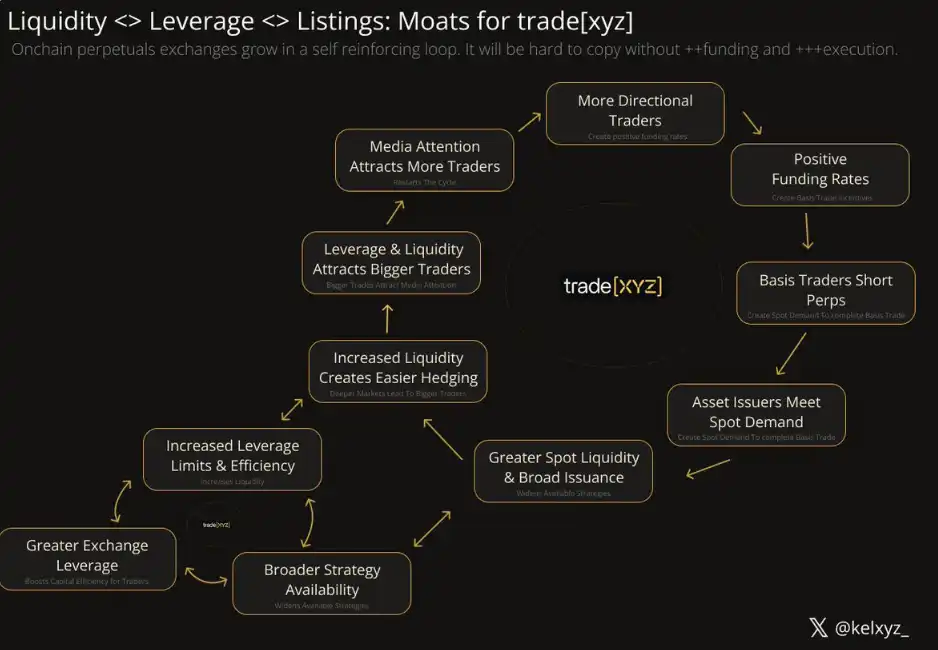
Some predictions for the next few years: On-chain perpetual futures will gradually shift from "reacting to news" to "predicting news," then to "front-running news," and eventually even to "creating news." Perpetual futures covering traditional financial assets will generate over $10 billion in revenue for trading platforms annually.
The flywheel of liquidity, market access, brand partnerships, user experience, and capital efficiency built by trade.xyz will allow it to capture the maximum value share in this market.
We will see several macro hedge funds worth billions of dollars being settled on-chain in real time. Garrett Bullish's high-profile multimillion-dollar liquidation is just the beginning.
The next "Roaring Kitty" will profit in a cross-jurisdiction short squeeze, and counterparties will be unable to artificially hit the "pause button."
As autonomous intelligence continues to expand in duration and capability, intelligent entities highly sensitive to computational power will utilize permissionless leverage offered by Trade, combined with automated "persuasion capabilities," to create and monetize market volatility.
I. The "Second Act" of Perpetual Futures
Between 1997 and 2008, Blackberry created about $80 billion in value for its shareholders, with company revenue peaking at $20 billion in 2008. During these 11 years, its smartphone achieved unprecedented cultural influence. In a sense, the smartphone has changed the world.
But that was just the first act.
By 2025, Apple's revenue reached $416 billion, with the iPhone's single product line contributing $209 billion.
If the first act was the expansion of market size, then the second act is the reshaping of the "human-information relationship," a change that was almost inconceivable at the time. Beyoncé falling asleep with a Blackberry was at most a distant cultural archetype; later on, Netflix, leveraging smartphones, directly competed with "sleep itself" and grew into a company worth hundreds of billions of dollars.
Perpetual Futures are at a similar inflection point.
Act One saw the rise of futures trading around native crypto assets, generating trillions of dollars in trading volume and birthing a cohort of multibillion-dollar companies, including Hyperliquid.
Perpetual Futures may seem straightforward at first glance: a contract without an expiry date, pegged to the price of an underlying asset. While the pricing mechanism can be complex, at a high level, that is its structure. And as these contracts begin to be applied to traditional financial assets, they have started making news, even preemptively "pricing in the news." In just a few months, we have already seen the nascent effects of its second-order impact.
II. Capital in Motion at the Speed of Information
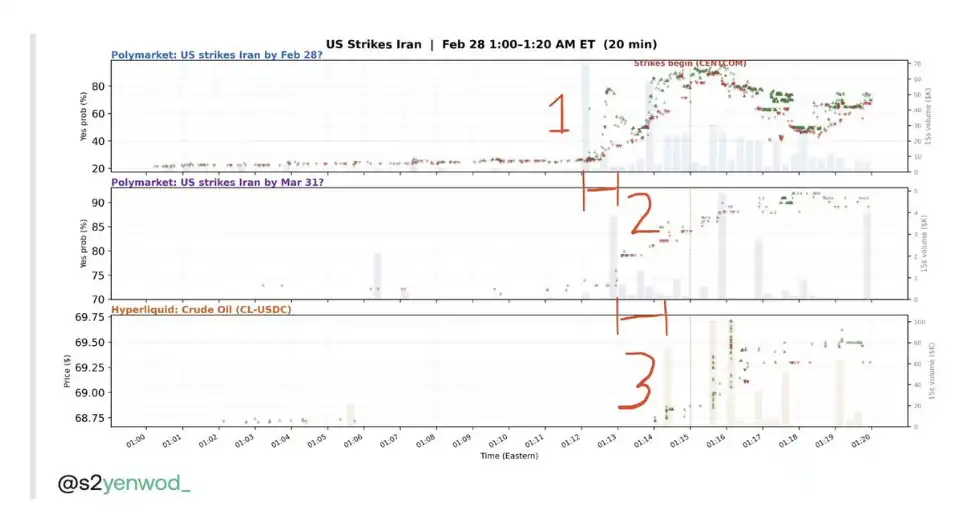
The market's response to news in Trade is accelerating, as evidenced by the Iranian missile strike event a month ago.
Source: yenwod
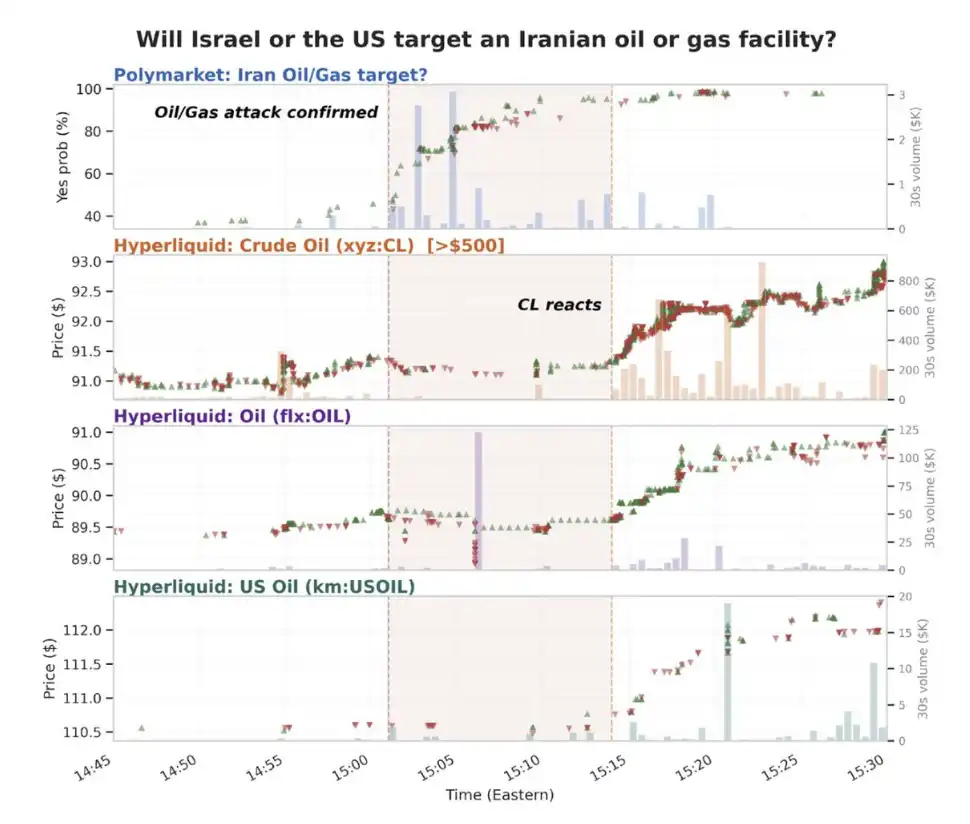
In this newly emerged 24/7 "speed game," Trade primarily competes with prediction markets, vying for the "world's fastest" pricing authority. The current landscape is as follows:
· An anonymous news account first posts the news on social media
· Professional traders (sharps) on Polymarket react first
· Trade's market response is relatively slower but with noticeably greater liquidity
Source: yenwod
The endgame will be vastly different. The phase of "news preceding market moves" will not last long, as the market will start front-running the news.
We anticipate Trade surpassing Polymarket in the "speed game" position, mainly for three reasons:
First, compared to Polymarket, Trade has the potential for significantly increased profit margins due to higher liquidity.
Second, Polymarket's current speed advantage largely stems from the political attention accumulated post-2024 election, whereas Trade entered the mainstream spotlight in just a few weeks.
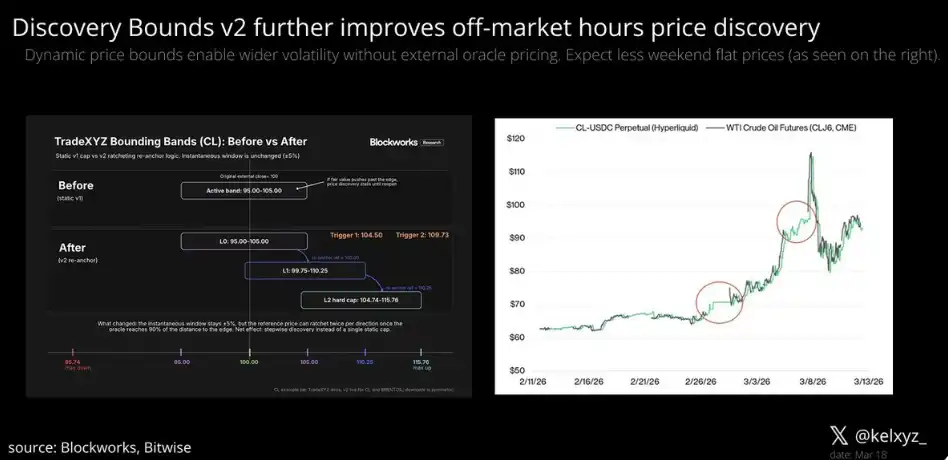
Third, Trade's market was initially constrained by the Discovery Bounds v1 design in the early stages — a risk management mechanism to keep "abnormal market prices" within a reasonable range. With the launch of Discovery Bounds v2, the system will have greater price flexibility during non-trading hours while maintaining robust risk control.
Source: Steven x Bitwise
Trading has shown signs of market pricing transitioning from "passive response" to "active guidance." In the future, these markets will move towards the "direction where news is about to happen" before the news actually occurs.
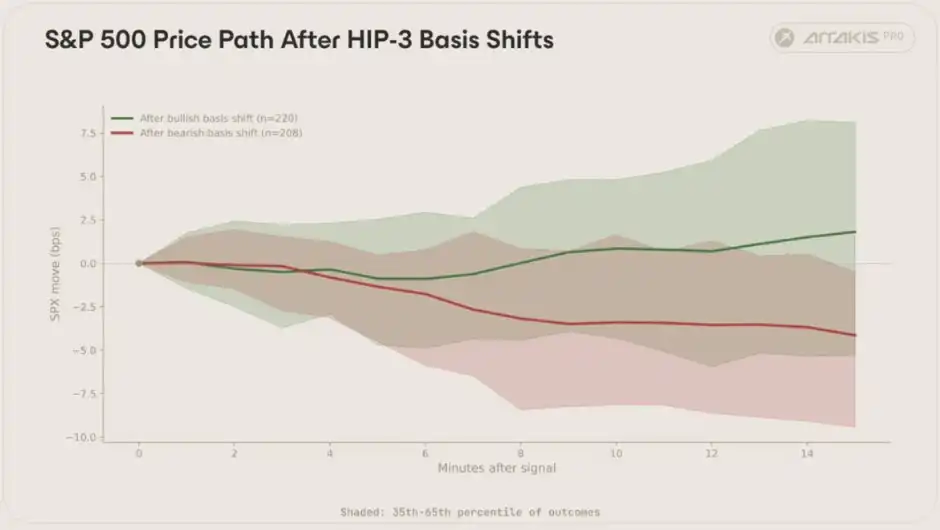
Microstructure
Analysis from Shaun DeDevens (Blockworks) has always been one of the most valuable content in the market microstructure field. His latest research focuses on "weekend price discovery."
During the recent Easter weekend, the overlay of social media-driven sentiment and trading behavior caused the market to once again experience intense volatility, especially notably in assets related to oil.
The key points are as follows:
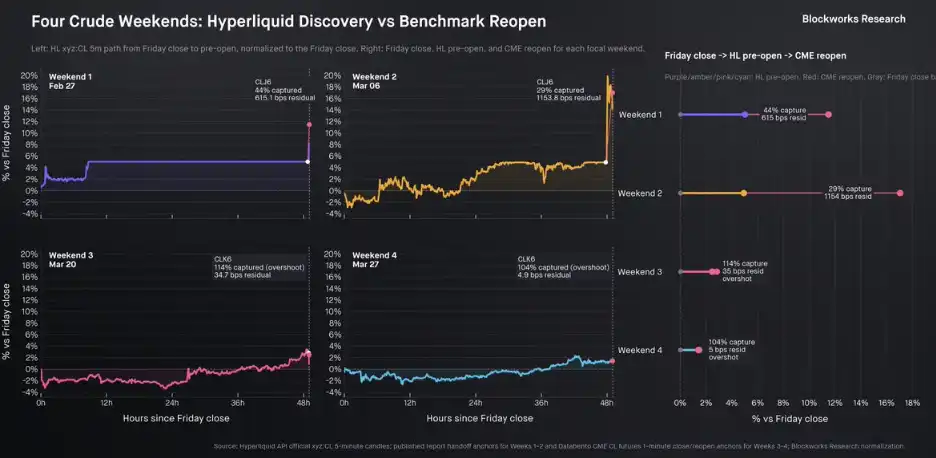
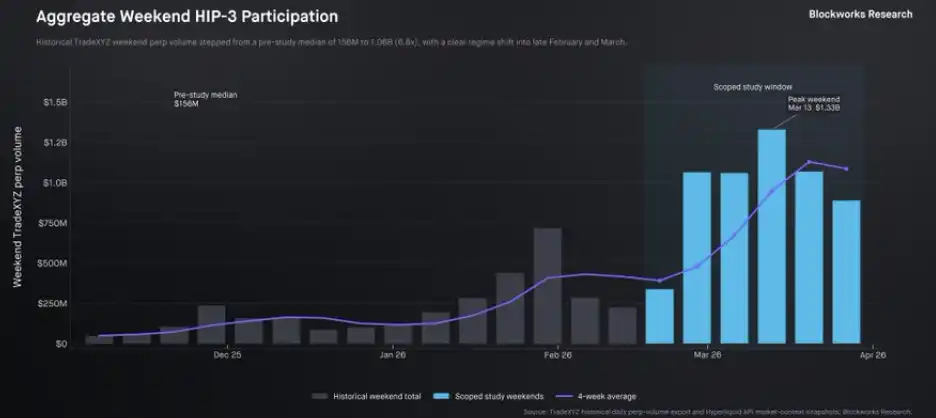
The generated volatility is highly attractive to traders. Over the weekend, the median trading volume in the commodity markets led by trade.xyz has surged from around $150 million to over $1 billion, a sevenfold increase.
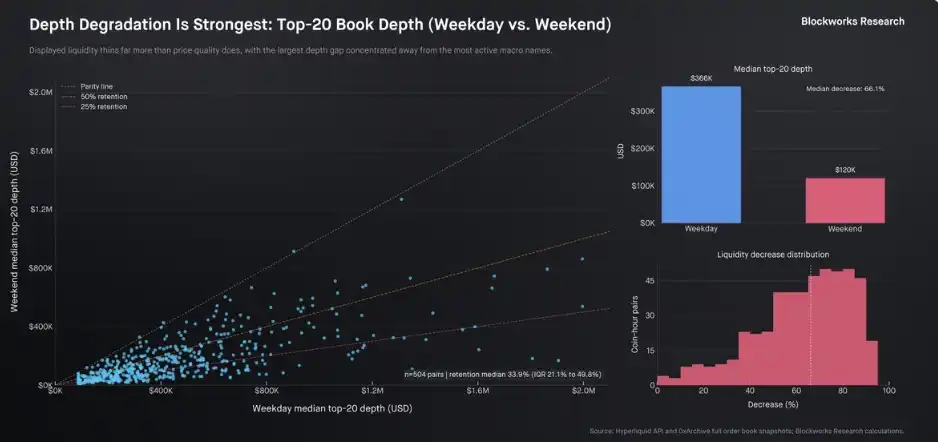
Initially, weekend liquidity appears to have significantly decreased—overall median market liquidity has declined by around 66.1%. However, at the same time, the liquidity of those top markets contributing the majority of the volume has remained at levels close to weekdays.
His analysis of the silver market microstructure is also worth reading (it was also the original focus of this section). These studies all point to a core conclusion: "Hyperliquid and Trade.xyz have shown that the 24/7 on-chain markets are playing an increasingly important role in the price discovery process for traditional assets."
III. Gorilla Game: Moat and Competition
Geoffrey Moore's "Gorilla Game" provides a classic framework for analyzing high-growth technology industries. The core logic is simple: companies that dominate in the early stages often grow into a "Gorilla" and long-term market leader until new technological innovations kick off the next round of competition.
This framework considers that investment and determining the "winner" focus on two stages:
· Application Layer: Penetration capability of early-stage niche markets
· Infrastructure Layer: Expansion capability after entering the high-growth stage
However, currently, an increasing number of companies and protocols (including Trade) exhibit a certain degree of vertical integration characteristics, blurring the boundary between "application" and "infrastructure"—making the distinction between "infrastructure-level penetration" and "application-level growth" no longer clear.
How to accurately define these positions will be key to understanding the competitive landscape, making investment decisions, and determining the ultimate winner.
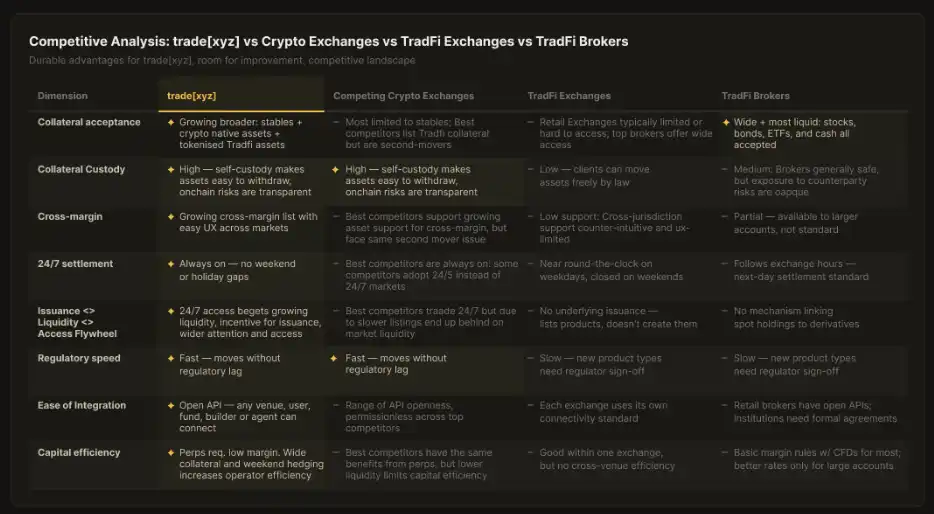
Since its launch in October 2025, Trade has achieved record growth (with annualized fees approaching $100 million), established an official partnership with the S&P 500, and led in various market indicators. From a product perspective, Trade is gradually evolving into the "Gorilla" of the traditional financial perpetual futures field.
According to Geoffrey Moore's framework, becoming a "Gorilla" typically relies on four core competitive advantages:
1. Customer Scale Advantage (driven by media exposure and partnerships)
Acquire more users through extensive media coverage and key partnerships. Trade has been featured multiple times on Bloomberg, The Wall Street Journal, and collaborated with S&P Dow Jones Indices (SPDJI), clearly leading peers in this dimension.
2. Higher Entry Barriers (elevating switching costs through technical nuances)
Enhance user migration costs through a series of "hidden" technical optimizations. This part is currently relatively weak, but mechanisms such as portfolio margining, native spot markets, and fee reduction through a growth model have begun to show preliminary effects.
3. Economies of Scale (lowering costs through liquidity and reputation)
Liquidity itself attracts more liquidity, and the brand effect further amplifies the advantage. Trade's HIP-3 native competitor—theoretically benefiting from Hyperliquid's brand endorsement—continues to lag behind in liquidity competition in similar markets. For example, in the S&P 500 market, within less than a day of Trade's launch, the trading volume exceeded that of other similar markets that have been operating longer.
4. Premium Pricing Power (Pricing Power Due to Industry Standard Position)
This point is still debatable, but a potential signal is this: even in the presence of zero-fee competitors (such as Lighter), Trade's market price has repeatedly experienced premium trades.
These advantages individually already have significant power, and once stacked, they may determine the final shape of the entire market.
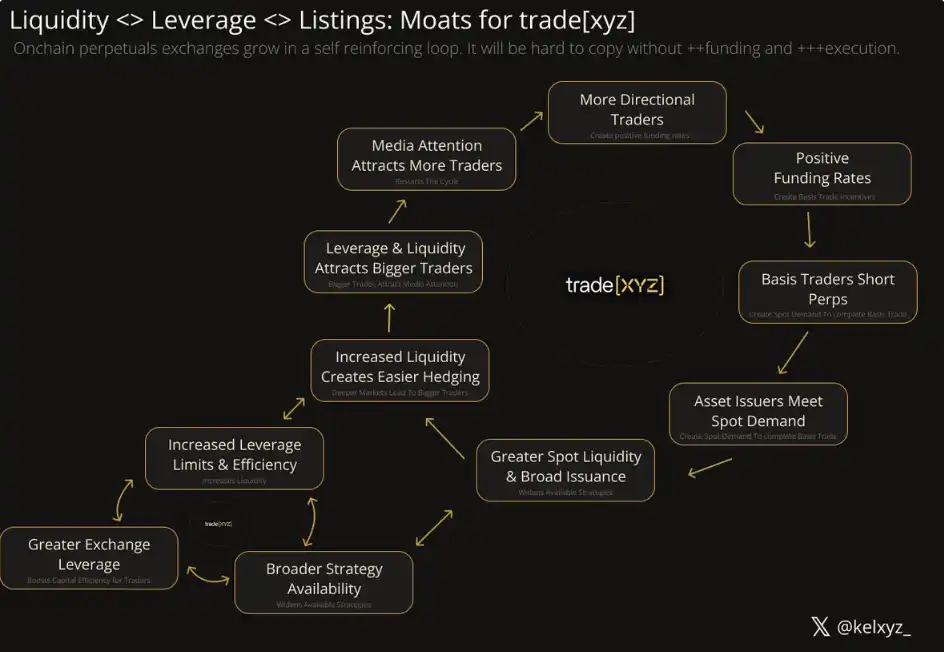
Although the logic of "self-reinforcement, always leading" is quite clear, competitors still have multiple paths to vie for the position of "Perpetual Futures King." At least a second winner will emerge, and there may even be a true challenger to Trade's early advantages. The main paths include:
1. Product Commoditization
Wealthy and resourceful competitors may use a "commoditization" strategy to eliminate differences. If Trade's advantages in liquidity acquisition and branding are weakened, competition will return to the same starting line—especially in a scenario where "premium pricing power" and "user switch costs" have not yet been firmly established. This pattern is not uncommon in many VC-backed industries: latecomers, while not completely replacing pioneers, can still gain a significant market share.
Projects like Lighter are adopting this strategy—using top-tier capital support and "zero fees" to attract retail flow. Although the market response has been lukewarm so far (its token has underperformed since launch), there are still forward-looking funds betting on its potential turnaround.
2. Incentivization
The traditional "airdrop mining" has been extensively utilized in the crypto industry, and relying solely on token incentives is difficult to establish long-term competitive advantages. Historically, a few successful cases, such as Uniswap vs. SushiSwap and Compound vs. Aave, have combined incentives with product advantages or other competitive elements. Especially Aave, by combining "incentives + product leadership," ultimately won the Gorilla Game in the lending race.
For tradfi perpetual products, it is not possible to open up the situation by incentives alone; they must be combined with other differentiation means.
3. Brand and Regional Differentiation
An often overlooked case is PancakeSwap—compared to SushiSwap, it has achieved more lasting success through a combination of incentives, resource support, and "brand + regional positioning."
A more typical example comes from centralized exchanges: such as Bybit, Upbit, etc., which have achieved significant growth by focusing on different user groups and communities.
Potential paths include:
· Regional differences (e.g., edgeX targeting Asian users)
· User type segmentation (e.g., Architect targeting institutions, edgeX focusing on mobile)
· Channel partnerships (e.g., Lighter's collaboration with Telegram Wallet)
The key question of competition is: in the context of leaders continuously expanding horizontally (covering regions, brands, distribution channels), whether these differentiated "wedges" can be solid enough, and further develop into deeper competitive barriers.
4. Technical Differentiation
Currently, the infrastructure Trade relies on, Hyperliquid, is at the forefront in terms of performance. However, the performance race has no end.
New expansion paths (such as LayerZero, Fogo) or liquidity mechanisms (such as Ostium, Variational, Extended) may build new competitive dimensions. In a market that is extremely sensitive to "latency," technological breakthroughs theoretically have disruptive potential.
However, the question remains: whether these performance improvements that are still in the theoretical stage are sufficient to translate into growth in liquidity and market share in reality, remains to be seen.
5. Incumbents Compete + Regulate
According to Geoffrey Moore's framework, in the early stages of the market, incumbents often compete while simultaneously pushing to raise industry entry barriers.
This trend has already emerged. Regulatory bodies from the Futures Industry Association have expressed clear concerns about the 24/7 market based on the Hyperliquid and Trade architecture and have issued strongly worded public letters.
Overall, competition is not absent, but the barriers are rising rapidly. The real issue is no longer about who can "enter this market," but about who, after entering, can continue to build a sufficiently strong structural advantage.
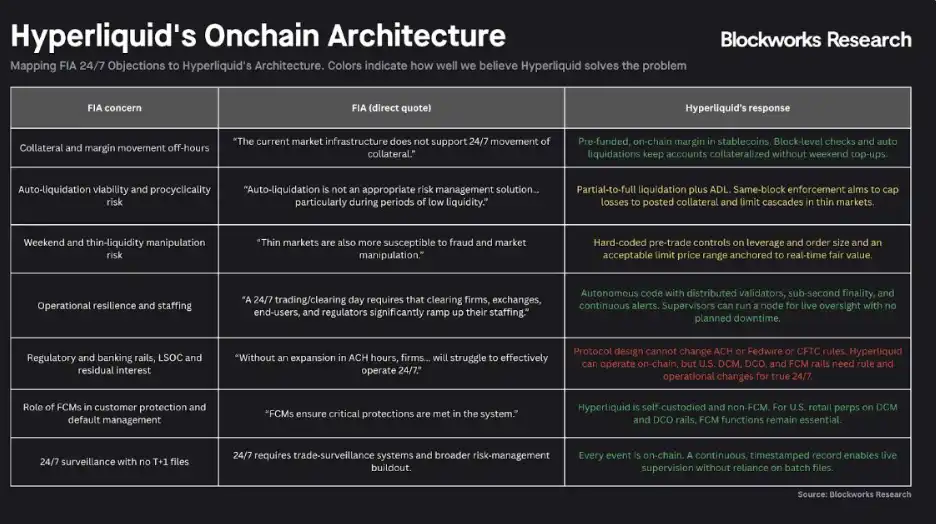
Source: Blockworks
Traditional institutions with deep pockets and regulatory resources may seek to slow down the development of the on-chain market while accelerating the rollout of their own "compliance alternative solutions."
This is currently one of the most commonly mentioned competitive risks—participants with high market value, strong distribution capabilities, ample liquidity, and profound political influence, such as the traditional brokerage system, Robinhood, etc., may enter the market where Trade operates.
However, their "regulatory advantage" that they are trying to capitalize on is a double-edged sword. It can indeed wield significant impact, but it is more like a broadsword—extremely powerful but slow to wield. Even if it delivers a devastating blow once it strikes, the ability to strike in a timely manner remains uncertain. Time will tell.
IV. Taking the Long View: Speculative Entertainment, Autonomous Real-Time Bubbles, and the Future of Finance
Discussions around autonomous systems often tend to veer to two extremes in online discourse: either it is the Anthropic soon to "create gods from stones," or the entire narrative is nothing but a bubble wrapped in selective data.
Reality often lies somewhere in between.
When "reasoning ability" is combined with "task duration," a class of more intelligent agents with stronger execution capabilities emerges—agents whose "lifecycle" is long enough to capture, generate, and even proactively create opportunities in market fluctuations.
Differing from past high-frequency traders (flash boys), this capability is no longer confined to millisecond-level time scales but can unfold across any time dimension. We believe that such market activities will ultimately flow to the markets with the least restrictions and the strongest liquidity.
At this point, trade.xyz is in a uniquely advantageous position.
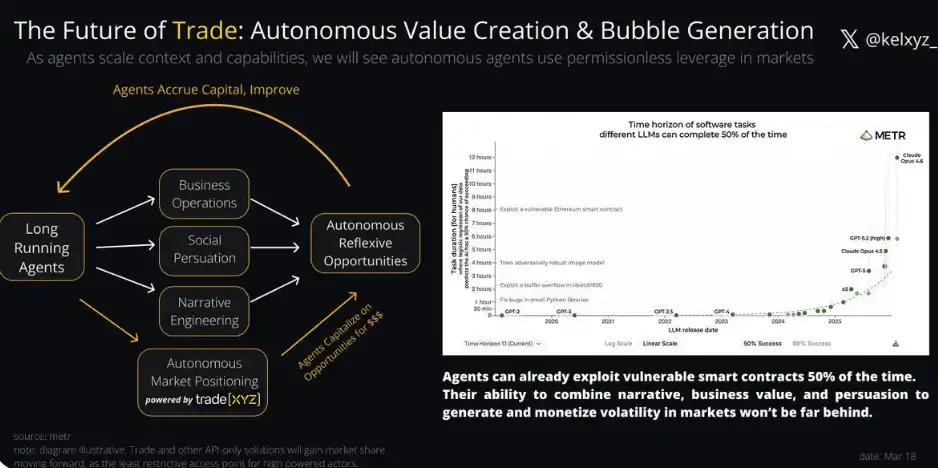
Since 2021, the intertwining of finance and "entertainment" has only deepened. The provocative narratives from Twitter-native brands are now able to leverage market fluctuations on a scale of billions of dollars. The public trading behavior itself also brings liquidity, brand value, and financial reflexivity, further reinforcing the legitimacy of "larger-scale on-chain positions."
Whether it's intelligent entities, anonymous predictors, whimsical whales, or overnight "protagonist" retail traders—the drama of the market will only continue to intensify. And Trade's position as a "universal trading venue" will also rise in tandem.
Appendix: Opportunities at the Frontier
We have identified several directions that developers, investors, traders, and researchers should pay particular attention to:
1. Arbitrage
The emergence of new trading venues signifies new arbitrage opportunities. Cross-exchange arbitrage (including between DEXs, as well as between DEXs and traditional financial exchanges) is still in its early stages and is becoming more complex. A deep understanding of details such as oracle mechanisms, funding rate structures, futures contract rollover timing, etc., may lead to significant profit opportunities and research value.
2. Rates Trading
Particularly, conducting rates trading through perpetual contracts (e.g., the path of Nunchi) and funding rate trading similar to Boros or Jetty.
As on-chain perpetual contracts begin to anchor a more diverse set of traditional financial assets, their funding rate structure will be significantly different from the past crypto markets, exhibiting more decentralized and low correlation characteristics. Future yield-generating funds may achieve attractive risk-adjusted returns by first understanding these market structures.
3. Rolling Microstructure Analyses
Shaun DeDevens' microstructure analysis of the silver and oil markets accurately revealed the growth trajectory and current bottlenecks in the market. Continuously conducting such depth data-based tracking research to dynamically depict the evolution of these markets will almost certainly become high-value content and a research hotspot.
4. High-yield Consumer Products
Protocols that can convert "floating funding rates + scalable borrowing demand" into user-side returns (such as Liminal) are poised for rapid growth and are becoming the "next-generation Ethena" targeting this new market. Ethena itself is also attempting to incorporate basis trading of stocks and commodities into its product suite.
5. Aggregation
Although Trade holds approximately 90% of the market share in most trading pairs, if the execution optimization brought by cross-market aggregation can cover its additional costs, then the "aggregation layer" may still be a user-entry point.
6. Conditional Markets
The "market of truth" is boundless. We once predicted that perpetual futures contracts might become the earliest reflection of news. However, this information is still "indirect expression": for example, the rise in oil prices is because the market believes that the correlation "increased probability of Iran invasion → rise in oil prices" holds true.
This expression is effective but not precise. Protocols like Lightcone attempt to strip away this indirectness by allowing users to directly express their views through "conditional markets": What will be the price of oil if the U.S. invades Iran in the next week?
Once such protocols succeed, these kinds of questions will become objects that can be directly priced by the market.
7. Agent System Engineering
Over the past few years, various attempts have emerged around the infrastructure for a "continuous-operation agent" — but most are poorly designed, difficult to implement, and even fraudulent. However, it can be expected that someone (or the agent itself) will find a way: to keep the agent running continuously, automatically seek the cheapest computing power, and use this capability to earn profits in the market.
The most radical experiments have already appeared in subnetwork ecosystems like Bittensor. Although the feasibility of this path remains uncertain, one can imagine a composite system:
Synth (prediction)
Hippius (storage)
Targon (privacy reasoning)
These modules work together to build a market agent that can actively "harvest volatility."
8. Investment
Hyperliquid can split 50% of the revenue generated by Trade. This mechanism has significantly boosted the price of its token HYPE recently. With Trade expanding rapidly, the market is beginning to gradually form a consensus: Hyperliquid may be evolving into an asset form of "winner takes all" (PR News Wire)
This consensus itself also opens up a high-risk, high-reward window for investors and builders: if any of the above competitive paths can form an effective "wedge" against Trade, early positioning may lead to asymmetric returns.
This content is provided for general informational purposes only and doesn't constitute financial, investment, legal, or tax advice. Any events, rewards, online promotions, or related information mentioned herein should not be considered a recommendation, solicitation, or invitation to purchase, sell, trade, or otherwise deal in any crypto assets. Crypto assets are highly volatile and may result in loss. The availability of WEEX services, products, and related events may vary by region. You are responsible for ensuring that your participation is in accordance with applicable local laws and regulations.
You may also like

web3: Mexico's Avocado Exports Resume After US Lifts Security Alert

Morgan Stanley Reveals Recommended Sectors to Capitalize on Gains in Wall Street

Gemini 3.7 Flash Review: Google's Cheap Model Isn’t Dumb Anymore

Crypto investors are looking past market-cap rankings and back to fundamentals

7 AI Agents Tasked with Classifying and Correcting Bitcoin Flaws: What Did They Find?

Berkshire Increases Stake in Alphabet, Bets on AI Infrastructure

web3: Stablecoin Market Cap Approaches $300 Billion, Marks Third Largest Historical Drawdown

Cryptocurrency Assets Reach $4.3 Billion

Wall Street's Enthusiasm for Private, Permissioned Blockchains Heats Up Again! Etherealize: Consortium Chain 2.0 is Destined to Fail

Geopolitical Risks of Asset Tokenization! Trump Family's Cryptocurrency Project WLFI Delays Loan Token Sale for Maldives Resort
Connecticut Primary Results May Influence U.S. Social Security Debate

Bitcoin: Is the 21 Million Cap Really Untouchable?

Crypto Adoption Grows but Prices Fall – What’s Happening with Crypto in 2026?
Web3: Foreign Media Reports U.S. Stablecoin Yield Battle Resurfaces Impacting Legislation

DeepSeek's Self-Evolution Blueprint Revealed: Harness Makes AI Development as Fun as Playing with LEGO
ADRs and Country Risk Take a Heavy Hit in August: What Lies Behind the Fall of Argentine Assets

SpaceX Acquires Cursor for $60 Billion, Aiming for AI Dominance
$3.13 Million NFT Trading Surpasses Ethereum on Robinhood Chain

Cardano Dijkstra targets 2026 Leios, 2027 Peras rollout

Cyberattacks on Water in the U.S.: Over 30 Plants Affected in Minnesota
Tether Denies Building a Dedicated Blockchain; Paolo Ardoino: We Have No Such Plans
Who Benefits from Nasdaq's 23-Hour Trading?

Abelardo De La Espriella Thanks Trump for Assistance After Tragedy

Payward Q2 revenue hits $508M as EBITDA falls

Apple Changes AI Strategy in China, with Alibaba in the Loop

Wall Street finally turned staking into a dividend, now Ethereum and Solana want to shrink it
Prompt Engineering for Cryptocurrency Analysis (10-Step Framework)

Media: Anthropic anticipates revenue of up to $200 billion by 2028 ahead of IPO

UBS Multiplies Its Bitcoin Options Exposure via ETF by 24 Times
A Bitcoin at 1 Million Dollars Would Be Mathematically Impossible According to Markus Thielen
web3: Mexico's Avocado Exports Resume After US Lifts Security Alert
Morgan Stanley Reveals Recommended Sectors to Capitalize on Gains in Wall Street
Gemini 3.7 Flash Review: Google's Cheap Model Isn’t Dumb Anymore
Crypto investors are looking past market-cap rankings and back to fundamentals
7 AI Agents Tasked with Classifying and Correcting Bitcoin Flaws: What Did They Find?
Berkshire Increases Stake in Alphabet, Bets on AI Infrastructure

Contents
Latest articles








Latest coin listings on WEEX


