
How Overseas Crypto Exchanges Work for Japan Residents (and the Risks)

 Prefer us on Google


In Japan, the phrase "overseas exchange" (海外取引所) usually means a crypto-asset trading platform that is run from outside Japan and is not authorised by Japan's Financial Services Agency (FSA, 金融庁) to offer its services to people living in Japan. Understanding what that authorisation is — and what its absence means — is the key to reading this part of the market clearly.
The legal line: the Payment Services Act
Japan regulates crypto trading under the Payment Services Act (資金決済法). Any business that runs a crypto-asset exchange service (暗号資産交換業) for Japanese residents must be authorised by the FSA through a Local Finance Bureau (財務局). Article 63-2 (第63条の2) of that Act specifically prohibits soliciting Japanese residents without this authorisation. So in the Japanese legal context, an "overseas exchange" is typically a global platform that holds no Japanese authorisation and is therefore not permitted to actively market to residents.
This is not the same as saying the platform is unlawful everywhere — many are licensed in other jurisdictions. It means that, from the standpoint of Japanese law and Japanese user protections, the platform sits outside the domestic framework.
How they operate, mechanically
An overseas platform is usually reachable through a global website or app. Accounts are opened online, and funds are typically moved in and out using crypto transfers or cards rather than the domestic banking rails that authorised Japanese operators use. Because the platform is not authorised in Japan, it generally does not belong to the Japan Virtual and Crypto assets Exchange Association (JVCEA, 日本暗号資産取引業協会) — the accredited self-regulatory body — and it is not bound by the customer-protection rules that Japanese authorisation carries, such as the requirement to keep customer money and crypto separate from the company's own funds under Japanese oversight.
How to read the FSA's public warning mechanism
When the FSA identifies an operator soliciting Japanese residents without authorisation, it issues a public warning letter (警告書) and adds the operator to its public list, published as 「無登録で暗号資産交換業を行う者の名称等について」 on fsa.go.jp. Enforcement can escalate from there to formal requests that app stores remove the operator's apps.
The public record shows this mechanism in action. According to the FSA's published list, well-known overseas operators including Bybit, MEXC and Bitget have been named, and were re-listed across two waves — in March 2023 and again in November 2024. On 6 February 2025, at the FSA's request, Apple removed several of these apps (Bybit, Bitget, MEXC, KuCoin and LBank) from Japan's App Store — the first action of its kind. Bybit then began phasing out its services for Japan from December 2025.
One nuance is essential. The FSA states on the list itself that "even a party that is not listed may be conducting unauthorised exchange business" (掲載されていない者であっても、無登録交換業に該当する行為を行っていることがあり得ます). In other words, absence from the warning list is not a mark of approval or safety — it may simply mean an operator has not yet been publicly named.
The risks for Japanese residents
- No Payment Services Act protections. Without Japanese authorisation, there is no domestic requirement to segregate and safeguard customer assets, and no Japanese supervisor overseeing the platform.
- No JVCEA safeguards. The self-regulatory guardrails that apply to authorised operators — listing screening, advertising standards, asset-management guidance — do not apply.
- Difficulty recovering funds. If an overseas operator freezes withdrawals, fails, or exits the market, there is no Japanese authority to appeal to, and cross-border recovery is slow, costly, and often unsuccessful.
- Sudden loss of access. As the app-store removals and the Bybit Japan phase-out show, access can be curtailed with limited notice, which can strand users who still hold balances or open positions.
- Tax obligations do not disappear. Using an overseas venue does not change Japanese tax rules. Gains from crypto are still taxable, and residents remain responsible for declaring them (確定申告). Believing otherwise is a costly misunderstanding, not a strategy.
How to check before trusting any platform
The practical safeguard is to consult the FSA's own published lists — both its list of authorised operators and its public warning list — and to keep the FSA's caution in mind: an operator's absence from the warning list does not prove it is safe or authorised. When protections matter, the domestic, authorised route is the one built to provide them.
Summary
An "overseas exchange" in Japan is a platform that operates without FSA authorisation and therefore outside Japan's user-protection framework. The FSA's warning-letter and public-list mechanism — and its escalation to app-store removals, as seen across 2023–2025 — shows how that boundary is enforced. For a Japanese resident, the core takeaways are that these venues carry real, structural risks around fund safety and recovery, that sudden loss of access is a documented pattern, and that tax duties remain unchanged regardless of where trading happens.
This article is for educational and informational purposes only and does not constitute investment, financial, tax, or legal advice. Regulatory facts are current as of publication and may change; always verify the latest information directly with the FSA (金融庁) and official sources, and do your own research.
Disclaimer: This content is provided for general branding and informational purposes only and doesn't constitute financial, investment, legal, or tax advice. Any events, rewards, online events, or related information mentioned herein should not be considered a recommendation, solicitation, or invitation to purchase, sell, trade, or otherwise deal in any crypto assets or to use any services. Crypto assets are highly volatile and may result in loss. WEEX services and online events may not be available in all regions and are subject to applicable laws, regulations, and eligibility requirements. You are responsible for ensuring that your use of WEEX services complies with local laws and for carefully assessing the risks before participating in any crypto-related activities.
You may also like

Gold Price Outlook 2026: Third-Party Analyst Scenarios (Maintained, Educational)

Silver Price Outlook 2026: Third-Party Analyst Scenarios (Maintained, Educational)
How to Buy Bitcoin in Brazil: A Step by Step Guide for Beginners

Dolar Crypto in Argentina: How to Use Stablecoins for Dollar Exposure and Buy Bitcoin
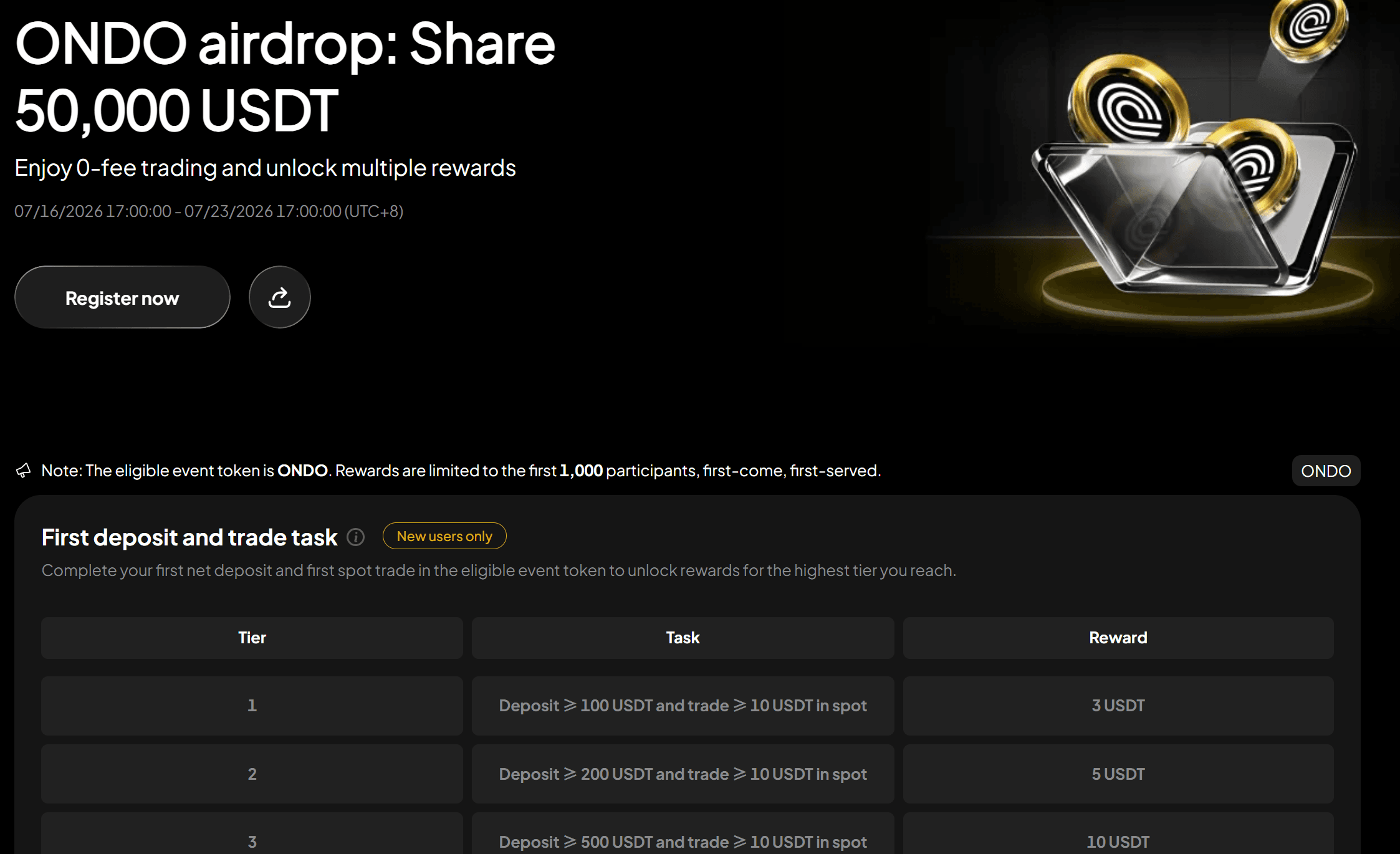
Claim ONDO Airdrop Rewards: Complete Tasks and Share 50,000 USDT
Claim ONDO Airdrop rewards on WEEX and share 50,000 USDT. Learn how to join, complete trading tasks, earn bonuses, and trade ONDO/USDT during the event.
Japan's Crypto Regulation Basics: The FSA, JVCEA, and User Protections
Modelo 721 Explained: Declaring Foreign Crypto Holdings in Spain
DEX vs CEX for Perpetuals: Trading Perps On-Chain vs on an Exchange
What Is an On-Chain Order Book? How Order-Book DEXs Work
What Is a Perp DEX? Perpetual Futures on Decentralized Exchanges
Italy Crypto Tax 2026: The Capital Gains Rate Rises to 33%
Support and Resistance: How to Identify Key Levels on the Chart

Supply and Demand Zones: A Smart-Money Trading Guide
Price Action Trading: Reading Raw Market Behavior

Head and Shoulders Pattern: How to Spot and Trade It
Classic Chart Patterns: Triangles, Double Tops/Bottoms and Flags
Airdrop Farming: How to Farm Crypto Airdrops the Right Way
What Is a Moving Average (MA)? Types and How to Read Them
What Is Elliott Wave Theory? A Beginner's Guide to Counting Waves
What Is Fibonacci Retracement? How to Draw and Use It
What Is the Ichimoku Cloud? A Beginner's Guide to Reading It
What Is the VIX (Fear Index)? How to Read It and Its Link to Crypto
What Is Dow Theory? The Six Principles Explained
What Is a Death Cross? Understanding the Bearish Signal
What Is a Golden Cross? A Beginner's Guide to the Bullish Signal
MiCA Regulation: What Changes for Polish Crypto Investors
Open Interest: What It Means in Futures Trading
Call vs Put Options: What They Are and How They Differ
What Are Sakata's Five Methods? Classic Candlestick Patterns Explained
What Is the FOMC? Meeting Schedule and Why Crypto Reacts
Gold Price Outlook 2026: Third-Party Analyst Scenarios (Maintained, Educational)
Silver Price Outlook 2026: Third-Party Analyst Scenarios (Maintained, Educational)
How to Buy Bitcoin in Brazil: A Step by Step Guide for Beginners
Dolar Crypto in Argentina: How to Use Stablecoins for Dollar Exposure and Buy Bitcoin
Claim ONDO Airdrop Rewards: Complete Tasks and Share 50,000 USDT
Claim ONDO Airdrop rewards on WEEX and share 50,000 USDT. Learn how to join, complete trading tasks, earn bonuses, and trade ONDO/USDT during the event.
Japan's Crypto Regulation Basics: The FSA, JVCEA, and User Protections
Contents
Latest articles


Latest coin listings on WEEX


