
Modelo 721 Explained: Declaring Foreign Crypto Holdings in Spain

 Prefer us on Google


Modelo 721 is a Spanish tax form — the "Declaración informativa sobre monedas virtuales situadas en el extranjero", the information return on virtual currencies held abroad. It is filed with Spain's Agencia Tributaria. This guide explains what it is, who must file it, the threshold, and the deadline. It is educational and is not tax advice; its purpose is to help you understand and meet the obligation correctly, not to describe ways to avoid declaring. Every figure is dated and attributed — this is a snapshot as of 16 July 2026, based on the Agencia Tributaria's Modelo 721 FAQ (last updated 8 July 2026). Always confirm the current rules with the Agencia Tributaria or a qualified professional.
What Modelo 721 is — and is not
Modelo 721 is informational. It reports the existence and value of virtual currencies you hold abroad; it does not itself charge tax on those holdings. It is separate from the income tax (IRPF) you may owe on gains when you sell or exchange crypto — a topic covered in the Spain crypto tax guide. Think of Modelo 721 as a disclosure of what you hold abroad, filed once a year, running alongside — not instead of — your ordinary tax return.
Who must file
According to the Agencia Tributaria, the obligation falls on persons and entities resident in Spain (and permanent establishments in Spain of non-residents) who, as of 31 December, are titulares (owners), beneficiarios (beneficiaries), autorizados (authorised persons), or otherwise hold power of disposal over virtual currencies located abroad.
The €50,000 threshold
There is no obligation to file if the combined 31 December balances of all your types of virtual currency held abroad, valued in euros, do not jointly exceed €50,000. If that combined figure is exceeded, you must report all of the virtual currencies. The test is on the aggregate value across currency types, taken at the year-end date.
What counts as held "abroad"
This is the point most often misunderstood, and the Agencia Tributaria is specific: virtual currencies count as held abroad — and therefore reportable on Modelo 721 — only when both conditions are met:
- the virtual currencies are custodied by a person or entity that provides services to safeguard private cryptographic keys on behalf of third parties; and
- that custodian is not resident in Spain (and is not a permanent establishment in Spanish territory).
Two important consequences follow directly from the FAQ:
- Self-custody is excluded. Crypto held in wallets where you control the private keys is not reported on Modelo 721 — the FAQ states that coins held in wallets over which the holder keeps control are not to be reported here.
- Spanish-resident platforms are outside its scope. Holdings on a custodian that is resident in Spain are not "abroad" for Modelo 721 purposes (they may fall under other Spanish reporting, such as Modelo 172/173 filed by the provider).
Valuation and the deadline
Balances are valued in euros as of 31 December of the reference year. Modelo 721 is filed the following year, in a fixed window: from 1 January to 31 March. For the 2025 reference year, that means the filing window 1 January to 31 March 2026. The return is submitted electronically through the Agencia Tributaria's Sede Electrónica.
After the first year
Once you have filed, you generally only need to file again in a later year when your position changes in a way the rules require you to report again — for example a material increase in value, or ceasing to hold. The exact re-filing thresholds are set out in the Modelo 721 instructions; check the current version on the Agencia Tributaria site rather than assuming, as these details can change.
Keeping records
Because Modelo 721 turns on year-end values and on who custodies your keys, keep clear records: which platforms hold your crypto and where those platforms are resident, and the euro value of each holding at 31 December. Most platforms let you export balances and history; if you trade perpetual futures on WEEX, you can export your transaction history for your records. Complete records help you file correctly — that is the goal here, not reducing any obligation.
Key takeaways
- Modelo 721 is an information return for virtual currencies held abroad — it discloses, it does not itself tax.
- You must file if the combined 31 December value of virtual currencies held abroad exceeds €50,000.
- "Abroad" means a non-Spain-resident custodian holds your keys; self-custody and Spanish-resident platforms are outside its scope.
- The filing window is 1 January to 31 March of the following year (1 Jan–31 Mar 2026 for 2025). Snapshot as of 16 July 2026 — verify with the Agencia Tributaria.
Record of revisions
- 16 July 2026: Initial version. Threshold, scope, self-custody exclusion and deadline verified against the Agencia Tributaria Modelo 721 FAQ (last updated 8 July 2026). This page joins the monthly refresh cycle; each review updates this log and the "as of" date.
This article is for informational and educational purposes only and does not constitute tax, legal, financial or investment advice. It does not describe any means of avoiding a filing or reporting obligation. Tax rules change and the position described is a snapshot as of 16 July 2026. For your specific situation and the current rules, consult the Agencia Tributaria (sede.agenciatributaria.gob.es) or a qualified tax professional. Cryptocurrency trading — especially futures trading with leverage — carries a high level of risk.
Disclaimer: This content is provided for general branding and informational purposes only and doesn't constitute financial, investment, legal, or tax advice. Any events, rewards, online events, or related information mentioned herein should not be considered a recommendation, solicitation, or invitation to purchase, sell, trade, or otherwise deal in any crypto assets or to use any services. Crypto assets are highly volatile and may result in loss. WEEX services and online events may not be available in all regions and are subject to applicable laws, regulations, and eligibility requirements. You are responsible for ensuring that your use of WEEX services complies with local laws and for carefully assessing the risks before participating in any crypto-related activities.
You may also like

Gold Price Outlook 2026: Third-Party Analyst Scenarios (Maintained, Educational)
Silver Price Outlook 2026: Third-Party Analyst Scenarios (Maintained, Educational)
How to Buy Bitcoin in Brazil: A Step by Step Guide for Beginners

Dolar Crypto in Argentina: How to Use Stablecoins for Dollar Exposure and Buy Bitcoin
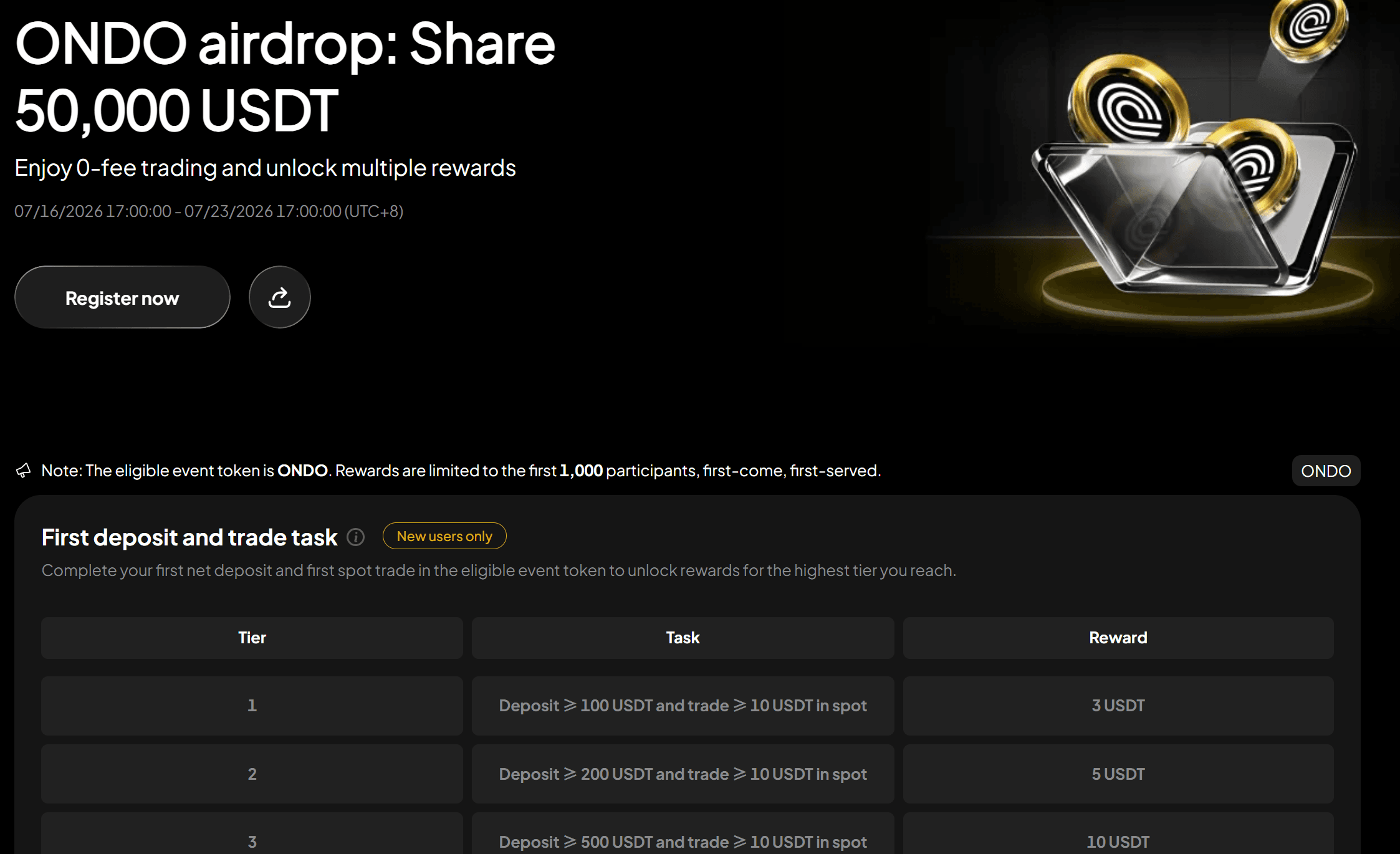
Claim ONDO Airdrop Rewards: Complete Tasks and Share 50,000 USDT
Claim ONDO Airdrop rewards on WEEX and share 50,000 USDT. Learn how to join, complete trading tasks, earn bonuses, and trade ONDO/USDT during the event.
Japan's Crypto Regulation Basics: The FSA, JVCEA, and User Protections
How Overseas Crypto Exchanges Work for Japan Residents (and the Risks)
DEX vs CEX for Perpetuals: Trading Perps On-Chain vs on an Exchange
What Is an On-Chain Order Book? How Order-Book DEXs Work
What Is a Perp DEX? Perpetual Futures on Decentralized Exchanges
Italy Crypto Tax 2026: The Capital Gains Rate Rises to 33%
Support and Resistance: How to Identify Key Levels on the Chart

Supply and Demand Zones: A Smart-Money Trading Guide
Price Action Trading: Reading Raw Market Behavior

Head and Shoulders Pattern: How to Spot and Trade It

Classic Chart Patterns: Triangles, Double Tops/Bottoms and Flags
Airdrop Farming: How to Farm Crypto Airdrops the Right Way
What Is a Moving Average (MA)? Types and How to Read Them
What Is Elliott Wave Theory? A Beginner's Guide to Counting Waves
What Is Fibonacci Retracement? How to Draw and Use It
What Is the Ichimoku Cloud? A Beginner's Guide to Reading It
What Is the VIX (Fear Index)? How to Read It and Its Link to Crypto
What Is Dow Theory? The Six Principles Explained
What Is a Death Cross? Understanding the Bearish Signal
What Is a Golden Cross? A Beginner's Guide to the Bullish Signal
MiCA Regulation: What Changes for Polish Crypto Investors
Open Interest: What It Means in Futures Trading
Call vs Put Options: What They Are and How They Differ
What Are Sakata's Five Methods? Classic Candlestick Patterns Explained
What Is the FOMC? Meeting Schedule and Why Crypto Reacts
Gold Price Outlook 2026: Third-Party Analyst Scenarios (Maintained, Educational)
Silver Price Outlook 2026: Third-Party Analyst Scenarios (Maintained, Educational)
How to Buy Bitcoin in Brazil: A Step by Step Guide for Beginners
Dolar Crypto in Argentina: How to Use Stablecoins for Dollar Exposure and Buy Bitcoin
Claim ONDO Airdrop Rewards: Complete Tasks and Share 50,000 USDT
Claim ONDO Airdrop rewards on WEEX and share 50,000 USDT. Learn how to join, complete trading tasks, earn bonuses, and trade ONDO/USDT during the event.
Japan's Crypto Regulation Basics: The FSA, JVCEA, and User Protections





