
What Is Elliott Wave Theory? A Beginner's Guide to Counting Waves

 Prefer us on Google


Elliott Wave theory is a technical-analysis framework that argues market prices move in repeating patterns of waves, driven by swings in crowd psychology between optimism and pessimism. Developed by Ralph Nelson Elliott in the 1930s, it tries to break a chart down into a recognisable structure so a trader can locate where the market might be within a larger cycle.
The basic wave structure
The core idea is that a trend unfolds in a five-wave move in the direction of the main trend, followed by a three-wave move against it (a correction). Together these form one complete cycle of eight waves.
- Waves 1, 3, and 5 are "impulse" waves that push in the direction of the trend.
- Waves 2 and 4 are pullbacks that partly retrace the impulses.
- Waves A, B, and C form the corrective phase that follows.
A key principle is that this pattern is fractal: the same five-up, three-down shape appears at many scales, so each wave can be broken into smaller waves of the same form. Elliott theory is often discussed alongside the trend logic of Dow Theory, since both describe how trends develop in stages.
How traders use it — with Fibonacci
Elliott analysts frequently pair the wave count with Fibonacci ratios, the levels covered in Fibonacci retracement. For example, corrective waves are often expected to retrace a Fibonacci proportion of the prior impulse, and projected wave targets are commonly estimated using the same ratios. Some traders also use tools like moving averages to sanity-check the broader trend a wave count implies.
The appeal is that, when the pattern is clear, it offers a structured way to think about where a market is and what might come next.
The big limitation: subjectivity
Elliott Wave theory is powerful in hindsight but notoriously subjective in real time. Two skilled analysts can look at the same chart and count the waves differently, arriving at opposite conclusions. Wave counts are also frequently revised as new price data arrives. For these reasons it is best treated as a framework for organising a view, not a precise predictive system — and certainly not a guarantee.
A worked example
Imagine an asset in a clear uptrend.
- Price rises (wave 1), pulls back modestly (wave 2), surges strongly (wave 3), pulls back again (wave 4), and makes a final push higher (wave 5).
- An Elliott analyst would then expect a corrective A-B-C sequence against the trend.
- Using Fibonacci, they might estimate that wave 2 retraced around 61.8% of wave 1, and set expectations for the correction accordingly.
Because wave counts can be wrong or revised, acting on them carries real risk, and leverage magnifies it. Anyone applying Elliott analysis in futures or perpetual contracts should predefine risk and avoid over-committing to a single count. This is educational information, not trading advice.
Related concepts
- Dow Theory: an earlier framework for how trends develop — Dow Theory.
- Fibonacci retracement: the ratios used to measure and project waves — Fibonacci retracement.
- Moving average (MA): a tool to cross-check the underlying trend — moving averages.
Summary
Elliott Wave theory describes markets as moving in a five-wave trend followed by a three-wave correction, repeating in a fractal pattern driven by crowd psychology. Often paired with Fibonacci ratios, it offers structure — but its heavy subjectivity means counts vary between analysts and get revised, so it is a framework to guide thinking, not a crystal ball.
This article is for educational and informational purposes only and does not constitute investment, financial, or tax advice. Cryptocurrency and derivatives trading involve significant risk. Always do your own research.
Disclaimer: This content is provided for general branding and informational purposes only and doesn't constitute financial, investment, legal, or tax advice. Any events, rewards, online events, or related information mentioned herein should not be considered a recommendation, solicitation, or invitation to purchase, sell, trade, or otherwise deal in any crypto assets or to use any services. Crypto assets are highly volatile and may result in loss. WEEX services and online events may not be available in all regions and are subject to applicable laws, regulations, and eligibility requirements. You are responsible for ensuring that your use of WEEX services complies with local laws and for carefully assessing the risks before participating in any crypto-related activities.
You may also like

Gold Price Outlook 2026: Third-Party Analyst Scenarios (Maintained, Educational)

Silver Price Outlook 2026: Third-Party Analyst Scenarios (Maintained, Educational)
How to Buy Bitcoin in Brazil: A Step by Step Guide for Beginners

Dolar Crypto in Argentina: How to Use Stablecoins for Dollar Exposure and Buy Bitcoin
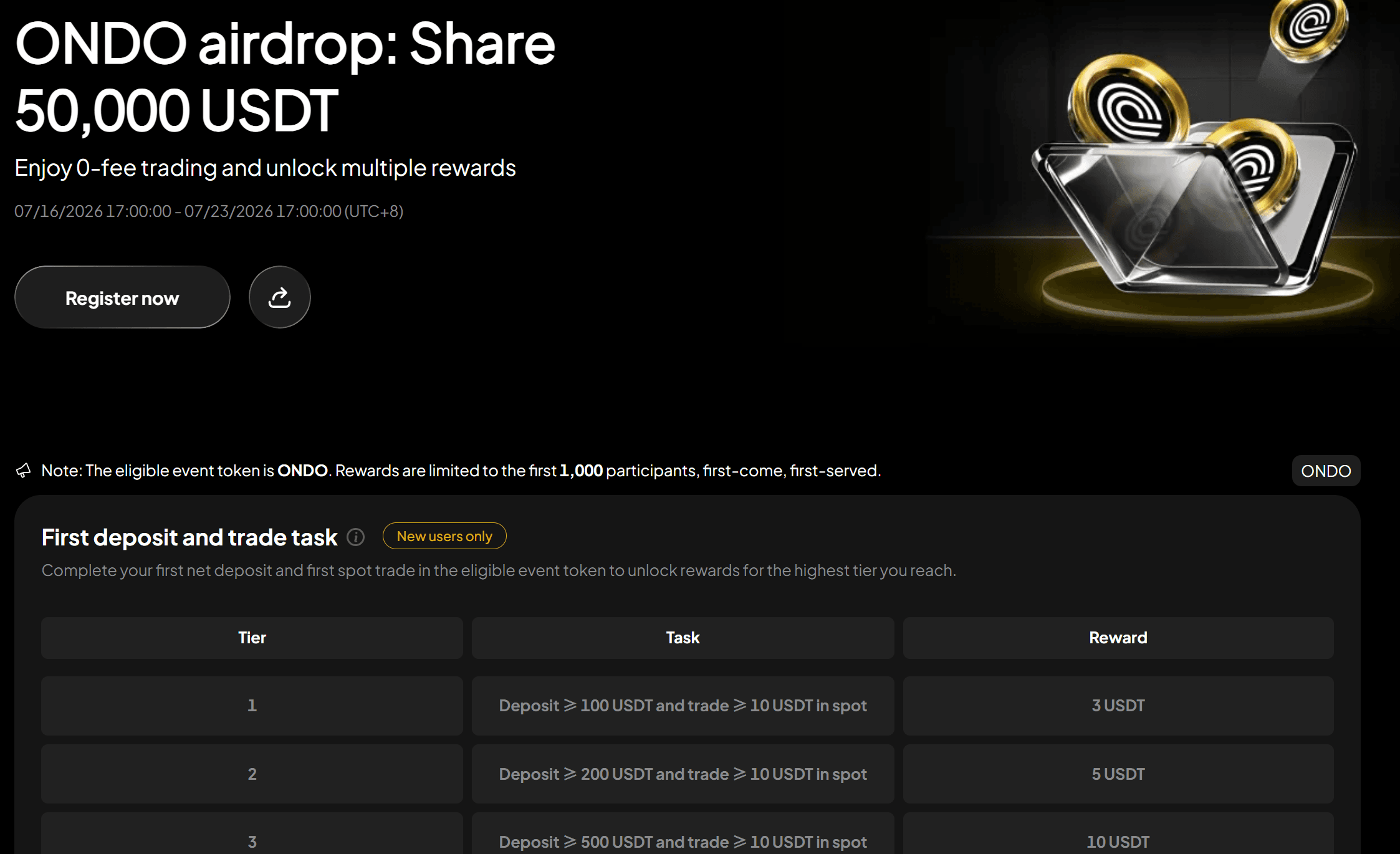
Claim ONDO Airdrop Rewards: Complete Tasks and Share 50,000 USDT
Claim ONDO Airdrop rewards on WEEX and share 50,000 USDT. Learn how to join, complete trading tasks, earn bonuses, and trade ONDO/USDT during the event.

Japan's Crypto Regulation Basics: The FSA, JVCEA, and User Protections

How Overseas Crypto Exchanges Work for Japan Residents (and the Risks)
Modelo 721 Explained: Declaring Foreign Crypto Holdings in Spain

DEX vs CEX for Perpetuals: Trading Perps On-Chain vs on an Exchange

What Is an On-Chain Order Book? How Order-Book DEXs Work
What Is a Perp DEX? Perpetual Futures on Decentralized Exchanges
Italy Crypto Tax 2026: The Capital Gains Rate Rises to 33%
Support and Resistance: How to Identify Key Levels on the Chart

Supply and Demand Zones: A Smart-Money Trading Guide
Price Action Trading: Reading Raw Market Behavior

Head and Shoulders Pattern: How to Spot and Trade It

Classic Chart Patterns: Triangles, Double Tops/Bottoms and Flags
Airdrop Farming: How to Farm Crypto Airdrops the Right Way
What Is a Moving Average (MA)? Types and How to Read Them
What Is Fibonacci Retracement? How to Draw and Use It
What Is the Ichimoku Cloud? A Beginner's Guide to Reading It
What Is the VIX (Fear Index)? How to Read It and Its Link to Crypto
What Is Dow Theory? The Six Principles Explained
What Is a Death Cross? Understanding the Bearish Signal
What Is a Golden Cross? A Beginner's Guide to the Bullish Signal
MiCA Regulation: What Changes for Polish Crypto Investors
Open Interest: What It Means in Futures Trading
Call vs Put Options: What They Are and How They Differ
What Are Sakata's Five Methods? Classic Candlestick Patterns Explained
What Is the FOMC? Meeting Schedule and Why Crypto Reacts
Gold Price Outlook 2026: Third-Party Analyst Scenarios (Maintained, Educational)
Silver Price Outlook 2026: Third-Party Analyst Scenarios (Maintained, Educational)
How to Buy Bitcoin in Brazil: A Step by Step Guide for Beginners
Dolar Crypto in Argentina: How to Use Stablecoins for Dollar Exposure and Buy Bitcoin
Claim ONDO Airdrop Rewards: Complete Tasks and Share 50,000 USDT
Claim ONDO Airdrop rewards on WEEX and share 50,000 USDT. Learn how to join, complete trading tasks, earn bonuses, and trade ONDO/USDT during the event.
Japan's Crypto Regulation Basics: The FSA, JVCEA, and User Protections



