
Nasdaq-100 and Dow Jones: Prices, Outlook and How to Trade

 Prefer us on Google

The Nasdaq-100 and the Dow Jones Industrial Average are two headline gauges of the US market, built differently. The Nasdaq-100 (NDX) holds the 100 largest non-financial companies on Nasdaq; the Dow (DJIA) is a 30-stock, price-weighted average of blue chips. As of July 2026 they tell different stories: the Dow set record closes in early July while the Nasdaq-100 pulled back in a semiconductor sell-off. This page covers what each index is, how 2026 has played out, and how to trade them from Japan, including without a US brokerage account.
▶ Browse the stock futures markets on WEEX ・ Dow Jones Today: Record Highs and the Signal for Crypto
Nasdaq-100 and Dow prices: where to track them
Cash indices trade 9:30 a.m.–4:00 p.m. ET; brokerages quote the Nasdaq-100 (often via the Invesco QQQ ETF), the Dow and the S&P 500 in real time. The Dow is quoted in points, so convert to percentages to compare it: at roughly 53,000, 100 points is only about 0.19%. Outside cash hours, CME futures (E-mini "ES", "NQ" and "YM") trade nearly around the clock and react to overnight news. On WEEX, Nasdaq-100 and S&P 500 exposure runs through tokenized ETFs (QQQON and IVVON); see the market listings for what is offered.
What are the Nasdaq-100 and the Dow?
The Nasdaq-100 is the 100 largest non-financial companies on Nasdaq, modified market-cap weighted and rebalanced quarterly; financials are excluded by rule. Do not confuse it with the Nasdaq Composite, a broader index of 3,000-plus stocks. The Dow is 30 committee-selected blue chips and is price-weighted: a higher share price, not a bigger company, means a bigger weight. The S&P 500 holds about 500 large caps, float-adjusted market-cap weighted. Tracking funds: QQQ/QQQM (Nasdaq-100), DIA (Dow), IVV (S&P 500).
Outlook for 2026
What's working
- Nasdaq-100 up roughly 19–20% in H1 2026 (+19.13% as of June 22)
- The Dow set record closes into early July; H1 up 8.9%, its best first half since 2021
- The S&P 500 rose about 9.6% in H1 (10.2% total return)
Risk factors
- Concentration: nearly all of the Nasdaq-100's H1 gain came from about ten stocks; Micron alone drove over a quarter
- Semiconductor sensitivity: an early-July chip sell-off pulled the Nasdaq-100 down about 1.9% in a session even as the Dow hit records
- Macro and event risk: the next FOMC decision is July 29, 2026, and Q2 earnings season began July 14
This page carries no point-in-time price targets; for scenarios, see the coverage below.
How to trade the Nasdaq-100 and Dow from Japan
Route 1, a domestic broker (funds and ETFs): most investors get index exposure through index funds or ETFs, such as a Nasdaq-100 fund, an S&P 500 fund, or a Dow ETF like DIA, via a broker that offers US-linked products.
Route 2, on WEEX: for those without a US equity account, WEEX offers tokenized ETFs: QQQON (a tokenized QQQ ETF tracking the Nasdaq-100) and IVVON (a tokenized iShares Core S&P 500 ETF). There is no Dow-tracking product, so for Dow exposure check the listings.
- Create a WEEX account and complete verification.
- Deposit USDT.
- Open the QQQON or IVVON market (or check the listings for other index-linked markets).
- Place your order.
A tokenized ETF is not the fund or index itself: a blockchain instrument that tracks the price, with no voting rights or distributions, and its price can deviate from the underlying.
Which route fits you?
| Point of comparison | Domestic broker (funds/ETFs) | WEEX (tokenized ETFs) |
|---|---|---|
| Tracks | Nasdaq-100, S&P 500, Dow and more | Nasdaq-100 (QQQON), S&P 500 (IVVON); no Dow product |
| What you hold | Fund or ETF units | A tokenized, price-tracking instrument |
| Account requirement | Brokerage account | WEEX account |
| Trading hours | US hours for ETFs; daily NAV for funds | See the market page |
| Rights and distributions | Fund distributions may apply | None; price exposure only |
What are tokenized ETFs and stock futures?
Stock futures track a price via derivative contracts, tradable long or short with leverage. Tokenized ETFs such as QQQON and IVVON follow a listed ETF and, through it, the underlying index. Both are price exposure only, with no voting rights or distributions, and can deviate from the underlying.
2026 milestones and recent moves
- July 2 and 6, 2026: the Dow set record closes of 52,900.07 then 53,055.91; H1 2026 finished up 8.9%
- July 7, 2026: SPCX (SpaceX) joined the Nasdaq-100 before the open, under a month after its June 12 IPO, the fastest-ever addition, at an entry weight below 1%
- Early July 2026: a chip sell-off (soft Broadcom AI guidance) sent a semis index down 6.3% and Micron about 10% intraday; the Nasdaq-100 slid ~1.9% toward 29,287 as the Dow hit records
- July 10, 2026: the Nasdaq-100 closed at 29,825.11, near but below its 52-week high
- July 14, 2026: Q2 2026 earnings season opened with the big US banks; the next FOMC decision is July 29
FAQ
What is the difference between the Nasdaq-100 and the Nasdaq Composite?
The Nasdaq Composite covers 3,000-plus Nasdaq-listed stocks; the Nasdaq-100 is only the 100 largest non-financial names. They differ in performance too: in H1 2026 the Composite rose about 12.8% versus roughly 19–20% for the Nasdaq-100.
What are Dow futures?
Dow futures are CME index futures on the Dow (E-mini Dow, symbol YM). Unlike the cash index (9:30 a.m.–4:00 p.m. ET), they trade Sunday 6:00 p.m. to Friday 5:00 p.m. ET with a daily 60-minute halt, so they move on overnight and Asia-session news.
QQQ vs QQQM, what is the difference?
Both track the same Nasdaq-100 with identical holdings. The difference is cost: QQQM's expense ratio is 0.15% versus QQQ's 0.18%, so QQQM suits buy-and-hold while QQQ's liquidity suits active traders.
When did SPCX join the Nasdaq-100?
SpaceX (SPCX) joined before the open on July 7, 2026, under a month after its June 12, 2026 IPO, at an entry weight below 1% because only a small share of its stock is publicly floated.
When is the next FOMC meeting?
The remaining 2026 FOMC meetings are July 28–29, September 15–16, October 27–28 and December 8–9; the next decision is July 29, 2026.
Can I get index exposure without a US brokerage account?
On WEEX, Nasdaq-100 and S&P 500 exposure runs through tokenized ETFs (QQQON and IVVON): price exposure only, with no distributions, and prices can deviate from the underlying.
This content is for information only and is not investment advice.
Related coverage
Disclaimer: This content is provided for general branding and informational purposes only and doesn't constitute financial, investment, legal, or tax advice. Any events, rewards, online events, or related information mentioned herein should not be considered a recommendation, solicitation, or invitation to purchase, sell, trade, or otherwise deal in any crypto assets or to use any services. Crypto assets are highly volatile and may result in loss. WEEX services and online events may not be available in all regions and are subject to applicable laws, regulations, and eligibility requirements. You are responsible for ensuring that your use of WEEX services complies with local laws and for carefully assessing the risks before participating in any crypto-related activities.
You may also like
Gold Price Outlook 2026: Third-Party Analyst Scenarios (Maintained, Educational)
Silver Price Outlook 2026: Third-Party Analyst Scenarios (Maintained, Educational)
How to Buy Bitcoin in Brazil: A Step by Step Guide for Beginners
Dolar Crypto in Argentina: How to Use Stablecoins for Dollar Exposure and Buy Bitcoin
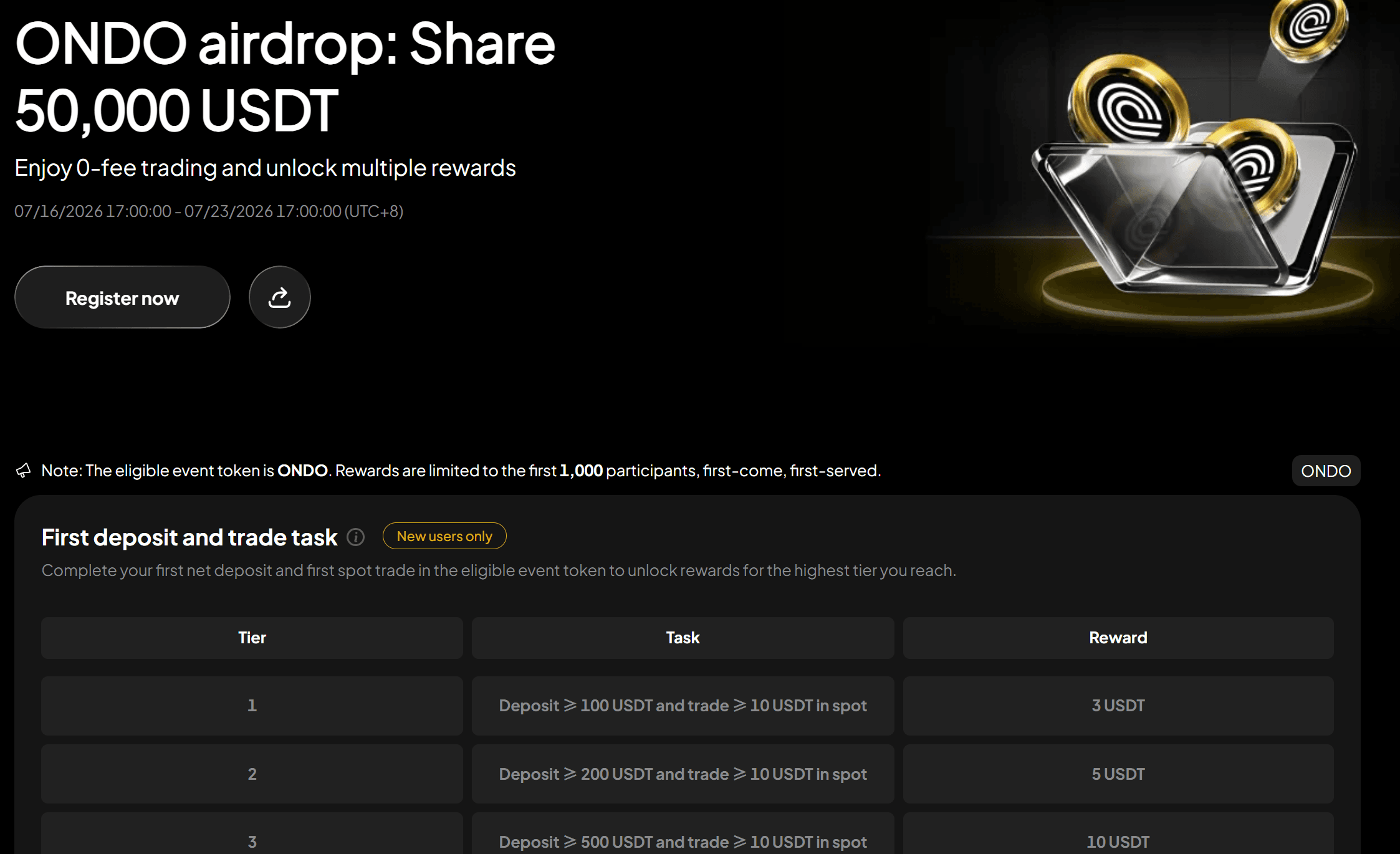
Claim ONDO Airdrop Rewards: Complete Tasks and Share 50,000 USDT
Claim ONDO Airdrop rewards on WEEX and share 50,000 USDT. Learn how to join, complete trading tasks, earn bonuses, and trade ONDO/USDT during the event.
Japan's Crypto Regulation Basics: The FSA, JVCEA, and User Protections
How Overseas Crypto Exchanges Work for Japan Residents (and the Risks)
Modelo 721 Explained: Declaring Foreign Crypto Holdings in Spain
DEX vs CEX for Perpetuals: Trading Perps On-Chain vs on an Exchange
What Is an On-Chain Order Book? How Order-Book DEXs Work
What Is a Perp DEX? Perpetual Futures on Decentralized Exchanges
Italy Crypto Tax 2026: The Capital Gains Rate Rises to 33%
Support and Resistance: How to Identify Key Levels on the Chart
Supply and Demand Zones: A Smart-Money Trading Guide
Price Action Trading: Reading Raw Market Behavior

Head and Shoulders Pattern: How to Spot and Trade It
Classic Chart Patterns: Triangles, Double Tops/Bottoms and Flags
Airdrop Farming: How to Farm Crypto Airdrops the Right Way
What Is a Moving Average (MA)? Types and How to Read Them
What Is Elliott Wave Theory? A Beginner's Guide to Counting Waves
What Is Fibonacci Retracement? How to Draw and Use It
What Is the Ichimoku Cloud? A Beginner's Guide to Reading It
What Is the VIX (Fear Index)? How to Read It and Its Link to Crypto
What Is Dow Theory? The Six Principles Explained
What Is a Death Cross? Understanding the Bearish Signal
What Is a Golden Cross? A Beginner's Guide to the Bullish Signal
MiCA Regulation: What Changes for Polish Crypto Investors
Open Interest: What It Means in Futures Trading
Call vs Put Options: What They Are and How They Differ
What Are Sakata's Five Methods? Classic Candlestick Patterns Explained
Gold Price Outlook 2026: Third-Party Analyst Scenarios (Maintained, Educational)
Silver Price Outlook 2026: Third-Party Analyst Scenarios (Maintained, Educational)
How to Buy Bitcoin in Brazil: A Step by Step Guide for Beginners
Dolar Crypto in Argentina: How to Use Stablecoins for Dollar Exposure and Buy Bitcoin
Claim ONDO Airdrop Rewards: Complete Tasks and Share 50,000 USDT
Claim ONDO Airdrop rewards on WEEX and share 50,000 USDT. Learn how to join, complete trading tasks, earn bonuses, and trade ONDO/USDT during the event.
Japan's Crypto Regulation Basics: The FSA, JVCEA, and User Protections
Contents
Latest articles



Latest coin listings on WEEX


