
What Are Perpetual Contracts? The Futures That Never Expire

 Prefer us on Google


A perpetual contract (or "perpetual future") is a type of futures contract with no expiry date. Unlike traditional futures, which settle on a fixed calendar date, a perpetual can be held open indefinitely. This is the dominant form of crypto futures — when people say "crypto futures trading," they usually mean perpetuals.
Understanding perpetuals ties together several concepts you may have already met: leverage, margin, funding rate, and liquidation. This article shows how they fit into one product.
How Perpetual Contracts Work
Traditional (dated) futures have a built-in problem for continuous trading: they expire, forcing you to close or roll the position. Perpetuals remove the expiry — but that creates a new problem. Without a settlement date, what keeps the contract's price tied to the actual (spot) price of the coin?
The answer is the funding rate: small periodic payments exchanged directly between long and short traders.
- When the perpetual trades above spot, longs pay shorts — nudging the price back down.
- When it trades below spot, shorts pay longs — nudging it back up.
This continuous incentive keeps the perpetual price anchored close to spot without any expiry. Everything else works like standard leveraged futures: you post margin, choose leverage and direction (long or short), and face liquidation if losses exhaust your margin.
A worked example: you open a 10x long perpetual on BTC with 100 USDT margin (a 1,000 USDT position). You profit if BTC rises and lose if it falls; a ~10% adverse move liquidates you. On top of price P&L, each funding interval you either pay or receive a small funding amount depending on the rate and your direction — a cost that accrues the longer you hold.
Why Traders Use Perpetuals
- No expiry to manage — no forced roll-overs; a position can stay open as long as it is funded and not liquidated.
- Deep liquidity — perpetuals are the most actively traded crypto derivative, which tends to mean tighter spreads.
- Two-directional, leveraged exposure — the full flexibility of futures (long/short, leverage) in a continuously tradable product.
The Risk Section — Read This Carefully
- Leverage + liquidation apply exactly as in any futures product: an adverse move can consume your entire margin, at a price you do not choose.
- Funding is a running cost. "No expiry" is not "no cost of carry" — holding through many funding periods, especially on a leveraged size, adds up and can quietly erode a position.
- The lack of expiry can encourage over-holding. Because nothing forces you out, it is easy to sit in a losing position too long. Discipline (stop-losses, sizing) matters more, not less, on perpetuals.
Perpetual contracts guarantee no profit; they are a flexible but high-risk instrument that demands active risk management.
A Practical Next Step
Learn how funding, margin, and liquidation interact on a perpetual before risking real money. WEEX offers a demo futures mode with virtual funds where you can hold a perpetual position across funding intervals and watch the combined effect on your balance. When you trade real perpetuals, use low leverage, size positions with a fixed risk cap, and set a stop-loss.
Download the WEEX app, open the futures section, and practise perpetuals in demo mode first.
FAQ
Q. What is the difference between perpetual and dated futures? A. Dated futures expire on a set date and settle; perpetuals never expire and use a funding rate to stay anchored to the spot price.
Q. How does a perpetual stay close to the spot price? A. Through the funding rate — periodic payments between longs and shorts that push the contract price back toward spot.
Q. Do I pay to hold a perpetual position? A. You pay or receive funding at each interval, depending on the rate and your position's direction. Over time this is a real cost (or income) separate from price moves.
Q. Are perpetuals riskier than spot? A. Yes. They are leveraged and can be liquidated, and they carry funding costs — none of which apply to simply buying and holding a coin on spot.
This article is general educational information about trading terminology, not investment advice. Perpetual futures trading carries a high risk of loss and guarantees no profit. Trade at your own responsibility.
Disclaimer: This content is provided for general branding and informational purposes only and doesn't constitute financial, investment, legal, or tax advice. Any events, rewards, online events, or related information mentioned herein should not be considered a recommendation, solicitation, or invitation to purchase, sell, trade, or otherwise deal in any crypto assets or to use any services. Crypto assets are highly volatile and may result in loss. WEEX services and online events may not be available in all regions and are subject to applicable laws, regulations, and eligibility requirements. You are responsible for ensuring that your use of WEEX services complies with local laws and for carefully assessing the risks before participating in any crypto-related activities.
You may also like

Gold Price Outlook 2026: Third-Party Analyst Scenarios (Maintained, Educational)
Silver Price Outlook 2026: Third-Party Analyst Scenarios (Maintained, Educational)
How to Buy Bitcoin in Brazil: A Step by Step Guide for Beginners

Dolar Crypto in Argentina: How to Use Stablecoins for Dollar Exposure and Buy Bitcoin
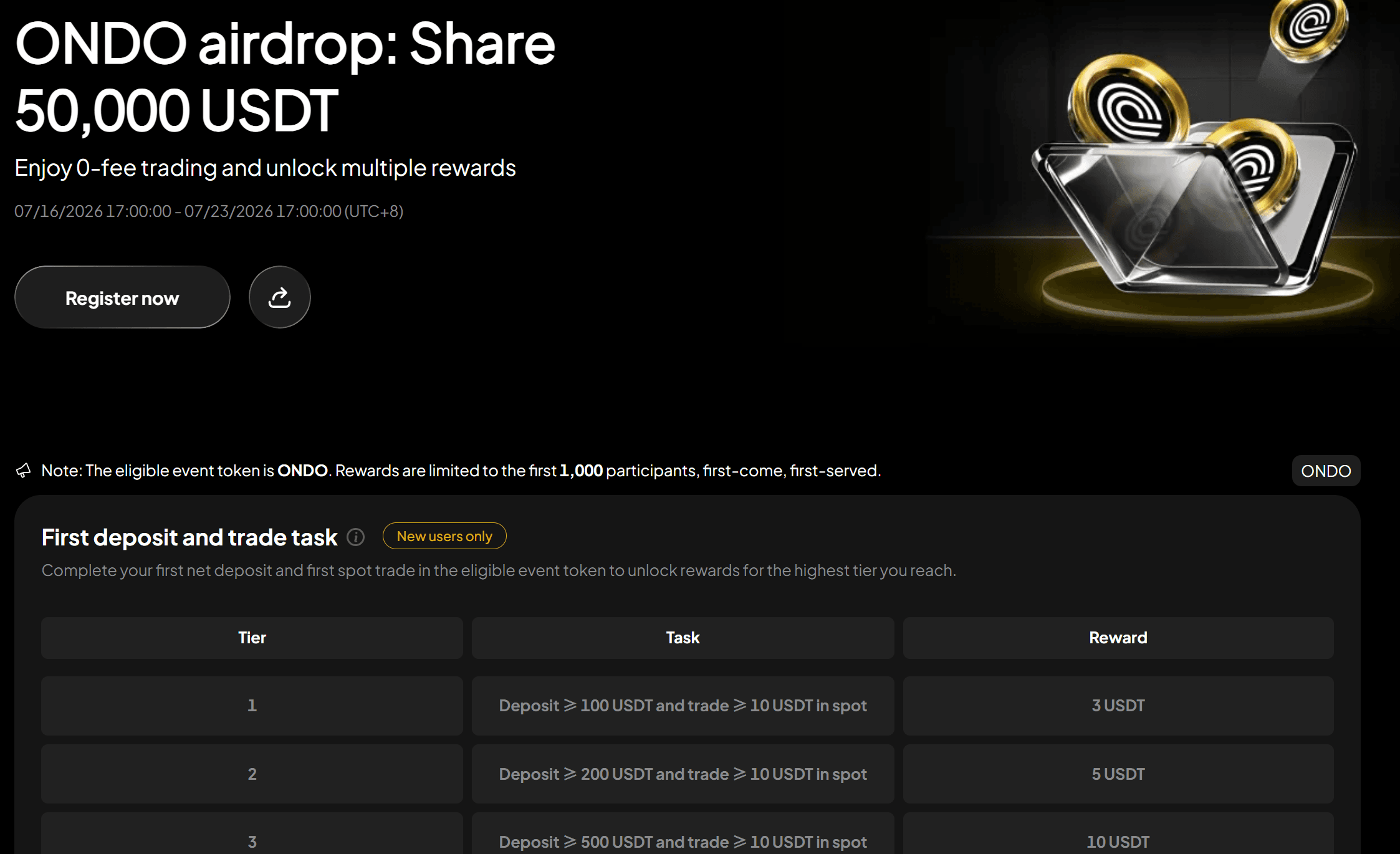
Claim ONDO Airdrop Rewards: Complete Tasks and Share 50,000 USDT
Claim ONDO Airdrop rewards on WEEX and share 50,000 USDT. Learn how to join, complete trading tasks, earn bonuses, and trade ONDO/USDT during the event.
Japan's Crypto Regulation Basics: The FSA, JVCEA, and User Protections

How Overseas Crypto Exchanges Work for Japan Residents (and the Risks)
Modelo 721 Explained: Declaring Foreign Crypto Holdings in Spain
DEX vs CEX for Perpetuals: Trading Perps On-Chain vs on an Exchange
What Is an On-Chain Order Book? How Order-Book DEXs Work
What Is a Perp DEX? Perpetual Futures on Decentralized Exchanges
Italy Crypto Tax 2026: The Capital Gains Rate Rises to 33%
Support and Resistance: How to Identify Key Levels on the Chart
Supply and Demand Zones: A Smart-Money Trading Guide
Price Action Trading: Reading Raw Market Behavior

Head and Shoulders Pattern: How to Spot and Trade It
Classic Chart Patterns: Triangles, Double Tops/Bottoms and Flags
Airdrop Farming: How to Farm Crypto Airdrops the Right Way
What Is a Moving Average (MA)? Types and How to Read Them
What Is Elliott Wave Theory? A Beginner's Guide to Counting Waves
What Is Fibonacci Retracement? How to Draw and Use It
What Is the Ichimoku Cloud? A Beginner's Guide to Reading It
What Is the VIX (Fear Index)? How to Read It and Its Link to Crypto
What Is Dow Theory? The Six Principles Explained
What Is a Death Cross? Understanding the Bearish Signal
What Is a Golden Cross? A Beginner's Guide to the Bullish Signal
MiCA Regulation: What Changes for Polish Crypto Investors
Open Interest: What It Means in Futures Trading
Call vs Put Options: What They Are and How They Differ
What Are Sakata's Five Methods? Classic Candlestick Patterns Explained
Gold Price Outlook 2026: Third-Party Analyst Scenarios (Maintained, Educational)
Silver Price Outlook 2026: Third-Party Analyst Scenarios (Maintained, Educational)
How to Buy Bitcoin in Brazil: A Step by Step Guide for Beginners
Dolar Crypto in Argentina: How to Use Stablecoins for Dollar Exposure and Buy Bitcoin
Claim ONDO Airdrop Rewards: Complete Tasks and Share 50,000 USDT
Claim ONDO Airdrop rewards on WEEX and share 50,000 USDT. Learn how to join, complete trading tasks, earn bonuses, and trade ONDO/USDT during the event.
Japan's Crypto Regulation Basics: The FSA, JVCEA, and User Protections




