
What Is Liquidation? How Forced Position Closing Works in Futures

 Prefer us on Google


Liquidation is when a platform automatically force-closes your leveraged position because your losses have consumed the collateral (margin) backing it. It is the single most important risk in futures trading — and understanding it is the difference between managing risk and being surprised by it.
Liquidation is not a penalty invented by crypto exchanges. Any margin-based market — forex, stock margin accounts, commodity futures — closes positions that can no longer be covered by their collateral. The mechanics below are anchored in crypto futures, but the principle is universal.
How Liquidation Works
When you open a leveraged position, you post margin. As the market moves against you, that margin absorbs the loss. When your losses approach the maintenance margin — the minimum collateral required to keep the position open — the platform closes the position to stop it going negative. That closing is liquidation.
A worked example: you open a 10x long on BTC at 100 USDT margin (a 1,000 USDT position).
- Every 1% BTC falls, you lose about 10 USDT (1% of 1,000).
- After roughly a 10% drop, your ~100 USDT margin is exhausted.
- At that point the position is liquidated — closed automatically, and your margin is lost.
The rough rule: at X times leverage, a move of about (100 / X)% against you brings liquidation. Higher leverage = a closer liquidation price = less room for the market to breathe.
Why It Matters to a Trader
Liquidation is where leverage stops being abstract. It defines your true worst case on a position: the loss of your posted margin, at a price you do not choose. Many beginners focus on the upside multiple and never calculate their liquidation price — the exact level at which the position dies. Knowing that number before you enter is the core of survival.
Two things push the liquidation price closer:
- Higher leverage — a thinner margin buffer.
- Cross margin vs isolated — cross margin pulls from your whole balance (harder to liquidate but risks more of your account); isolated margin caps the loss to that position but liquidates sooner.
The Risk Section — This Is the Risk
- You do not control the timing. The market triggers liquidation, often during fast, volatile moves — exactly when you can least react.
- Liquidation is usually final for that margin. Once closed, the loss is realised; a later price recovery does not bring the position back.
- Fees and slippage around liquidation can make the realised loss slightly worse than the theoretical level.
- Cascading liquidations in volatile markets can accelerate price moves, making the environment even more dangerous.
There is no technique that guarantees you avoid liquidation while using leverage. You can only reduce its probability: lower leverage, stop-losses set before the liquidation price, and conservative position sizing.
A Practical Next Step
The safest way to feel how liquidation works is to trigger a few — with simulated money. WEEX offers a demo futures mode with virtual funds where you can watch a position approach and hit its liquidation price without losing anything real. Do that until the mechanics are second nature. On real funds, always know your liquidation price before entering, keep leverage low, and place a stop-loss above (for shorts) or below (for longs) that level.
Download the WEEX app, open futures, and practise in demo mode first.
FAQ
Q. What exactly is a liquidation price? A. The price at which your losses exhaust your maintenance margin and the platform force-closes the position. Most futures interfaces display it for each open position.
Q. Can I avoid liquidation? A. You can lower the risk — use lower leverage, add margin, or set a stop-loss before the liquidation level — but no method removes the risk entirely while leveraged.
Q. Do I lose everything if I'm liquidated? A. You typically lose the margin backing that position. Crypto futures are generally designed to cap the loss at your margin; confirm the exact terms on your platform.
Q. What is the difference between a stop-loss and liquidation? A. A stop-loss is a level you set to exit early and limit loss. Liquidation is a forced close by the platform when margin runs out. A well-placed stop-loss triggers before liquidation would.
This article is general educational information about trading terminology, not investment advice. Leveraged futures trading carries a high risk of loss and guarantees no profit. Trade at your own responsibility.
Disclaimer: This content is provided for general branding and informational purposes only and doesn't constitute financial, investment, legal, or tax advice. Any events, rewards, online events, or related information mentioned herein should not be considered a recommendation, solicitation, or invitation to purchase, sell, trade, or otherwise deal in any crypto assets or to use any services. Crypto assets are highly volatile and may result in loss. WEEX services and online events may not be available in all regions and are subject to applicable laws, regulations, and eligibility requirements. You are responsible for ensuring that your use of WEEX services complies with local laws and for carefully assessing the risks before participating in any crypto-related activities.
You may also like

Gold Price Outlook 2026: Third-Party Analyst Scenarios (Maintained, Educational)
Silver Price Outlook 2026: Third-Party Analyst Scenarios (Maintained, Educational)
How to Buy Bitcoin in Brazil: A Step by Step Guide for Beginners

Dolar Crypto in Argentina: How to Use Stablecoins for Dollar Exposure and Buy Bitcoin
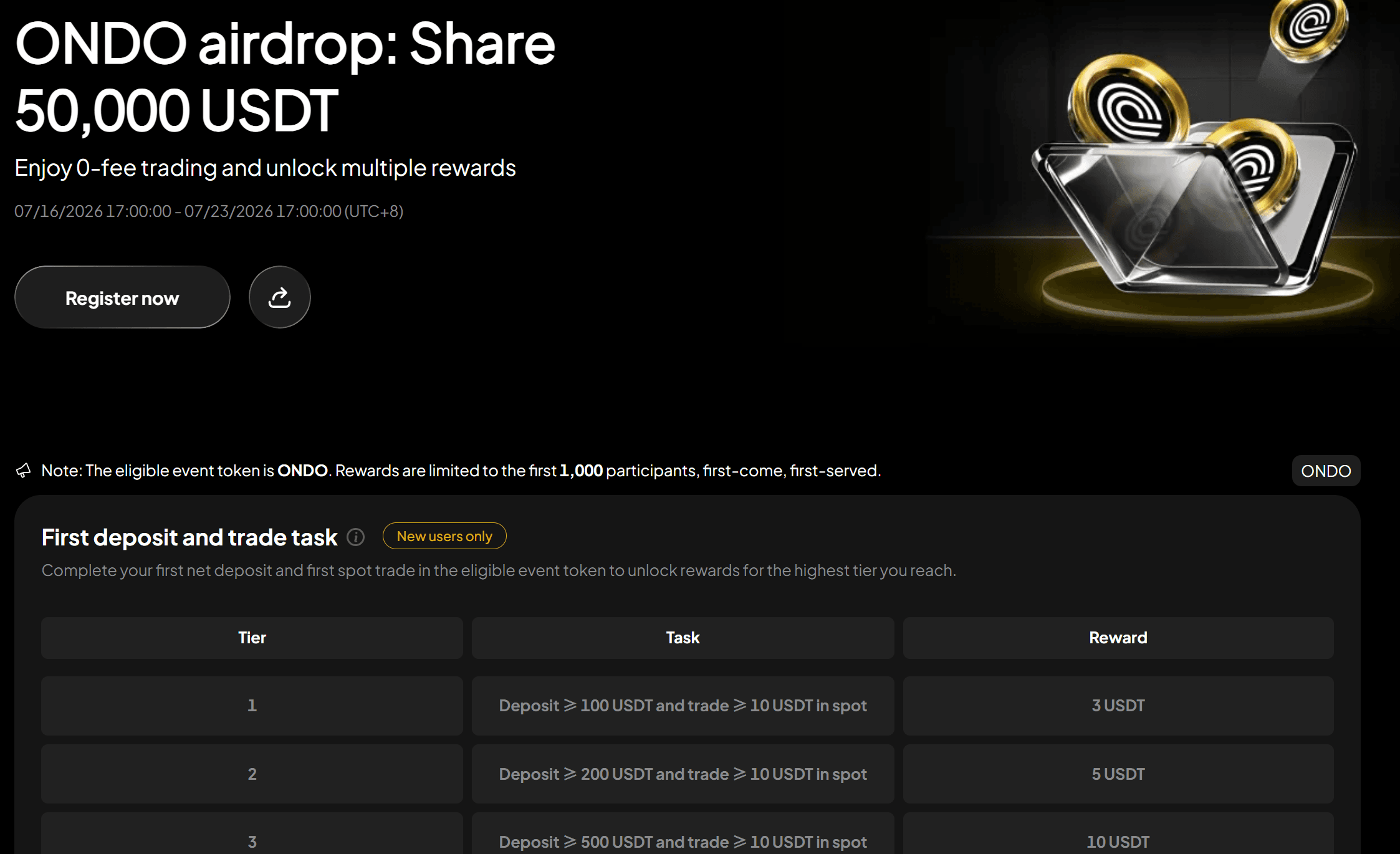
Claim ONDO Airdrop Rewards: Complete Tasks and Share 50,000 USDT
Claim ONDO Airdrop rewards on WEEX and share 50,000 USDT. Learn how to join, complete trading tasks, earn bonuses, and trade ONDO/USDT during the event.
Japan's Crypto Regulation Basics: The FSA, JVCEA, and User Protections

How Overseas Crypto Exchanges Work for Japan Residents (and the Risks)
Modelo 721 Explained: Declaring Foreign Crypto Holdings in Spain
DEX vs CEX for Perpetuals: Trading Perps On-Chain vs on an Exchange
What Is an On-Chain Order Book? How Order-Book DEXs Work
What Is a Perp DEX? Perpetual Futures on Decentralized Exchanges
Italy Crypto Tax 2026: The Capital Gains Rate Rises to 33%
Support and Resistance: How to Identify Key Levels on the Chart

Supply and Demand Zones: A Smart-Money Trading Guide
Price Action Trading: Reading Raw Market Behavior

Head and Shoulders Pattern: How to Spot and Trade It

Classic Chart Patterns: Triangles, Double Tops/Bottoms and Flags
Airdrop Farming: How to Farm Crypto Airdrops the Right Way
What Is a Moving Average (MA)? Types and How to Read Them
What Is Elliott Wave Theory? A Beginner's Guide to Counting Waves
What Is Fibonacci Retracement? How to Draw and Use It
What Is the Ichimoku Cloud? A Beginner's Guide to Reading It
What Is the VIX (Fear Index)? How to Read It and Its Link to Crypto
What Is Dow Theory? The Six Principles Explained
What Is a Death Cross? Understanding the Bearish Signal
What Is a Golden Cross? A Beginner's Guide to the Bullish Signal
MiCA Regulation: What Changes for Polish Crypto Investors
Open Interest: What It Means in Futures Trading
Call vs Put Options: What They Are and How They Differ
What Are Sakata's Five Methods? Classic Candlestick Patterns Explained
Gold Price Outlook 2026: Third-Party Analyst Scenarios (Maintained, Educational)
Silver Price Outlook 2026: Third-Party Analyst Scenarios (Maintained, Educational)
How to Buy Bitcoin in Brazil: A Step by Step Guide for Beginners
Dolar Crypto in Argentina: How to Use Stablecoins for Dollar Exposure and Buy Bitcoin
Claim ONDO Airdrop Rewards: Complete Tasks and Share 50,000 USDT
Claim ONDO Airdrop rewards on WEEX and share 50,000 USDT. Learn how to join, complete trading tasks, earn bonuses, and trade ONDO/USDT during the event.
Japan's Crypto Regulation Basics: The FSA, JVCEA, and User Protections



