
What Is VOL (Volatility)? Understanding How Much Prices Swing

 Prefer us on Google


VOL (volatility) is a measure of how much an asset's price moves over time. When analysts say a market is "volatile," they mean its price swings are large. The wider and faster the moves, the higher the volatility; the calmer the market, the lower it is.
How Volatility Works
Volatility is usually quantified as the dispersion of prices (standard deviation) over a period. Historical volatility is calculated from past price moves; implied volatility is inferred from option prices as a forward-looking estimate of expected movement.
Crypto assets tend to be more volatile than traditional assets, moving sharply in short windows. That can look like opportunity, but it means the risk is equally large.
Why It Matters to a Trader
Volatility signals both the potential range and the size of the risk at once. It matters most in leveraged futures trading: when volatility is high, even small price moves swing your P&L hard and make forced liquidation more likely.
Two companion metrics help you read momentum alongside volatility:
- Volume — the amount traded in a period; volatility spikes often come with surging volume.
- Open interest — the total of undecided (open) positions. When open interest is high and volatility rises, cascading liquidations can amplify the moves further.
Trading Note — Volatility and Leverage
Applying leverage in a high-volatility environment widens the opportunity but magnifies losses by the same multiple. An adverse move can cost more than your posted margin or trigger liquidation. Volatility measures the size of the swings, not the ease of profit — it guarantees nothing.
In practice, the rule of thumb is: reduce leverage when volatility is high, always place stop-losses, and avoid oversized open interest. Platforms such as WEEX also offer futures products, but confirm leverage settings and margin terms on each service.
FAQ
Q. Is high volatility good or bad? A. Neither on its own. Larger swings expand both gains and losses, so it is a factor to match against your risk tolerance.
Q. How does VIX relate to volatility? A. VIX indexes the implied volatility of US equities and is watched as a gauge of overall market anxiety.
Q. Does low volatility mean it's safe? A. Sharp moves are less frequent, but large moves can follow calm periods, so low volatility does not equal safety.
Q. How is open interest related to volatility? A. When open interest is elevated and price moves suddenly, chained liquidations can push volatility even higher.
This article is general terminology education, not investment advice. It guarantees no profit; trade at your own responsibility.
Disclaimer: This content is provided for general branding and informational purposes only and doesn't constitute financial, investment, legal, or tax advice. Any events, rewards, online events, or related information mentioned herein should not be considered a recommendation, solicitation, or invitation to purchase, sell, trade, or otherwise deal in any crypto assets or to use any services. Crypto assets are highly volatile and may result in loss. WEEX services and online events may not be available in all regions and are subject to applicable laws, regulations, and eligibility requirements. You are responsible for ensuring that your use of WEEX services complies with local laws and for carefully assessing the risks before participating in any crypto-related activities.
You may also like
Gold Price Outlook 2026: Third-Party Analyst Scenarios (Maintained, Educational)
Silver Price Outlook 2026: Third-Party Analyst Scenarios (Maintained, Educational)
How to Buy Bitcoin in Brazil: A Step by Step Guide for Beginners
Dolar Crypto in Argentina: How to Use Stablecoins for Dollar Exposure and Buy Bitcoin
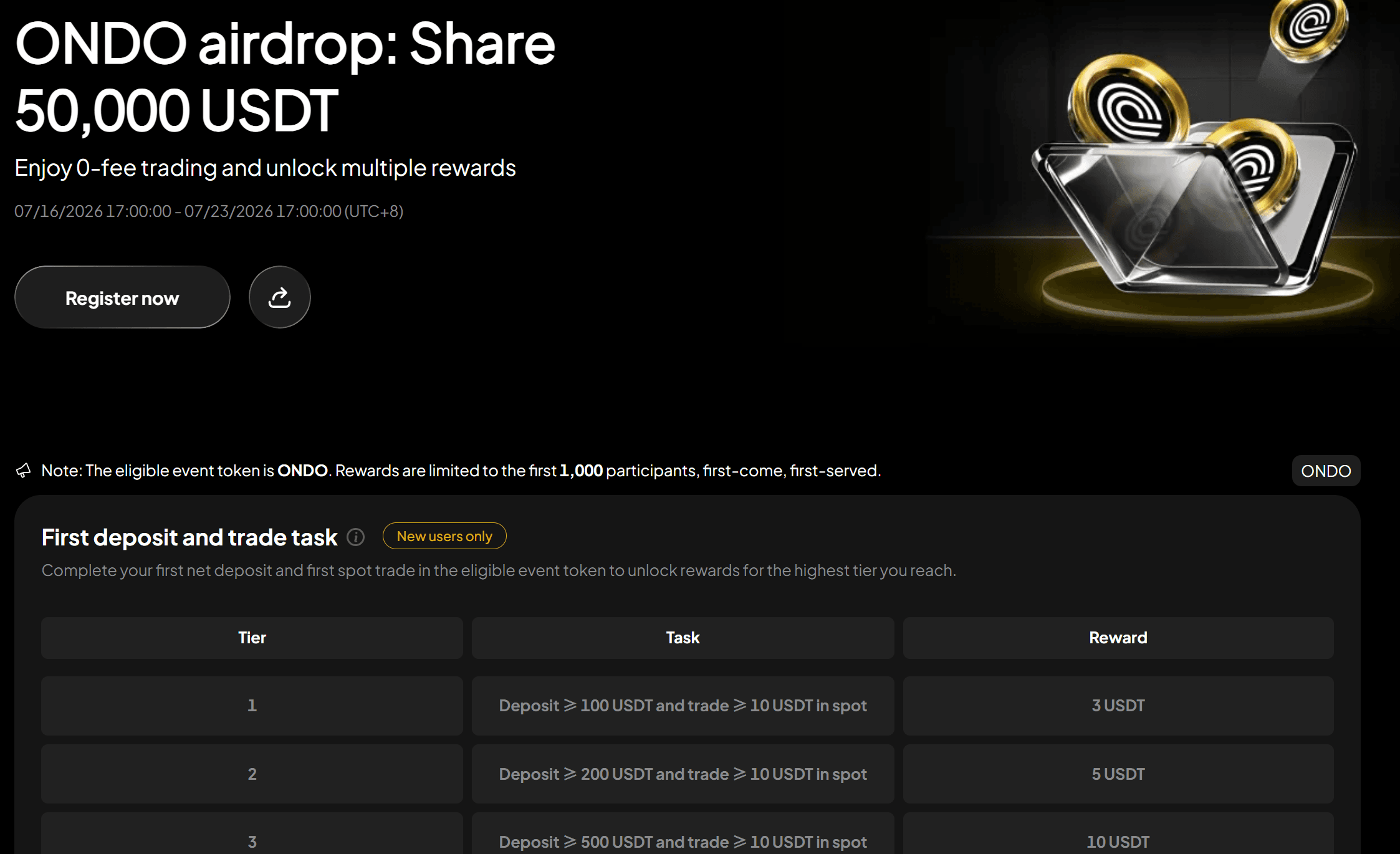
Claim ONDO Airdrop Rewards: Complete Tasks and Share 50,000 USDT
Claim ONDO Airdrop rewards on WEEX and share 50,000 USDT. Learn how to join, complete trading tasks, earn bonuses, and trade ONDO/USDT during the event.
Japan's Crypto Regulation Basics: The FSA, JVCEA, and User Protections
How Overseas Crypto Exchanges Work for Japan Residents (and the Risks)
Modelo 721 Explained: Declaring Foreign Crypto Holdings in Spain
DEX vs CEX for Perpetuals: Trading Perps On-Chain vs on an Exchange
What Is an On-Chain Order Book? How Order-Book DEXs Work
What Is a Perp DEX? Perpetual Futures on Decentralized Exchanges
Italy Crypto Tax 2026: The Capital Gains Rate Rises to 33%
Support and Resistance: How to Identify Key Levels on the Chart
Supply and Demand Zones: A Smart-Money Trading Guide
Price Action Trading: Reading Raw Market Behavior
Head and Shoulders Pattern: How to Spot and Trade It
Classic Chart Patterns: Triangles, Double Tops/Bottoms and Flags
Airdrop Farming: How to Farm Crypto Airdrops the Right Way
What Is a Moving Average (MA)? Types and How to Read Them
What Is Elliott Wave Theory? A Beginner's Guide to Counting Waves
What Is Fibonacci Retracement? How to Draw and Use It
What Is the Ichimoku Cloud? A Beginner's Guide to Reading It
What Is the VIX (Fear Index)? How to Read It and Its Link to Crypto
What Is Dow Theory? The Six Principles Explained
What Is a Death Cross? Understanding the Bearish Signal
What Is a Golden Cross? A Beginner's Guide to the Bullish Signal
MiCA Regulation: What Changes for Polish Crypto Investors
Open Interest: What It Means in Futures Trading
Call vs Put Options: What They Are and How They Differ
What Are Sakata's Five Methods? Classic Candlestick Patterns Explained
Gold Price Outlook 2026: Third-Party Analyst Scenarios (Maintained, Educational)
Silver Price Outlook 2026: Third-Party Analyst Scenarios (Maintained, Educational)
How to Buy Bitcoin in Brazil: A Step by Step Guide for Beginners
Dolar Crypto in Argentina: How to Use Stablecoins for Dollar Exposure and Buy Bitcoin
Claim ONDO Airdrop Rewards: Complete Tasks and Share 50,000 USDT
Claim ONDO Airdrop rewards on WEEX and share 50,000 USDT. Learn how to join, complete trading tasks, earn bonuses, and trade ONDO/USDT during the event.
Japan's Crypto Regulation Basics: The FSA, JVCEA, and User Protections



