
After Bybit's Japan Shutdown: A Neutral Map of Where Your Funds Can Go

 Prefer us on Google

Once your crypto is off Bybit, the next question is simply: where should it go? The internet is full of "best alternative" lists, most of them ranking whoever pays the most. This page does the opposite. It lays out the three factual paths a former Bybit Japan user has — a domestic FSA-registered exchange, self-custody, or another overseas venue — describes what each one actually means for you, and ends with a checklist of factors to weigh. It names no specific brand in any direction, recommends nothing, and warns against no one by name. It is general information, not financial advice.
The three paths, at a glance
| Path | What it is | Regulatory status in Japan |
|---|---|---|
| Domestic registered exchange | A crypto-asset exchange operator registered with the FSA | Registered and supervised under Japanese law |
| Self-custody wallet | A wallet whose keys you hold yourself | Not an exchange service; you are the custodian |
| Another overseas venue | An exchange based outside Japan | Many serving Japan residents are unregistered; check the FSA warning list |
Path 1 — A domestic, FSA-registered exchange
This is the regulated domestic route. Operators that serve Japanese residents are expected to be registered with the Financial Services Agency (FSA) as crypto-asset exchange operators under the Payment Services Act, and they appear in the FSA's public register.
What registration actually gives a user
- Asset segregation. Registered operators are required to manage customer assets separately from their own — a core customer-protection rule under the Japanese framework.
- A defined complaint and dispute route. Registered operators sit under FSA supervision and the industry's self-regulatory body, which gives users a recognized channel if something goes wrong.
- JPY on-ramps and off-ramps. Domestic exchanges connect to the Japanese banking system, so moving between yen and crypto is straightforward and reportable.
- A leverage cap of 2x. This is a concrete product difference: individual crypto margin trading in Japan is capped at 2x leverage (reduced to 2x around May 2020 under the amended Financial Instruments and Exchange Act and JVCEA self-regulation). Traders used to higher leverage overseas should note this is a hard limit domestically — presented here as a fact, not a judgment about whether more or less leverage is desirable.
How to check the register
You can confirm whether an operator is registered using the FSA's official search of licensed financial operators at search.fsa.go.jp. Registration is the single verifiable fact that separates this path from Path 3.
Path 2 — Self-custody
Self-custody means holding your crypto in a wallet whose private keys you control directly, rather than leaving it with any exchange. It is not an exchange service and not a product anyone sells you; it is you being your own custodian.
What that responsibility means
- You hold the keys — and the risk. There is no support desk to reset a lost seed phrase. If you lose your keys or recovery phrase, the funds are generally unrecoverable.
- Phishing and scams target self-custody users. Fake wallet apps, malicious approvals, and seed-phrase phishing are common attack vectors; the security burden is entirely yours.
- No counterparty exposure. The flip side: your holdings do not depend on an exchange staying solvent or continuing to serve your country.
When it tends to fit
Self-custody fits long-term holdings you do not intend to trade actively — you gain independence from any single platform's decisions (like a market exit) at the cost of taking on full security responsibility. It fits active trading much less well, since you cannot trade from a self-custody wallet without moving funds to a trading venue.
Path 3 — Another overseas venue
Other overseas exchanges exist, and some serve Japanese residents. Stated plainly and neutrally: many operators that serve Japan residents do so without FSA registration, and that status has concrete consequences worth understanding before moving funds.
The FSA warning-list mechanism
The FSA publishes a public warning list of operators conducting crypto-asset exchange business in Japan without registration, alongside a general caution that dealing with unregistered operators is high risk. In the FSA's words, for unregistered operators the authorities "cannot confirm whether a system to protect investors is in place, and it is highly likely that safeguards equivalent to a registered operator are not in place." You can check whether a given operator appears on that list yourself:
- FSA warning page on unregistered operators: fsa.go.jp/ordinary/chuui/highrisk.html
- FSA list "Names of operators conducting crypto-asset exchange business without registration" (PDF): fsa.go.jp/policy/virtual_currency/angoushisan_mutouroku.pdf
The consumer-protection gap
Because an unregistered venue is outside the domestic supervisory framework, the segregation rules, complaint routes, and oversight described under Path 1 are not assured. That is the factual trade-off — not a claim that any particular venue is good or bad, but a statement of what the regulatory framework does and does not cover. Checking the warning list is how you turn that abstract point into a concrete check on a specific operator.
Note also the tax dimension covered on the companion tax page: transactions on offshore or unregistered venues remain under comprehensive taxation, and are outside the scope of the proposed 2028 separate-taxation reform, which as drafted covers domestic registered venues only.
A decision checklist — factors, not a verdict
Rather than tell you which path to pick, here are the factors that usually decide it. Weigh them against your own situation.
- What are you holding? A few long-term coins point differently than an actively traded book.
- How often do you trade? Frequent trading needs a venue; buy-and-hold can favor self-custody.
- Do you need leverage — and how much? Domestic venues cap individual crypto leverage at 2x; if that constraint matters to you, factor it in honestly (without treating higher leverage as inherently better).
- How will you handle tax reporting? Domestic venues integrate with JPY and Japanese reporting; offshore activity stays under comprehensive taxation and you own the record-keeping. See the forced-liquidation tax page for how disposals are taxed.
- How much security responsibility do you want? Self-custody maximizes control and maximizes your personal responsibility for security.
- Is the operator registered? For any exchange, this is the one binary, checkable fact — via search.fsa.go.jp for registered operators and the warning list for unregistered ones.
Primary sources
- FSA — register of licensed financial operators (search.fsa.go.jp)
- FSA — warning on unregistered operators (fsa.go.jp/ordinary/chuui/highrisk.html) and the list of unregistered crypto-asset exchange operators (fsa.go.jp/policy/virtual_currency/angoushisan_mutouroku.pdf)
- Japan crypto leverage cap (2x) — amended Financial Instruments and Exchange Act and JVCEA self-regulation (jvcea.or.jp)
- Bybit official announcement — "Service Changes for Japanese Residents" (why a destination decision is needed)
This page is a neutral, general-information map of options; it is not financial, legal, or tax advice and it recommends no specific service. Verify any operator's registration status yourself, and consult a qualified professional about your own circumstances.
Disclaimer: This content is provided for general branding and informational purposes only and doesn't constitute financial, investment, legal, or tax advice. Any events, rewards, online events, or related information mentioned herein should not be considered a recommendation, solicitation, or invitation to purchase, sell, trade, or otherwise deal in any crypto assets or to use any services. Crypto assets are highly volatile and may result in loss. WEEX services and online events may not be available in all regions and are subject to applicable laws, regulations, and eligibility requirements. You are responsible for ensuring that your use of WEEX services complies with local laws and for carefully assessing the risks before participating in any crypto-related activities.
You may also like
Crypto Exchange Comparison for Germany (2026): Fees, Products, and How to Choose

Crypto Apps Compared for Germany (2026): Features, Demo Mode and Security — What to Check Before You Download
Crypto Platform Comparison for France (2026): Fees, Products, and How to Choose
Crypto Apps Compared for France (2026): Features, Demo Mode and Security — What to Check Before You Download
NVIDIA (NVDA) Earnings Date: When Q2 FY2027 Reports and What to Watch
Is WEEX Safe? A Facts-First Look at WEEX's Reserves, Security, and Regulatory Status in Japan
When an Overseas Exchange Ends Its Japan Service: The Typical Sequence and What Users Should Check
Bybit Japan Service Termination: The Complete Timeline and What Happens on July 22, 2026
How to Withdraw From Bybit After the Japan Service Shutdown: Step-by-Step and a Deadline Checklist
The Tax Consequences of a Forced Liquidation for Japanese Crypto Traders
Gold Price Outlook 2026: Third-Party Analyst Scenarios (Maintained, Educational)
Silver Price Outlook 2026: Third-Party Analyst Scenarios (Maintained, Educational)
How to Buy Bitcoin in Brazil: A Step by Step Guide for Beginners
Dolar Crypto in Argentina: How to Use Stablecoins for Dollar Exposure and Buy Bitcoin
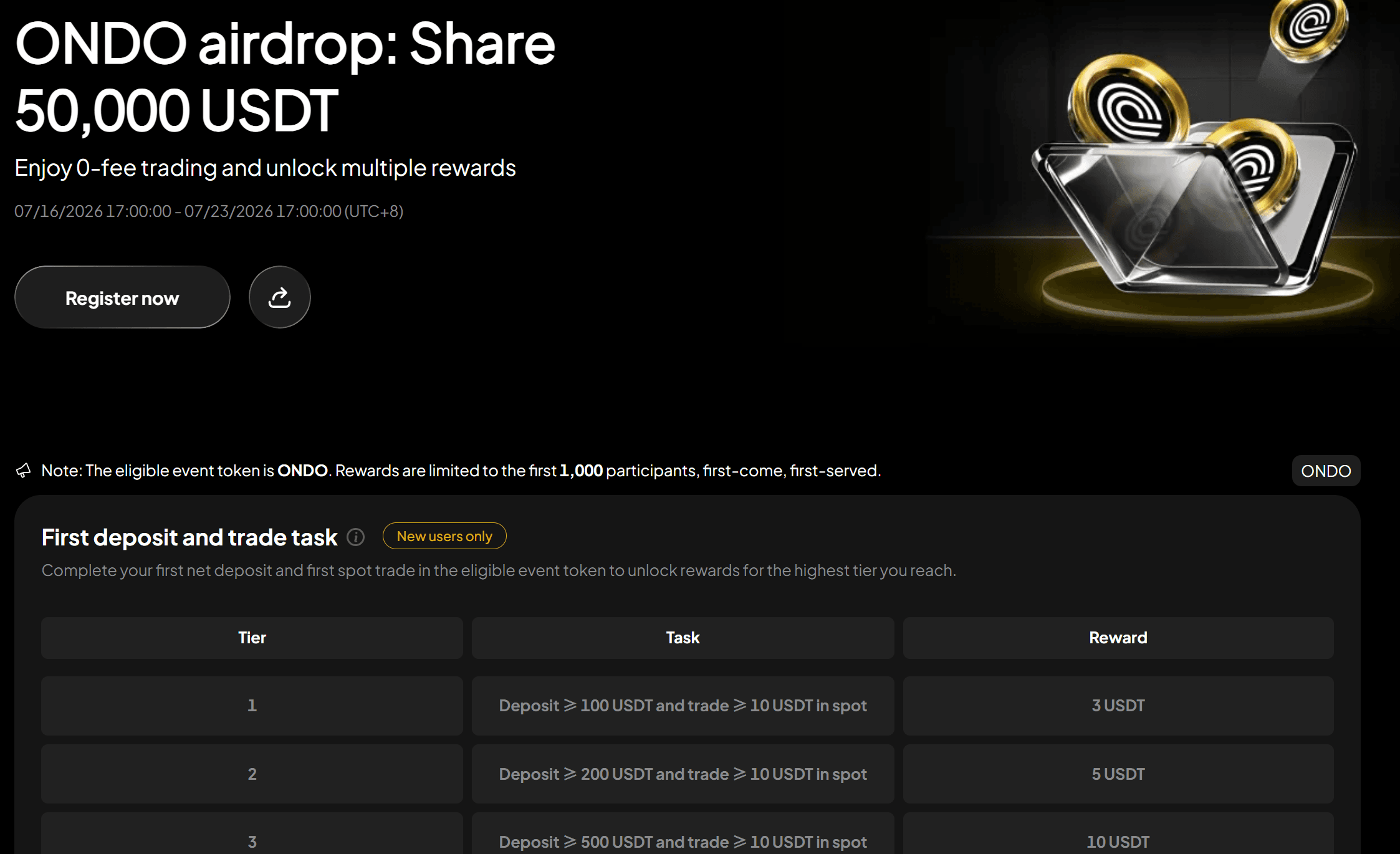
Claim ONDO Airdrop Rewards: Complete Tasks and Share 50,000 USDT
Claim ONDO Airdrop rewards on WEEX and share 50,000 USDT. Learn how to join, complete trading tasks, earn bonuses, and trade ONDO/USDT during the event.
Japan's Crypto Regulation Basics: The FSA, JVCEA, and User Protections
How Overseas Crypto Exchanges Work for Japan Residents (and the Risks)
Modelo 721 Explained: Declaring Foreign Crypto Holdings in Spain
DEX vs CEX for Perpetuals: Trading Perps On-Chain vs on an Exchange
What Is an On-Chain Order Book? How Order-Book DEXs Work
What Is a Perp DEX? Perpetual Futures on Decentralized Exchanges
Italy Crypto Tax 2026: The Capital Gains Rate Rises to 33%
Support and Resistance: How to Identify Key Levels on the Chart
Supply and Demand Zones: A Smart-Money Trading Guide
Price Action Trading: Reading Raw Market Behavior
Head and Shoulders Pattern: How to Spot and Trade It
Classic Chart Patterns: Triangles, Double Tops/Bottoms and Flags
Airdrop Farming: How to Farm Crypto Airdrops the Right Way
What Is a Moving Average (MA)? Types and How to Read Them
What Is Elliott Wave Theory? A Beginner's Guide to Counting Waves
Crypto Exchange Comparison for Germany (2026): Fees, Products, and How to Choose
Crypto Apps Compared for Germany (2026): Features, Demo Mode and Security — What to Check Before You Download
Crypto Platform Comparison for France (2026): Fees, Products, and How to Choose
Crypto Apps Compared for France (2026): Features, Demo Mode and Security — What to Check Before You Download
NVIDIA (NVDA) Earnings Date: When Q2 FY2027 Reports and What to Watch
Is WEEX Safe? A Facts-First Look at WEEX's Reserves, Security, and Regulatory Status in Japan
Contents
Latest articles


Latest coin listings on WEEX


