
NVIDIA (NVDA) Earnings Date: When Q2 FY2027 Reports and What to Watch

 Prefer us on Google


NVIDIA (NASDAQ: NVDA) reports its next quarterly results as its second quarter of fiscal 2027 (Q2 FY2027). Financial-data providers expect the report around Wednesday, August 26, 2026, after the US market close — but as of this draft, NVIDIA has not officially announced the date (it is expected, not confirmed). This page covers the expected schedule, how the report is released, last quarter's dated results (the facts you can rely on), and how scheduled earnings events relate to price volatility — with no result forecasts or price targets. For the full stock overview and how to buy, see the NVIDIA (NVDA) price, outlook and how-to-buy hub.
When is NVIDIA's next earnings report?
Expected: Wednesday, August 26, 2026, after the US market close (not yet confirmed). This is an estimate from financial-data providers such as MarketBeat and Zacks, which also state that NVIDIA has not confirmed the date. NVIDIA typically announces the exact date about two to three weeks in advance through a press release. This page will be updated to "confirmed" once NVIDIA's official announcement is published.
| Item | Detail |
|---|---|
| Report | Second quarter of fiscal 2027 (Q2 FY2027) |
| Period covered | The quarter ending in late July 2026 |
| Expected date (US) | Around Wednesday, August 26, 2026 — after market close (estimated, unconfirmed) |
| Expected time (US) | Release after the 4:00 p.m. ET close; conference call customarily ~2:00 p.m. PT / 5:00 p.m. ET |
| Status | Expected (not announced by NVIDIA) — awaiting official confirmation |
| Previous report | May 20, 2026 (Q1 FY2027) |
Time zones: the results are released after the US market close (4:00 p.m. ET), and NVIDIA customarily holds its conference call about an hour later (its long-standing slot is 2:00 p.m. Pacific / 5:00 p.m. Eastern). Convert to your local time zone — note that for many regions the release lands early the following morning. Exact times will be confirmed in NVIDIA's official announcement.
What reports when (the sequence)
A quarterly report arrives in parts. Knowing the order helps you follow the day calmly.
- Earnings press release (the headline numbers): published after the US market close. It carries revenue, per-segment results, earnings per share, and — importantly — the company's guidance (its own outlook) for the next quarter.
- Conference call / webcast: about an hour after the release. Management discusses demand and the product roadmap and takes analyst questions. A replay is posted on NVIDIA's investor-relations site.
- Form 10-Q: the detailed quarterly filing with the US Securities and Exchange Commission (SEC), filed around the same time — with fuller segment detail and notes than the press release.
Last quarter's results (reported May 20, 2026 — Q1 FY2027)
To understand what to watch next, here are the most recently confirmed results. These are past facts, not a forecast of the upcoming report.
- Quarter ended April 26, 2026 (reported May 20, 2026)
- Revenue: US$81.6 billion, up 85% year over year (a record)
- Data Center segment: US$75.2 billion, up 92% year over year (up 21% quarter over quarter) (a record)
- Shareholder returns: the quarterly dividend was raised from US$0.01 to US$0.25 per share (paid June 26, 2026)
Data Center continued to make up most of revenue (US$75.2 billion of US$81.6 billion). The figures are from NVIDIA's own earnings press release (see this page's facts ledger).
What observers watch in the report (line items, not a forecast)
The following are disclosures the report updates and points investors habitually watch — not predictions of direction or magnitude.
- Segment revenue: NVIDIA reports Data Center, Gaming, Professional Visualization, Automotive, and OEM & Other. In recent quarters the Data Center segment drives the result.
- Data-center product-cycle commentary: management's remarks on demand and supply for the current generation (Blackwell).
- Next-generation roadmap: any comment on the 2027 generation (Rubin / the "Kyber" rack). For related reporting and the company's response, see the Kyber-delay report and NVIDIA's denial.
- Company guidance: NVIDIA provides its own outlook for the following quarter alongside results.
This page does not carry point-in-time price targets or scenario analysis. See the NVDA hub and its related coverage.
How earnings events relate to price volatility (educational)
Earnings are scheduled information events. Because new results and fresh guidance arrive at a single moment, prices tend to move more than usual around the release — but the direction and size of any move cannot be predicted in advance.
- The anticipation build: interest in "when does it report" ramps up over the weeks before the date. This page exists to answer that need.
- Results are received relative to expectations: shares tend to react to how results compare with prior market expectations — and those expectations are themselves unknown in advance.
- An options "implied move" is not a forecast: it is the market's rough gauge of a possible range, not a guarantee of the outcome.
- Event risk rises for leveraged products: when moves can be larger, leveraged products such as the stock futures described below can amplify both gains and losses, so risk management matters more.
Trading NVDA-linked exposure on WEEX (futures first)
WEEX is a cryptocurrency exchange that offers NVDA-linked exposure through its stock markets, futures first — a way to trade NVDA's price movements without a US brokerage account. See the market listings for what is currently offered.
Route 1 — US brokerage access: buy NVDA directly on Nasdaq during US market hours through a brokerage that offers US equities. You hold the shares, with shareholder rights including the dividend.
Route 2 — on WEEX (futures first):
- Create a WEEX account and complete verification.
- Deposit USDT.
- Open the stock futures listings and select the market you want to trade.
- Place your order.
A stock-futures position is not the stock itself: it is a derivative designed to track share pricing, its market price can deviate from the underlying (funding, liquidity, volatility), and leverage amplifies losses as well as gains. This matters especially around earnings, when moves can be larger — understand the mechanics and risks before trading.
Which route fits you?
| Point of comparison | US brokerage (NVDA) | WEEX (stock futures markets) |
|---|---|---|
| What you hold | NVIDIA common stock | Futures position designed to track share pricing |
| Market type | Cash equity | Stock futures — see the listings for current markets |
| Account requirement | US-market brokerage account | WEEX account |
| Shareholder rights | Yes — including the quarterly dividend | No — price exposure only |
| Earnings-period event risk | Yes | Yes — amplified by leverage |
What are stock futures and tokenized stocks?
WEEX's stock markets offer exposure to listed shares in two forms: stock futures — derivative contracts designed to track a share's price, tradable long or short with leverage — and tokenized stocks, blockchain-issued instruments designed to follow a listed share. Both are price exposure only: no voting rights, no direct dividend receipt, and market prices can deviate from the underlying. For which NVDA-linked markets are currently offered, see the WEEX market listings.
FAQ
When is NVIDIA's next earnings report?
The Q2 FY2027 report is expected around Wednesday, August 26, 2026, after the US market close — an estimate from financial-data providers. NVIDIA has not officially confirmed the date as of this draft. It usually announces the exact date about two to three weeks ahead.
What time does NVIDIA report?
The release comes after the US market close (4:00 p.m. ET), and the conference call is customarily about an hour later (2:00 p.m. PT / 5:00 p.m. ET). Convert to your local time zone; exact times are set in NVIDIA's official announcement.
What were last quarter's results?
For Q1 FY2027 (reported May 20, 2026): revenue of US$81.6 billion (+85% YoY) and Data Center of US$75.2 billion (+92% YoY), both records, with the quarterly dividend raised from US$0.01 to US$0.25. These are past results, not a forecast.
Do prices move more around earnings?
Because earnings concentrate new information into one moment, prices tend to move more than usual around the release — but the direction and size cannot be predicted. Event risk is higher for leveraged products.
Can I trade NVDA around earnings without a US brokerage account?
On WEEX, NVDA-linked exposure runs through the stock futures markets. Futures are price exposure only, with no shareholder rights, and leverage amplifies losses as well as gains. See the listings for what is currently offered.
This content is for information only and is not investment advice. The date and time are expected and unconfirmed; NVIDIA's official announcement takes precedence. Tokenized stocks and stock futures are designed to track share pricing; they are not the stock itself and carry no voting rights or dividends.
Related coverage
Disclaimer: This content is provided for general branding and informational purposes only and doesn't constitute financial, investment, legal, or tax advice. Any events, rewards, online events, or related information mentioned herein should not be considered a recommendation, solicitation, or invitation to purchase, sell, trade, or otherwise deal in any crypto assets or to use any services. Crypto assets are highly volatile and may result in loss. WEEX services and online events may not be available in all regions and are subject to applicable laws, regulations, and eligibility requirements. You are responsible for ensuring that your use of WEEX services complies with local laws and for carefully assessing the risks before participating in any crypto-related activities.
You may also like

Crypto Exchange Comparison for Germany (2026): Fees, Products, and How to Choose

Crypto Apps Compared for Germany (2026): Features, Demo Mode and Security — What to Check Before You Download

Crypto Platform Comparison for France (2026): Fees, Products, and How to Choose
Crypto Apps Compared for France (2026): Features, Demo Mode and Security — What to Check Before You Download
Is WEEX Safe? A Facts-First Look at WEEX's Reserves, Security, and Regulatory Status in Japan

When an Overseas Exchange Ends Its Japan Service: The Typical Sequence and What Users Should Check

Bybit Japan Service Termination: The Complete Timeline and What Happens on July 22, 2026
How to Withdraw From Bybit After the Japan Service Shutdown: Step-by-Step and a Deadline Checklist
The Tax Consequences of a Forced Liquidation for Japanese Crypto Traders
After Bybit's Japan Shutdown: A Neutral Map of Where Your Funds Can Go
Gold Price Outlook 2026: Third-Party Analyst Scenarios (Maintained, Educational)

Silver Price Outlook 2026: Third-Party Analyst Scenarios (Maintained, Educational)
How to Buy Bitcoin in Brazil: A Step by Step Guide for Beginners
Dolar Crypto in Argentina: How to Use Stablecoins for Dollar Exposure and Buy Bitcoin
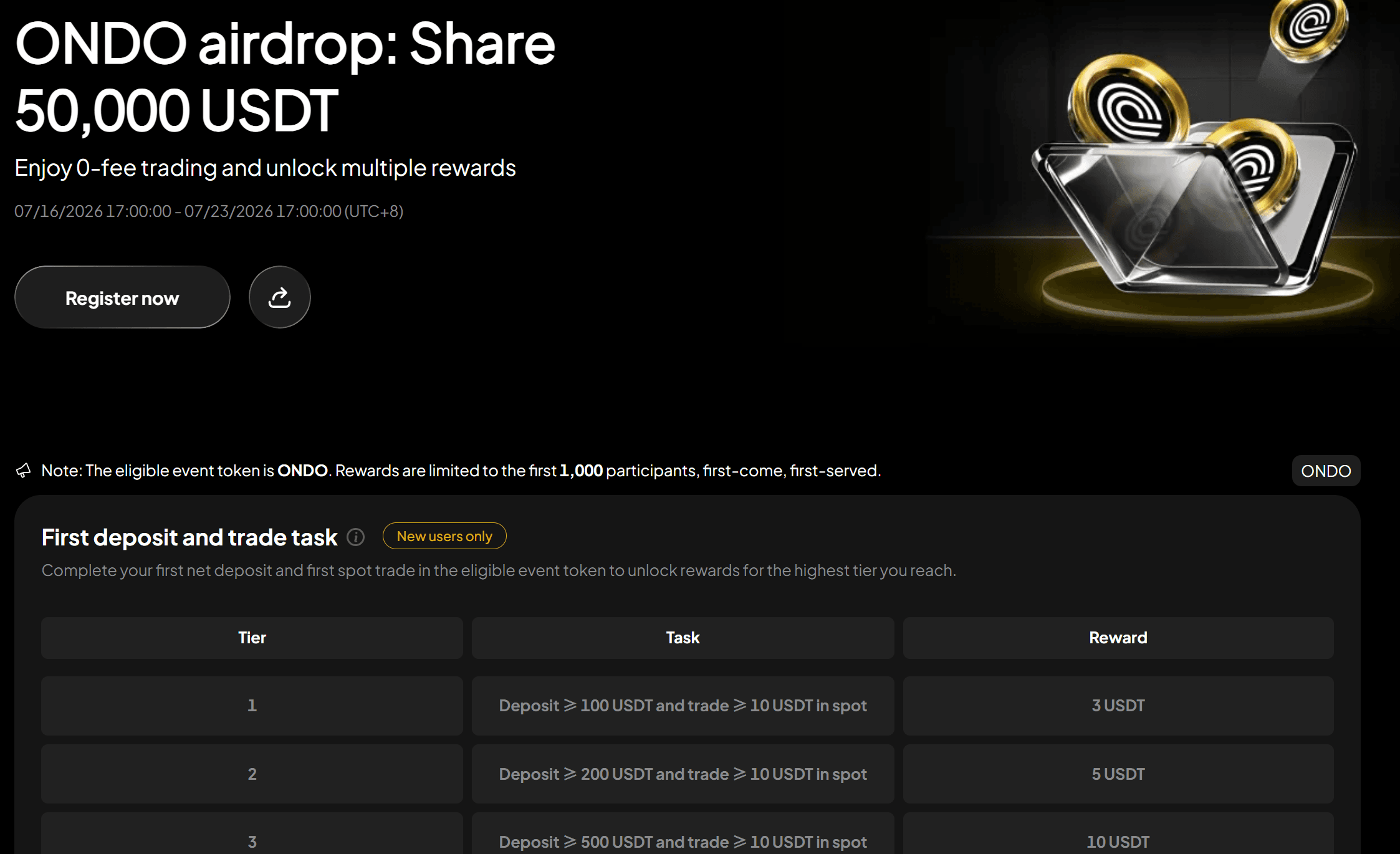
Claim ONDO Airdrop Rewards: Complete Tasks and Share 50,000 USDT
Claim ONDO Airdrop rewards on WEEX and share 50,000 USDT. Learn how to join, complete trading tasks, earn bonuses, and trade ONDO/USDT during the event.
Japan's Crypto Regulation Basics: The FSA, JVCEA, and User Protections
How Overseas Crypto Exchanges Work for Japan Residents (and the Risks)
Modelo 721 Explained: Declaring Foreign Crypto Holdings in Spain

DEX vs CEX for Perpetuals: Trading Perps On-Chain vs on an Exchange
What Is an On-Chain Order Book? How Order-Book DEXs Work
What Is a Perp DEX? Perpetual Futures on Decentralized Exchanges
Italy Crypto Tax 2026: The Capital Gains Rate Rises to 33%
Support and Resistance: How to Identify Key Levels on the Chart

Supply and Demand Zones: A Smart-Money Trading Guide
Price Action Trading: Reading Raw Market Behavior
Head and Shoulders Pattern: How to Spot and Trade It
Classic Chart Patterns: Triangles, Double Tops/Bottoms and Flags
Airdrop Farming: How to Farm Crypto Airdrops the Right Way
What Is a Moving Average (MA)? Types and How to Read Them
What Is Elliott Wave Theory? A Beginner's Guide to Counting Waves
Crypto Exchange Comparison for Germany (2026): Fees, Products, and How to Choose
Crypto Apps Compared for Germany (2026): Features, Demo Mode and Security — What to Check Before You Download
Crypto Platform Comparison for France (2026): Fees, Products, and How to Choose
Crypto Apps Compared for France (2026): Features, Demo Mode and Security — What to Check Before You Download
Is WEEX Safe? A Facts-First Look at WEEX's Reserves, Security, and Regulatory Status in Japan
When an Overseas Exchange Ends Its Japan Service: The Typical Sequence and What Users Should Check