
What Is Options Trading? Understanding Calls and Puts

 Prefer us on Google


An option is a financial contract that gives its buyer the right, but not the obligation, to buy or sell an underlying asset at a set price by a set date. That single feature — a right rather than an obligation — is what sets options apart from other instruments and makes them a distinct corner of the derivatives world. This article explains the concept for education only; it is not a description of a specific product available on any particular platform.
The two basic building blocks
Every option is one of two types:
- Call option: gives the buyer the right to buy the underlying asset at the agreed price (the "strike").
- Put option: gives the buyer the right to sell the underlying asset at the strike price.
The differences between the two are explored in detail in call and put options. A few terms recur throughout options:
- Strike price: the agreed price at which the option can be exercised.
- Expiry: the date by which the decision must be made.
- Premium: the price the buyer pays upfront to acquire the option.
The buyer's key advantage is limited downside: if the option ends up worthless, the most a buyer can lose is the premium paid.
How options differ from futures and perpetuals
It is important not to confuse options with other derivatives. A futures or perpetual contract represents an obligation tied to the price of an asset, whereas an option represents a right the holder may choose not to use. WEEX offers futures and perpetual products; vanilla options are a separate instrument type, and this page does not assert that options are available to trade on WEEX. If you are looking at derivatives on WEEX, those are its futures and perpetual markets.
Options are closely tied to volatility — the concept in volatility (VOL) — because the chance of large price moves directly affects an option's value. In traditional markets, options also connect to settlement mechanics such as the special quotation explained in MSQ.
Why options are considered advanced and risky
Options can behave in complex ways. Their value depends not only on the underlying price but also on time remaining and expected volatility, so they can lose value even when the underlying moves in the expected direction, simply because time passes. For option sellers in particular, the risk can be very large. Options are generally regarded as an advanced instrument that requires study before use.
A worked example
Imagine an asset trading at 100, and a call option with a strike of 110 that expires in one month, bought for a premium of 3.
- If the asset rises above 110, the call gains value, and the buyer's maximum loss remains the 3 premium.
- If the asset stays below 110 until expiry, the option expires worthless, and the buyer loses the 3 premium — but no more.
- The seller of that call, by contrast, collected the 3 premium but took on the risk of a much larger loss if the asset rallied sharply.
This asymmetry — limited, known risk for buyers; potentially large risk for sellers — is central to how options work. Because options are complex, this is educational information only, not a recommendation to trade them, and not a claim that they are offered on WEEX.
Related concepts
- Call vs put options: the two option types compared — call and put options.
- MSQ (special quotation): a settlement mechanism used for options and futures — MSQ.
- Volatility (VOL): a key driver of option value — volatility (VOL).
Summary
Options are contracts granting the right, not the obligation, to buy (call) or sell (put) an asset at a set price by a set date. They differ fundamentally from futures and perpetuals, which are obligations. Options are powerful but complex and risky, especially for sellers. This page is educational and does not assert that vanilla options are available to trade on WEEX, whose derivative markets are futures and perpetuals.
This article is for educational and informational purposes only and does not constitute investment, financial, or tax advice. Cryptocurrency and derivatives trading involve significant risk. Always do your own research.
Disclaimer: This content is provided for general branding and informational purposes only and doesn't constitute financial, investment, legal, or tax advice. Any events, rewards, online events, or related information mentioned herein should not be considered a recommendation, solicitation, or invitation to purchase, sell, trade, or otherwise deal in any crypto assets or to use any services. Crypto assets are highly volatile and may result in loss. WEEX services and online events may not be available in all regions and are subject to applicable laws, regulations, and eligibility requirements. You are responsible for ensuring that your use of WEEX services complies with local laws and for carefully assessing the risks before participating in any crypto-related activities.
You may also like

Gold Price Outlook 2026: Third-Party Analyst Scenarios (Maintained, Educational)

Silver Price Outlook 2026: Third-Party Analyst Scenarios (Maintained, Educational)
How to Buy Bitcoin in Brazil: A Step by Step Guide for Beginners

Dolar Crypto in Argentina: How to Use Stablecoins for Dollar Exposure and Buy Bitcoin
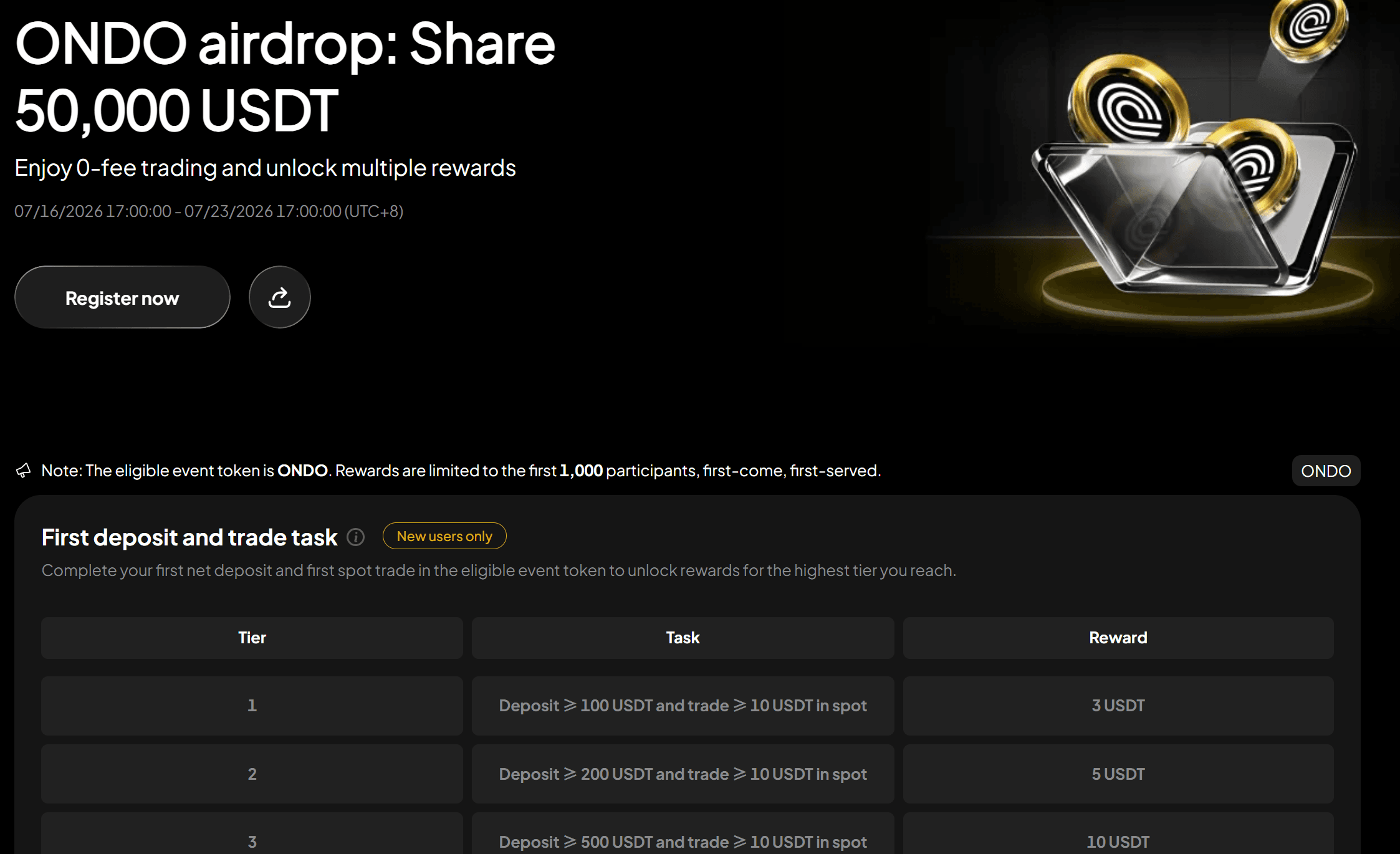
Claim ONDO Airdrop Rewards: Complete Tasks and Share 50,000 USDT
Claim ONDO Airdrop rewards on WEEX and share 50,000 USDT. Learn how to join, complete trading tasks, earn bonuses, and trade ONDO/USDT during the event.
Japan's Crypto Regulation Basics: The FSA, JVCEA, and User Protections

How Overseas Crypto Exchanges Work for Japan Residents (and the Risks)
Modelo 721 Explained: Declaring Foreign Crypto Holdings in Spain
DEX vs CEX for Perpetuals: Trading Perps On-Chain vs on an Exchange
What Is an On-Chain Order Book? How Order-Book DEXs Work
What Is a Perp DEX? Perpetual Futures on Decentralized Exchanges
Italy Crypto Tax 2026: The Capital Gains Rate Rises to 33%
Support and Resistance: How to Identify Key Levels on the Chart
Supply and Demand Zones: A Smart-Money Trading Guide
Price Action Trading: Reading Raw Market Behavior

Head and Shoulders Pattern: How to Spot and Trade It
Classic Chart Patterns: Triangles, Double Tops/Bottoms and Flags
Airdrop Farming: How to Farm Crypto Airdrops the Right Way
What Is a Moving Average (MA)? Types and How to Read Them
What Is Elliott Wave Theory? A Beginner's Guide to Counting Waves
What Is Fibonacci Retracement? How to Draw and Use It
What Is the Ichimoku Cloud? A Beginner's Guide to Reading It
What Is the VIX (Fear Index)? How to Read It and Its Link to Crypto
What Is Dow Theory? The Six Principles Explained
What Is a Death Cross? Understanding the Bearish Signal
What Is a Golden Cross? A Beginner's Guide to the Bullish Signal
MiCA Regulation: What Changes for Polish Crypto Investors
Open Interest: What It Means in Futures Trading
Call vs Put Options: What They Are and How They Differ
What Are Sakata's Five Methods? Classic Candlestick Patterns Explained
Gold Price Outlook 2026: Third-Party Analyst Scenarios (Maintained, Educational)
Silver Price Outlook 2026: Third-Party Analyst Scenarios (Maintained, Educational)
How to Buy Bitcoin in Brazil: A Step by Step Guide for Beginners
Dolar Crypto in Argentina: How to Use Stablecoins for Dollar Exposure and Buy Bitcoin
Claim ONDO Airdrop Rewards: Complete Tasks and Share 50,000 USDT
Claim ONDO Airdrop rewards on WEEX and share 50,000 USDT. Learn how to join, complete trading tasks, earn bonuses, and trade ONDO/USDT during the event.
Japan's Crypto Regulation Basics: The FSA, JVCEA, and User Protections
Contents
Latest articles

Latest coin listings on WEEX


